– the Revelations of Julian of Norwich
For our third installment on contemplation, having looked at Jesus as our model of contemplation and experiencing the twentieth-century gift of Thomas Merton and the necessary blending of action and contemplation, we go backward to medieval times and the mystics. Though her writing is of the fourteenth–century, Julian of Norwich (1342-c.1416) resonates deeply within our aching modern world as she has much to teach us about contemplation, our relationship with the blessed Trinity, and love.
Julian is one of the four English Mystics of the Middle Ages – the others being Richard Rolle, Walter Hilton, and the anonymous author of The Cloud of Unknowing. Despite her popularity today, we know very little about her. We do not even know her name as she is known by the name of the church, St. Julian’s Church in Norwich, England, to which her cell was attached.

Image of the original St. Julian’s Church, Norwich, Norfolk, England.
Julian was Catholic and an anchoress, a female anchorite. Choosing an extreme form of religious life, an anchoress/anchorite (from Greek, anchorein, to withdraw) left the secular world to live an interior life of prayer. Irreversibly walled up in a cell in which the last rites were administered before the door was sealed (talk about being “dead to the world!”), an anchoress/anchorite would participate in church services through one window which looked onto the church and often provide spiritual guidance through another window which would look onto the street. Many of us at times may want to withdraw from our lives or even the world, but I doubt we could handle the life of an anchoress/ anchorite for very long. Julian lived in her cell for over 20 years, contemplating the meaning of her visions. How could this fourteenth-century recluse have any possible meaning for us today?
Julian of Norwich’s mystical writings Revelations of Divine Love is found in two versions the “Short Text” written shortly after her mystical experiences and the “Long Text” which was 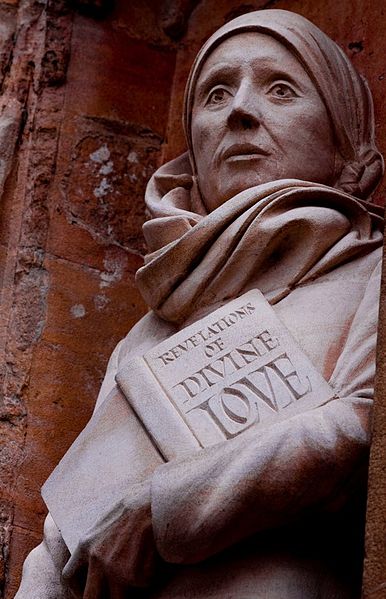 written after a couple of decades of reflection on those experiences. She tells us her revelations occurred on 8 May 1373 (13 May as expressed in her writing which were based on the old Julian calendar) when she was 30 years old and a lay woman. Julian was born into and wrote during a time of great political and social unrest– the black plague was rampant, the Hundred Years War was in full swing, and the Church was in disarray with the Great Western Schism (Can you find any parallels to today’s world?) Julian’s mystical experiences have been described as near death experiences as she was so close to death a priest had given her the last rites. She had a vision of Jesus dying on the cross, and in that one night had sixteen visions or showings in which Christ spoke to her.
Julian understood that the way to union with God was through the suffering humanity of Christ (Lane 26). However, instead of trying to understand the mystery of suffering (which will be revealed in the next life), Julian chose to concentrate her energy on what has been revealed – choosing to concentrate on the revelation not the mystery. Christ told Julian, “I know how to make all things well, and I wish to make all things well. I shall make all things well. You will see for yourself: every kind of thing shall be well” (LT 31, Julian 74). Julian explains our faulty reasoning with understanding these words (note: I am using Mirabai Starr’s contemporary translation of Julian’s Middle English).
From our point of view, there are many actions in this world that seem to be done with evil intent, and we see that they cause great harm. It seems impossible to us that such things could ever have a good outcome. When we think about this, our hearts are filled with such sorrow and grief that we cannot rest joyfully beholding our God, which we would like to do. The problem lies with our faulty reason. We are too blind to comprehend the wondrous wisdom of God, too limited to grasp the power and goodness of the blessed Trinity. That’s why he says, “You will see for yourself: every kind of thing shall be well” … the loving goodness of our Lord God wishes for us to be aware that it will be done, yet his power and wisdom, which stem from the same love, choose to hide from us exactly what it will be and how it will be done…he wishes our souls to rest in ease and our hearts to abide in peaceful love…And so how could it be that every kind of thing shall be well? … it seems impossible! The only answer I could find in any of my showings was when our beloved said, “What is impossible for you is not impossible for me. I shall keep my word in all things, and I shall make all things well” …This is the great blessing our Beloved will bestow, and by which he will keep his word and make everything well that is not well. Still, what that deed is and how he will do it remain a mystery to any mind inferior to the mind of Christ. (LT 32, Julian 77-79)
“More than anything else in her life, Julian needed the reassurance that well-being in an ultimate sense was possible, no matter how many terrible things happened in the world” (Rolf 384). Many of us need that reassurance as well. We should not be anxious about things of this world, though we need to take action when necessary. We need to trust God’s wisdom and “trust that we will know whatever we need to know in this life” (LT 1, Julian 4).
Julian also emphasized our oneness with God, our union with the Trinity (and as such, with each other), her description of “our soul dwelling in God” provides a fresh perspective and helps put the “all shall be well” in a new context:
We would be right to rejoice that God dwells within our own souls, and even more so that our souls dwell in God. Our soul was created to be God’s dwelling place, and he who is uncreated is also the place where we dwell. It is a sublime realization to see with inner eyes that God, our Creator, dwells inside us, and it is an even more exalted thing to understand inwardly that the essence of our soul, which is created, dwells in God. It is by this essence that, through God, we are what we are. I saw no difference between the divine substance and the human substance; it was all God. I was able to accept that our essence is in God, that our essence is a creation of God, and God is simply God. (LT 54, Julian 149).
How can all not be well if we dwell in God? Julian knew that only in the contemplation of God can our soul find rest, thus we must seek our soul in God. Everything is nothing without the love of God. As with St. Augustine, Julian knew the happy life cannot be obtained except in God. The fullness of joy is to contemplate God in everything – every form of creation, every form of life.
Julian reflects on the motherhood of God, in connection with her fourteenth revelation, as she pondered, “Do I know what such love is?” (Rolf 512). She equates the motherhood of God with Christ, the Second Person of the Trinity, who gives birth to the entire creation (Col 1:16), who is wisdom, and who loves us and longs for us. “As truly as God is our Father, just as truly God is our Mother,” states Julian, for in the “It is I,” God means:
I am the Power and the Goodness of the Fatherhood. I am the Wisdom and the Loving-kindness of the Motherhood. I am the Light and Grace of all blessed love. I am the Threefold nature of the Divine. I am Unity. I am the supreme goodness in every kind of thing. I am the one who causes you to love. I am the one who causes you to yearn. It is I, the endless fulfillment of all desire (LT 59, Julian 163).
Julian goes on to state, “I saw that there is no greater statue in this life than that of a child, who is naturally humble and free from the encumbrances of power and intelligence, until our Divine Mother brings us up to the bliss of our Divine Father (LT 63, Julian 174-175). This is what Christ meant when he said, “All will be well. You will see for yourself: every kind of thing shall be well” (Julian 175).
Julian provides us the three medicines needed to heal every soul: contrition, compassion, true yearning for God. These gifts from God help us along our spiritual journey: “By contrition we are washed clean. By compassion we are made ready. By true longing for God we are rendered worthy” (LT 39, Julian 95). This is the true blending of contemplation and action. Our contrition and humility, our compassion towards all of creation (our love), and our longing for God (and finding God in every form of life) are all important.
Ultimately, the meaning of Julian’s revelations is love:
Throughout the time of my showings, I wished to know what our Beloved meant. More than fifteen years later, the answer came in a spiritual vision. This is what I heard. “Would you like to know our Lord’s meaning in all this? Know it well: love was his meaning. Who revealed it to you? Love. What did he reveal to you? Love. Why did he reveal it to you? For love. Stay with this and you will know more of the same. You will never know anything but love, without end” And so what I saw most clearly was that love is his meaning. God wants us to know that he loved us before he even made us, and this love has never diminished and never will. All his actions unfold from this love, and through this love he makes everything that happens of value to us, and in this love we find everlasting life. Our creation has a starting point, but the love in which he made us has no beginning, and this love is our true source (LT 86, Julian 224-225).
Indeed, with God’s love, all will be well.
Fawn Waranauskas teaches spirituality for Saint Joseph’s College Online Theology Programs.
Works cited/consulted:
Julian of Norwich. The Showings of Julian of Norwich: A New Translation. Translated by Mirabai Starr, Hampton Roads, 2013.
Lane, Margaret. “Julian, a Woman for Our Time.” Journey to the Heart: Christian Contemplation through the Centuries,” Edited by Kim Nataraja, Orbis Books, 2011, pp. 260-270.
Rolf, Veronica Mary. Julian’s Gospel: Illuminating the Life & Revelations of Julian of Norwich. Orbis Books, 2013.