This week, we begin a four-part series on the saints and the contemplative nature of spirituality. There is no better place to start than with Jesus Christ.
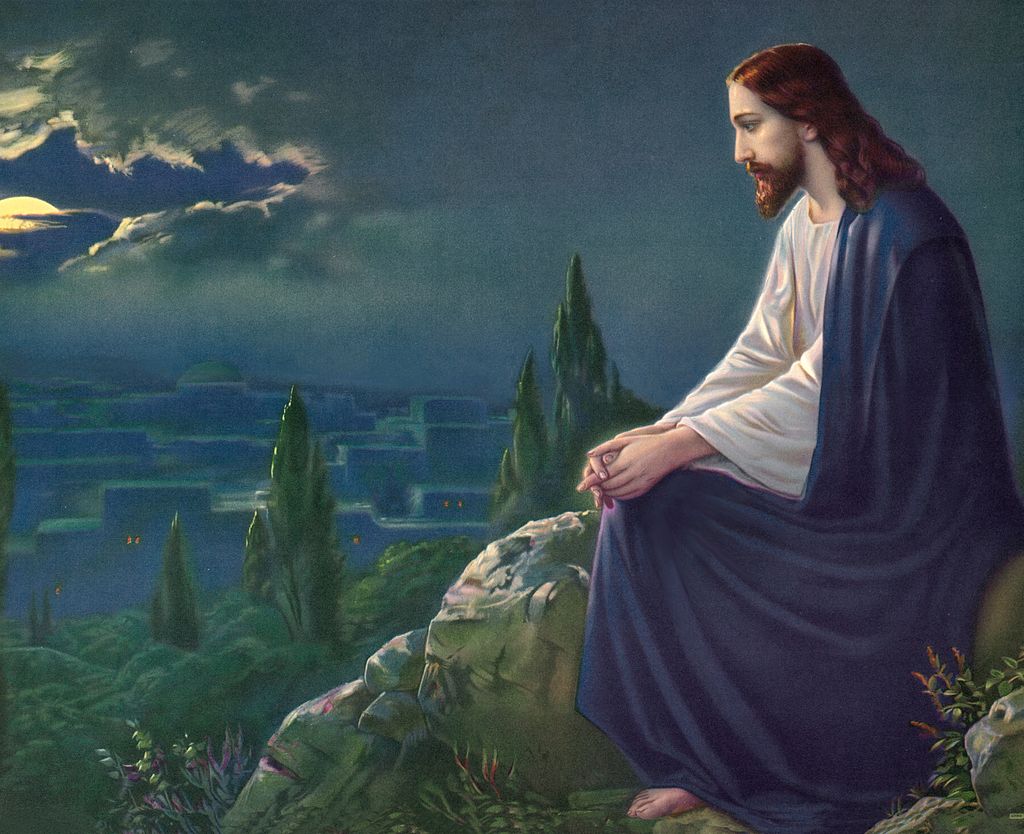
Christ on the Mount of Olives, by Josef Untersberger
Jesus was a contemplative… and the best teacher of contemplation! Jesus is the expert and our very source of contemplation. Western Christianity historically identifies more with action than with contemplation, and though action is important, action cannot reach its full fruition without contemplation. Contemplative prayer involves (Freeman 20):
- Interiority: going into “our inner room” (Mt 6:6)
- Silence: prayer is about brevity, simplicity, and trust
- Calmness: freedom from anxiety and obsession with material things
- Mindfulness: focusing on God’s Kingdom before all else
- Presentness: living in present moment, free from fear of the future
Contemplation is “a path, an experience, a lifelong practice, an expansion and deepening of consciousness” (Freeman 9). Recovering the elements of contemplation is crucial to our relationship with Christ, our relationship to others, and to the recognition of the Divine Presence in all of creation. Contemplative orders recognize this reality and that contemplation is not about the solitary but community, not about a fervor to change but a capacity to coexist in search of wisdom – a solidarity with all creation. Turning to Christ as THE teacher of contemplation, we can understand the wisdom imparted for us all to discover.
As evidence of Christ’s contemplative nature, we certainly can point to the various times Jesus goes off to pray either alone or with a few of his disciples (e.g., Lk 6:12, 9:18, 22:39) teaching us that “religion without contemplation lacks an essential part of holiness” (Freeman 6). Just going through the motions of our faith – attending weekly Mass, saying set prayers, volunteering at the token event to help the poor – without a contemplative dimension gets us only so far and misses the target of taking to heart Jesus’ message of love and care for all. Jesus, though, teaches us more than, “go into your inner room, shut your door, and pray to your Father in secret” (Mt 6:6), as imperative as that is to our spiritual life.
As good spiritual directors know, asking the right question (without offering answers) opens an individual to fruitful contemplation and reflection. Jesus uses this ‘open question’ technique asking, “Who do you say that I am?” (Mk 8:29, Mt 16:15). This question, so personal, so direct, carries us into the contemplative dimension, and like Peter we are tempted to give the set, “correct” answer missing Jesus’ point that there is no “correct” or “incorrect” answer. Contemplation helps you find your individual answer. Jesus, the ultimate paradox, helps us hold contradictions and see that the way to God’s Kingdom is through letting go of power and control, through forgiveness, through compassion, through solidarity with others in need, through childlikeness, and through wisdom. Jesus as our contemplative teacher, knows the right question to ask to lead us to the Kingdom. As Laurence Freeman states, “We have to pay attention to the quest in the questioning” (13).
Jesus also shows us, though, how to marry contemplation and action. If we turn to the story of the two sisters Martha and Mary (Lk 10:38-42), we find Martha and Mary symbolizing action and contemplation respectively – the two halves of our soul (Freeman 3). As Jesus visits, Martha is the one who is scurrying around (like so many of us do daily) stressed over the many tasks at hand to prepare for her guest. Mary on the other hand is sitting at Jesus’ feet listening attentively to his every word. Perhaps more shocking than Martha’s telling Jesus what to do (“Tell her then to help me.”) is Jesus’ calm reply that she is unduly stressing herself and that “Mary has chosen the better part.” (Lk 10:42). What Martha forgets (a mistake made by cultures, religions, as well as individuals) is that Mary is working as well – being still and listening. Here Jesus is teaching us the supremacy of contemplation over action, for our being comes before our doing. Contemplation helps move us beyond our egos and self-importance. Balancing our non-action and action is not easy, but our wholeness depends on it. We must have a deep sense of who we are in Christ before our actions can truly be effective. Like Jesus, the perfect example of the harmony between action and contemplation, we must withdraw at times to pray and contemplate.
Though it is difficult for us to achieve the right equilibrium, Jesus shows us how to balance action and contemplation – how to express non-violence, show compassion, and live in the divine image in which God made us. His delegalization of sin, “associating it with grace and forgiveness, not with exclusion and punishment” (Freeman 17), transforms our inner quest which in turn transforms the outward reality. In teaching us contemplation, Jesus gives us the means of seeing God in each person and throughout creation. He gives us the means to “not be afraid” despite conflict, anxiety, and obsessions. Jesus teaches us how to live in the present moment balancing contemplation and action – living the contemplative life in a hectic world.
Fawn Waranauskas teaches spirituality for the Saint Joseph’s College Online Theology Program.
Works Cited
Freeman, Laurence. “Jesus.” Journey to the Heart: Christian Contemplation through the Centuries,” Edited by Kim Nataraja, Orbis Books, 2011, pp. 1-20.