In his encyclical released this past week, Laudato Si, Pope Francis calls for “justice between generations,” by which he means frank, honest discussion and action about “the kind of world we are leaving to future generations.” This discussion requires a “struggle with … deeper issues,” and the pope raises the issue of how consumer lifestyles are reflected in environmental degradation. He also asks, even more importantly, now this lifestyle affects the moral character of society.
The pope’s words imply an important role for the elderly in wealthy societies. The elderly of today’s industrialized societies have lived in a period of astounding economic growth, and many of them have accumulated substantial wealth. The industries they have built have both increased pollution and have developed powerful means to clean up that pollution. Reflecting upon their lives and historical era, the elderly today must have something to say about the issues raised in Laudato Si and confronting every society in the world today.
For example, what are the most important values? Presuming that financial security is an
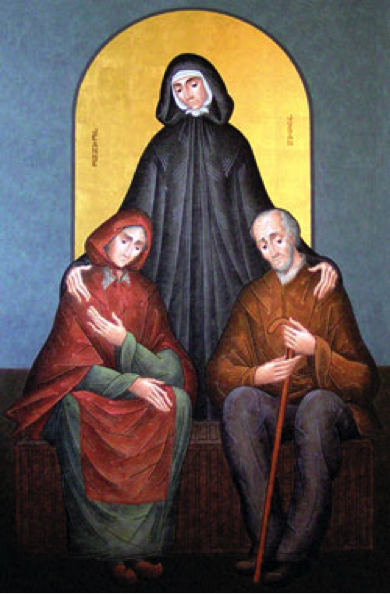
St. Jeanne Jugan, Foundress of the Little Sisters of the Poor and a patron saint of the elderly
important, but not the most important value, how does a family acquire and manage whatever wealth it has, in order to live both comfortably and generously down the generations of a family line? How do its members enjoy the fruits of God’s providence without becoming blind to the material and spiritual poverty of those in their own society and in other parts of the world? How do they place the needs of the poor before their own desires?
In order to begin reflecting upon their lives, the elderly in industrialized societies today might look at Pope Saint John Paul II’s “Letter to the Elderly” (1999). It is a difficult read in places, so I will point out some of the highlights.
In this letter, John Paul II looked back over his life in order to discern its meaning and place his life’s meaning in relation to God. In the second paragraph of the letter John Paul II writes “in my memory I recall the stages of my life, which is bound up with the history of much of this [the 20th] century, and I see before me the faces of countless people, some particularly dear to me: they remind me of ordinary and extraordinary events, and happy times and of situations touched by suffering” (1). The words “bound up with a history of much of this century” are all the more striking when one considers the pope’s role in world events such as the collapse of communism and in the Church’s response to modern secular culture. At the same time, the pope’s words reflect an investment of the heart in those whom he has touched and the vulnerability to the loss of friends and loneliness. Finally, this recollection becomes an occasion to recognize that his life has been part of God’s plan and to thank God for all his gifts.
The pope points out the advantages of age. Writing in a conversational tone to his fellow elderly people, he notes that their “retrospective gaze makes possible a more serene and objective evaluation of persons and situations we have met along the way. The passage of time helps us to see our experiences in a clearer light and softens their painful side ” (2, emphasis added) For this reason the elderly are “guardians of shared memory” and “the privileged interpreters of that body of ideals and common values which support and guide life in society” (10).
The pope also offers moral and theological principles necessary for grasping the meanings of one’s life and of the history of one’s own time in relation to God’s love and God’s plan. For example, in reviewing one’s life and the history of one’s own time, it is important to look for how God and man bring good from evil: “Like so many other times in history, our own has registered lights and shadows. Not all has been bleak. Many positive aspects have counterbalanced the negative, or have emerged from the negative has a beneficial reaction on the part of the collective consciousness” (3).
The pope acknowledges the hard lessons of the past. For example, he reminds us that “it would be both unjust and dangerous to forget… that unprecedented sufferings have affected the lives of millions and millions of people [as in World War II]” (3). He values the “blunt realism” that comes with age, and is reflected in the biblical proverb “all is vanity” (6; quoting Ecclesiastes 1:2). For him, this blunt realism is part of scripture’s overall “positive vision of the value of life” and its history of great deeds performed by God working through human beings, including the elderly.
Sixteen years after the “Letter to the Elderly,” Pope Francis asks the Church and the world for a dialogue about how to develop an integral ecology that lifts the poor from poverty without destroying the environment. The elderly in industrialized societies, which have both fostered economic growth and attempted to address the environmental problems it has causes, should make a contribution to this dialogue an important part of their legacy.
Grattan Brown teaches Ministry to the Aging, Sick and Dying for Saint Joseph’s College Online.