
Communion & Evangelization: A Lesson from Evangelii Gaudium

It’s Worth Repeating Wednesday! This post originally appeared on April 9, 2014.

Recently I was asked to participate in a panel discussion on Pope Francis’ apostolic exhortation, Evangelii Gaudium. The instructions one usually receives upon agreeing to be part of such an activity normally only extend as far as: “Just make a brief presentation on something that struck you in the text.” The instructions in this case would be no different. The following, therefore, is a short mediation on what I understand to be a great lesson to be learned, or reminder to be noted, from Evangelii Gaudium.

When one normally conceives of evangelization, a phrase often used is “handing on the faith.” While a good phrase, a temptation can be to understand faith strictly as it relates to the intellect. In other words, faith relates to what we believe, what we know as disclosed by divine revelation. Accordingly, missionary and evangelizing activity can be seen strictly as a task which communicates these truths to others. I am not attempting to disparage this task. In fact, this is precisely what I do every day in the classroom, i.e., communicate the truths of the faith as intelligibly as I can for my students. But the goal of evangelization is not a full understanding of the Catholic faith, rather, it is communion: communion with God and one another in the Church.

In this apostolic exhortation, Pope Francis is reminding us that “handing on the faith” is not simply an intellectual activity. Rather, and primarily, “handing on the faith” is the communication of God’s love for us; a love which is personal. As St. Paul wrote: “I live by faith in the Son of God who has loved me and given himself up for me” (Gal 2:20). For Pope Francis, as for St. Paul, faith cannot be separated from love in our evangelizing activity. It is “the love of Christ [that] urges us on” (2 Cor 5:14) in our missionary vocation, and impels our desire to seek out the least of Christ’s brothers (cf. Mt 25:40).

One passage of Evangelii Gaudium which, I think, points to this relationship between communion, love and evangelization, is the first section of chapter one, entitled, A Church which Goes Forth (Una Chiesa in uscita). This is more strictly translated as “A Church Going Forth,” a church active and in the process of reaching out. In this section Pope Francis mentions that the missionary impulse of the Church stems from the love of God who loved us first (cf. 1 Jn 4:19), and who calls us to be servants of one another (cf. Jn 13:17); thus forming an evangelizing community which “goes forth” in service. This service is not a disengaged and aloof didacticism, but an immersion in and among the evangelized, a taking on of “‘the smell of the sheep,’” a forming of communion in the one who has laid down his life for his sheep (cf. Jn 10:15).

This is the great reminder, I believe, of this apostolic exhortation: that the goal of evangelization is not knowledge but communion in love. This is the joy of the Gospel, that “God never tires of forgiving us” (§ 3) and constantly calls us into communion with Himself and, thereby, with one another.

Anthony Coleman teaches theology for Saint Joseph’s College Online.
 

“Do I have a vocation?” Yes!

The Church places great emphasis on “praying for vocations” with good reason. In order to carry out Christ’s mission on earth we need strong families, faithful lay people and, of course, priests, deacons and religious to care for our sacramental and spiritual needs. There is, however, a part of any discussion of vocations that is often left out: what is a vocation? This is an important question to answer because knowing what a vocation is will tell us who has one.

Before I met my husband people would ask me if I was married, or seeing someone. As the years went by and my twenties turned to thirties and beyond, the question came with a twist: “Well, have you considered a vocation?” That really bothered me, I guess because it felt like a reminder that I was “alone.” But it’s actually a question based on a misunderstanding – namely that as a single person I should only consider the religious life because I didn’t already have a vocation. The truth is that each one of us has a vocation, and it is activated at our baptism.

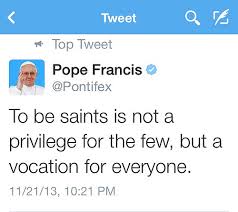
Pope TweetThe Catechism of the Catholic Church (no. 2013) quotes Vatican II, saying: “’All Christians in any state or walk of life are called to the fullness of Christian life and the perfection of charity.’ All are called to holiness….” The word vocation means a call, and this call comes from God and requires our response. The call to holiness is our responsibility and task as Christians. What does it mean to be holy? Scripture says God is holy, and that we are to be like God. According to St. John, “God is love.” (1 Jn 4:8). If being holy is to be like God, and God is love, then our call from God – our vocation – is to love! The answer to the question I heard repeated as a single person– “Have you considered a vocation?” – is, “I already have one. And so do you!”

The specific way we carry out our vocation to holiness and love is called our state of life. The states of life generally refer to marriage, priesthood and the consecrated life (religious sisters and brothers). We can spend many more articles just on the states of life, but the important point is that each one of us is called to holiness, to become like God: to love. Love is not a feeling, but a decision to do what’s good for another. If love were simply a feeling we couldn’t count on it, because our emotions change all the time. As persons made in the image and likeness of the God who is Love, it’s possible for us to love even when it’s difficult – or when we don’t particularly like someone. The way we love each day is enacted in our words, our actions, and in our very presence to another. We do this within our families, at work and school, at church, and in all of the encounters we have throughout our day.

Each of us is called to live out our vocation, regardless of our age or ability. For example, we wouldn’t think an infant “has a vocation,” because he can’t enact love in the ways we mentioned, much less make a decision to do so. Yet even the baby of the family is living his vocation by his very presence in the home. Next time you’re at church sitting behind a family with a baby, or see a mom or dad with a baby in a shopping cart, note your reaction. It’s only natural to coo, make faces and try to make him laugh. His presence alone is enough to draw out our love! God’s love is made present to us through the innocence (and cuteness!) of a child, and that child draws us out of ourselves. The same thing happens when we care for a family member who is ill, or non-responsive. She may not be able to say the words “I love you,” but her presence, her vulnerability and her need for us draw out love. We forget ourselves and we desire only the good of someone else. Our vocation to love is enacted in the care for a loved one – or fussing over the baby. Their vocations are enacted when they provoke in us a response of love. This provocation comes directly through the grace and loving presence of God.

We should “pray for vocations” every day; that each one of us enacts his or her vocation to love as spouses, parents and grandparents, children, priests and religious, and single persons, regardless of our age or capabilities. How is God calling you to carry out your vocation to love?

Ann Koshute teaches theology for Saint Joseph’s College Online. This article first appeared in Eastern Catholic Life, the official publication of rhe Byzantine Catholic Eparchy of Passaic.