Today is the feast of St. Vincent de Paul (1581-1660). Another post-Reformation era exemplar of holiness, St. Vincent most memorably served the poor. His Congregation of 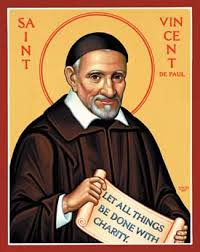 the Mission, the Vincentians (or “Lazarists”, named after their founding at the St. Lazarus prior in 1633), and a women’s order he co-founded with St. Louise de Marillac, the Daughters of Charity, sought to serve the poor’s spiritual and physical needs. Interestingly, together these two orders covered the needs of the French poor in both city and countryside. They did so based on St. Vincent’s personal example. Throughout his life, whether he tutored a wealthy family’s children, advised seminary training, or directed spiritual retreats, St. Vincent treated all equally. Having been sold into slavery for two years during his twenties, St. Vincent’s missionary zeal knew few boundaries. He addressed the spiritual needs of those whom he encountered, wherever he met them. One online biographer concludes: “It would be impossible to enumerate all the works of this servant of God. Charity was his predominant virtue. It extended to all classes of persons, from forsaken childhood to old age.” The parish society bearing his name, the St. Vincent de Paul Society, which has accomplished so much for America’s poor (as well as in other nations!), was founded in Paris in 1833 by Blessed Frederic Ozanam. This group, too, takes its inspiration from St. Vincent’s charity.
Charity should be everybody’s predominant virtue, and not just because St. Vincent de Paul embodied it so well. The Catechism teaches that charity is “the theological virtue by which we love God above all things for His own sake, and our neighbor as ourselves for the love of God” (#1822). Christ enjoined us to “love as He does, even our enemies,to make ourselves the neighbor of those farthest away, and to love children and the poor as Christ himself” (#1825). Clearly St. Vincent de Paul sought this last command throughout his life. Charity is, the Catechism continues, “the form of the virtues…it is the source and goal of their Christian practice” (#1827). Elsewhere the Catechism proclaims: “Charity is the greatest social commandment. It respects others and their rights. It requires the practice of justice, and it alone makes us capable of it. Charity inspires a life of self-giving” (#1889). So much for thinking of charity merely as dropping a few coins in the Salvation Army Christmas bucket! Charity is a virtue before it is an action, but the two are obviously related.
How fitting, therefore, that today concludes Pope Francis’ visit to Cuba and the United States. In the days leading up to this momentous occasion, more than one media or 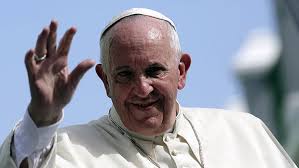 political figure took issue with Pope Francis’ stark call to serve people, and most immediately the poor, not ideologies. This is what one blogger has aptly called “Pope Francis Derangement Syndrome,” the inability of some—Catholic or not—to accept Francis’ criticism of capitalist economies. Despite evidence that many of Francis’ remarks follow similar ones made by Pope Benedict XVI, these critics reserve for themselves alone the right to select Pope Francis’ legitimate message. In other words, they are not charitable, nor, apparently do they much appreciate charity.
Bearing all that in mind, today’s readings might come into better focus. As Christ reminded the disciples in St. Mark’s gospel, the one who is not against us is for us. Pope Francis, who took his name after another saint who joyfully served the poor, is surely “for us”…us all, actually. He extols charity to both poor and rich. The latter, though, require the charity of being reminded that their material possessions are not, ultimately, their own. That resonates with St. James’ stark cry against the abuses committed by the wealthy. The Catechism does insist that charity requires, among other things, fraternal correction (#1829). So charity might help us hear more clearly the Holy Father’s message. Meanwhile, charity will also move us to make our love of neighbor and the poor and our enemies all the more real. Pope Francis merely extols a path which is also our goal. St. Vincent de Paul’s saintly example of charity reminds us of this.
Guest blogger Jeffrey Marlett blogs at Spiritual Diabetes.