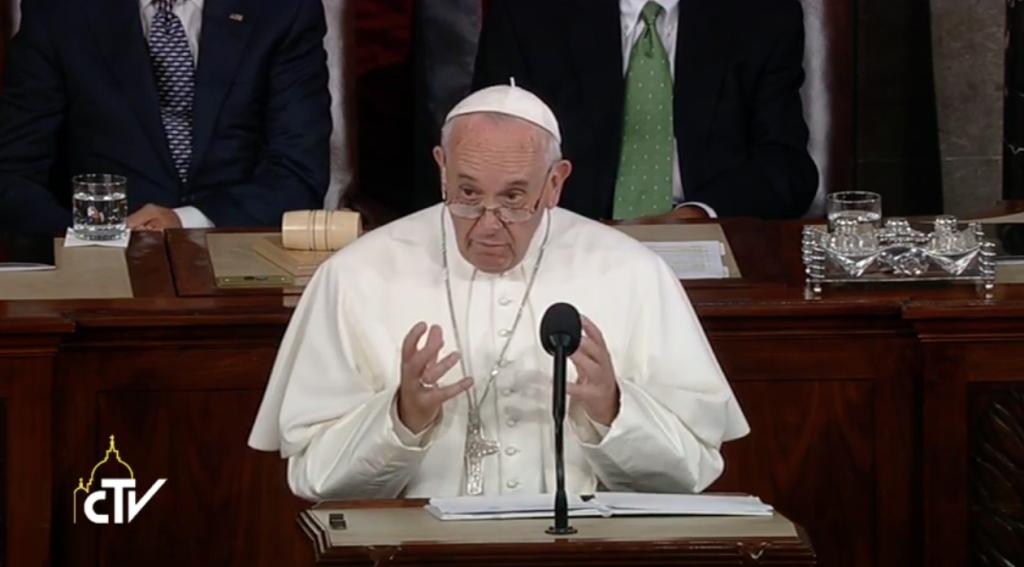
Mother Theresa diagnosed the world’s problems in these words: “We have just forgotten that we belong to one another.” Perhaps you were like many in the nation who watched or participated in the recent pastoral visit of Pope Francis to the United States of America and witnessed his actions and heard his words that echoed these very same sentiments of St. Mother Theresa of Calcutta. I was on a plane during his Mass in New York City. As I strolled up the aisle to the front of the plane, almost every person had their electronic device tuned in and were watching with apt attention Pope Francis deliver his homily!
The antidote Francis offers to a world who has simply forgotten that we belong to one another is to build a culture of encounter and to offer a spirituality of accompaniment. Recent studies have come out that show the sad reality that our modern lifestyle is making us more lonely! A report by the Mental Health Foundation suggests loneliness among youth and older adults is increasing and is having lasting repercussions on how we relate (or do not relate) with one another.
With each homily, pastoral visit or written document of his papacy, there emerges from Pope Francis reoccurring themes that are at one and the same time both simple and profound, basic yet revolutionary. Francis’ terminology speak to the heart which longs for happiness, pines for love, and seeks its definitive meaning and purpose in life. To academia he once stated: “the university (is) a place where the culture of closeness develops…. Isolation and withdrawing into one’s own interests are never the way to  restore hope and bring about a renewal. Rather, it is closeness, it is the culture of encounter.” Speaking as a “brother among brothers” in Philadelphia, Pope Francis, urged the Bishops: “As shepherds following in the footsteps of the Good Shepherd, we are asked to seek out, to accompany, to lift up, to bind up the wounds of our time.” To those gathered as members of ecclesial communities, Francis challenged: “In this ‘stepping out’ it is important to be ready for encounter. For me this word is very important. Encounter with others. Why? Because faith is an encounter with Jesus, and we must do what Jesus does: encounter others….with our faith we must create a culture of encounter, a culture of friendship, a culture in which we find brothers and sisters.” In a homily on the Year of Mercy this theme with still richer terminology is offered, “the Holy Year must keep alive the desire to know how to welcome the numerous signs of the tenderness which God offers to the whole world and, above all, to those who suffer, who are alone and abandoned, without hope of being pardoned or feeling the Father’s love.” In fact, Pope Francis calls for a “revolution of tenderness.” To the Cuban youth he rooted evangelization in this culture of encounter and spirituality of accompaniment with these words: “the path of hope is not an easy one. And it can’t be taken alone. There is an African proverb which says: ‘If you want to go quickly, walk alone, but if you want to go far, walk with another’…. I would like you to walk with others, together, looking for hope, seeking the future… Please, let us not “dis-encounter” one another. Let us go side by side with one other, as one. Encountering one another….”
Francis is clear as to the antidote for the culture which forgets that we belong to one another and that we are made in the image and likeness of God. Francis’ witness of life sets the example that we must accompany one another in this world no matter rich or poor, sinner or saint. To accompany another, for Pope Francis is to reveal the mercy of God, to point the way to Jesus, and to serve God and our neighbor.
The work of the evangelization, entrusted to all, is to teach Faith in a way which allows all people to discover one’s unshakeable inner goodness, one’s deep and abiding worthiness, and one’s sheer beauty because we are beloved children of God.
The beautiful Christmas hymn, O Holy Night, says it all:
It is the night of our dear Savior’s birth
Long lay the world in sin and error pining
‘Til He appeared and the soul felt its worth
A thrill of hope the weary world rejoices
For yonder breaks a new and glorious morn.
That is at the heart of the Church’s mission to which all the baptized are commissioned and sent forth. We help people encounter Christ and the sacraments of the Church so they can feel their worth. The poet Galway Kinnel wrote “sometimes it is necessary to reteach a thing its loveliness and when that happens we begin to foster tenderness for our own human predicament. A spacious and undefended heart finds room for who we are and carves a space for everyone else!” Pope Francis’ message to help everyone experience the tenderness mercies of God and thus to feel the worth of the soul is truly at the heart of his plea to return to the fundamental principles of the Faith and to accompany one another on the journey to the Father’s house. Perhaps then will this pervasive loneliness be dispelled and fulfillment in Christ be found in the company of one another in his community the Church.
Lisa Gulino teaches pastoral theology for Saint Joseph’s College.