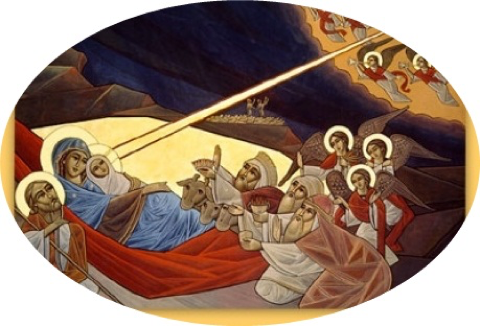
A few years ago a friend shared a prayer with me called the St. Andrew’s Christmas Novena. The devotion, popular in the Western Church, is prayed daily from the feast of St. Andrew until Christmas. It is a beautiful prayer, and it goes like this:
“Hail and blessed be the hour and moment in which the Son of God was born of the most pure Virgin Mary, at midnight, in Bethlehem, in the piercing cold. In that hour vouchsafe, I beseech Thee, O my God, to hear my prayer and grant my desires through the merits of Our Savior Jesus Christ, and of His blessed Mother. Amen.”
This prayer, profound in its simplicity, tells not only the meaning of Christmas, but the meaning of our lives in Jesus Christ. Close your eyes and picture the scene: night falls after a long day’s travel. Mary, uncomfortable and tired, knows her time of delivery is imminent. Joseph, doing his duty by registering for the census, feels the weight of responsibility for the care of the wife he brought so far from home, and the child who’s on his way. Searching the crowded city, the couple finally finds a cave in which to rest and wait. It’s quiet and cold. Finally, the child is born, but not just any child: the Word of God spoken as a helpless infant. The silence of the night is interrupted by the cries of the Child, the low hum of His mother’s comforting song, and Joseph softly stroking the newborn King’s head. Once again the quiet, and only Heaven really knows the wonder, the miracle of God’s love that the Earth will puzzle over and misunderstand as the Child grows.
In our “traditional” experience of Charlie Brown Christmas specials, “Midnight Mass,” and the breaking of oplatky embossed with Nativity scenes, it’s easy to embrace the “noise” of Christmas and lose the quiet contemplation and wonder. In our cozy kitchens, by the fireside, and snuggled in our beds we may forget the magnificence in the austerity of the Nativity of Christ. God becomes a man, the Creator becomes a creature, and the Son becomes a son. God breaks into time and history, into “the piercing cold” on a night a long time ago, in a place far away, yet into the very heart of the experience of each one of us.
The one, true living God is not a concept or a distant Watcher. He is a Person: a relationship of love – Father, Son and Holy Spirit – who desires to be so close to us for all eternity that He comes to meet us “on our own turf.” The Son of God enters His creation  as a baby, piercing not only the cold darkness of one night in history, but the cold, dark spaces of our human experience. Christmas shopping and gift-giving, baked ham and cranberry sauce, and the reunion of family and friends are an important and vital part of our Christmas experience. Worship in the Divine Liturgy and communion with each other are essential to the celebration. But so too is the quiet meditation, deep in each of our hearts, on the Word made flesh. Jesus became a man to save us – yes – to heal our spiritual infirmity – yes – and to conquer death – YES! Yet within the magnanimity of this saving act is the simple, subtle, unassuming truth of Emmanuel: God with us. When we are vulnerable, so is He. When we are weak and sick, so is He. When we laugh and when we cry, He is there.
As we wrap gifts and buy groceries, prepare feasts and make our way to Liturgy in the cold of night or the crisp early morning, let’s remember to steal moments of quiet thought. The gifts are signs pointing to the Gift of God Himself. The feast and fellowship we share foreshadow the bountiful goodness He has prepared for us. The Liturgy is that place where we meet Him, face to face, as vulnerable in the Bread and Wine as He was in the manger, but no less physically and spiritually present. Our hearts are the place where He lives, if we prepare a place there for Him to rest with us.
“Hail and blessed be the hour and moment,” and every moment of our lives, because God is near.
Ann Koshute teaches theology for Saint Joseph’s College Online. This article first appeared in Eastern Catholic Life, the official publication of the Byzantine Catholic Eparchy of Passaic.
 Now, in this holy season of Advent, the time spent waiting and preparing grows shorter. But waiting is never easy. Ask any child or the child in any of us for that matter. Sometimes the waiting can make us desire the object of our waiting more and even sharpen our focus on that which is the object of our interest and affection. We all know the adage “Absence makes the heart grow fonder”. That compulsive aspect of waiting can prompt some to try to distract their attention by shifting the focus to something else. Filling that emptiness with activity and distraction is likely something we’ve all done. While that strategy may help pass the time, I’m not so sure that it’s the best use of our time and that gift. In terms of our spiritual journey, my personal opinion is that the time of waiting is a gift, a grace that should be embraced as an opportunity to experience the longing for God. The experience of that utter absence sets the stage for our ability to clear the space in our hearts and lives and know so deeply that that space was always meant for him to fill. Realizing that this longing for God was the greatest gift that God could give me prompted me to pen these words many years ago. I prayerfully return to them every Advent and I pass them on to you in the hope that they may resonate in your Advent prayer.