Hope is a word that has been tossed around quite a bit recently – perhaps I have just become more aware of its frequency … or it really is having a resurgence! Just yesterday I noted the title of a book of Lenten reflections asking “what are we hoping for?”
Hope is a powerful thing, one that I am often unaware of, yet confident of its presence. A friend of mine, who has been in a very difficult place in life, recently mentioned finally being 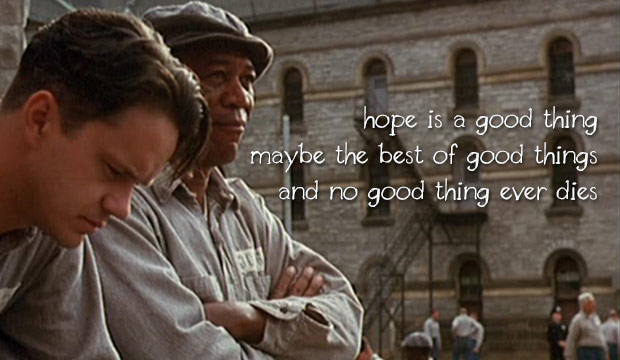 able to hope again. I had no idea. It’s true; when someone has “lost hope” they determine that they cannot go on. That was one of the most striking things for me when I first watched the movie, “The Shawshank Redemption.” The character played by Morgan Freeman was “an institutional man,” he had been incarcerated so long that he couldn’t imagine life on the outside or any possibility of his surviving it. Part of surviving life on the inside was to not hope – not look forward to the future, to better or even different times – “hope is a dangerous thing!” [You can watch the trailer here: https://www.youtube.com/watch?v=6hB3S9bIaco ] And yet, this movie is ultimately about this man, Red’s, journey to rediscovering hope – it ends with him listing all of the things he hopes for and hearing himself saying “I hope, I hope, I hope …”
We are encouraged, in our society, to state very clearly what we want – and this can be interpreted in many ways: what do we think we deserve, what we can earn, what our material goals are. Do we realize that these future desires speak of hope? Any yet, if someone were to ask me what I hope for, I would not be inclined to enumerate material things. The Christmas “hangover” has just about dissipated. Think of how we speak of our Christmas anticipation – what do I want for Christmas? What if the question were, what do I hope for at Christmas? What do I want? Maybe some new electronic gadget. What do I hope for? Peace on earth, safety of my brothers and sisters in places of war and violence, shelter for those without homes, heat for those with inadequate housing …
Hope is deeper than want. Hope is one of the “big three” – faith, hope, and love (1 Cor. 13:13), but not the most enduring. Why? Faith is belief in that which is not known – when we enter into the kingdom of God, all will be known so faith will not be necessary. Hope is desire for that which is not yet realized – as all will be known, so all will be realized, hope is fulfilled. Love is the only gift that endures in this life and the next. But 1 Cor. 13:7 tells us that love always hopes! Commentaries state that hope for another (not about myself) is a fruit of love.
Hope. Do I have hope? Do I remember what it is to hope? What do I hope for? I am hopeful in this Year of Mercy – that it will be full of graces for the Church, the world, and in my own life. What do I hope for?
I hope that you receive all of the graces that God has in store for you this year!
Sr. Kelly Connors, pm, teaches Canon Law for Saint Joseph’s College Online.