Here are five leading indicators about the assessment that I make about “how my mind changed,” i.e., about my mind’s development over the sixty-three years since I reached the age of reason. These leading, not lagging, indicators of “change” unveil the combined and specific quality of the development of my mind as a reinforcement and intensification of judgment, but not as a replacement of “this” judgment by “that” judgment. 1) In 1998, I dreamed that I was hiking up a mountain with Pope John Paul II. I pleaded about my way of believing, “Is it okay to be neo-orthodox?” Of course, I woke up. Had I not, I think that he might have referred me to Newman’s An Essay in Aid of a Grammar of Assent. (2) On the occasion of Hans Urs von Balthasar’s death in 1988, at a faculty seminar at Loyola University, New Orleans, a faculty member critiqued Balthasar as a “fideist.” Another colleague suggested that I was a “solipsistic fideist.” If Balthasar’s theology is fideist, I would be glad to be in his company. Of course, he would have objected to the use of such a term for his own work. (3) I noted that Bill Shea, in a book review, surmised that neo-orthodoxy was a pit-stop on the way to unbelief. (4) I commiserated that we both stood half-way down the slippery slope toward unbelief, the question being whether we slid further or climbed back. Thus, (5) I recall Dante’s conversation with Virgil at the entry to the mountain of purgatory:
“‘But if it please you, I should willingly
learn just how far it is we still must journey;
the slope climbs higher than my eyes can follow.’
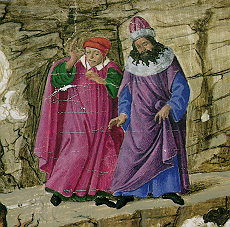 And he to me: ‘This mountain’s of such sort
that climbing is hardest at the start;
but as we rise, the slope grows less unkind.
Therefore, when this slope seems to you so gentle
that climbing farther up will be as restful
as traveling downstream by boat, you will
Be where this pathway ends, and there you can
expect to put your weariness to rest.
I say no more, and this I know as truth.”
The Base Line
In 1962 in seminary high school as a sophomore, I wrestled mightily with Frank Sheed’s Theology and Sanity, especially his treatment and explanation of the persons of the Holy Trinity. That year, the first theological paper I did was on “The Inadequacy for the Modern World of the Devotio Moderna,” written out in long-hand with a fountain pen! I still have it and still agree with the premise. In seminary college from 1964-1969 I plumbed the philosophical depths of Jacques Maritain’s epistemology in The Degrees of Knowledge. I also note two books that influenced me to go deeper, Bouyer’s The Meaning of the Monastic Life and Erikson’s Gandhi’s Truth. Bouyer taught me that the cosmos contains active and invisible angelic presences, and Erikson taught me about the quality of the integrity with which one must be true to oneself.
For a master’s degree in theology, from 1969-1971, at Saint John’s University in Jamaica, New York, I studied Origen and Athanasius; Raymond Brown on the sensus plenior; Karl Rahner and the ontological argument; Hieronymous Noldin and Josef Fuchs on human act. My thesis was a comparative study of Hans Kung’s Structures of the Church and his The Church. I discovered that Kung’s, Rahner’s, and perhaps Bernard Lonergan’s, earlier works were superior to their later. At least I did not follow their later developments. I found out that Origen and Athanasius are not dated in any essential way. I am not a Whig historian of theological progress. With Newman, I stress that the development of doctrine is change for the sake of preservation. It is certainly not development by subtraction, nor replacement by “something better.”
At Fordham University and at the Riverdale Center for Religious Research from 1971 to 1976, I did my doctorate with Thomas Berry, the single most formative intellectual influence on me. With him I read Teilhard de Chardin whose insights about the biology of spirit and the importance of temporal process I accept. I studied the great texts of Hinduism, Buddhism, and Confucianism. (1) The world religions have conflicting soteriologies that include contradictories. For the next forty years, this conclusion placed me at odds with the prevailing currents in the theology of religions. Only with the emergence of comparative [and contrastive] theology has a countervailing assumption been given a hearing. (2) Berry worked from the style of cultural history of Christopher Dawson. Berry maintained that the problematic of the present time is cultural, not theological. He stated that there was nothing basically wrong with the classical theology of God. Characteristically he bragged that he had never read anything by Karl Rahner. (3) I learned: go deeper in theology, do not innovate. I would add that Ewart Cousins also taught me that Paul Ricoeur was perhaps naïve about second naïveté, since there was nothing naïve about first naïveté. Depth is not to be achieved by revision.
Four Representative Changes of Mind
My mind has changed many times. Sometimes I have gone with the flow, other times rowed upstream. The following four changes of my mind—changes with continuity—changes for the sake of preservation—intensifications, rediscoveries, renewed conversions, are illustrative of my journey. I say that “I” changed my mind, but that misses the tension between activity and passivity; sometimes my mind changed me.
(1) As a historian of religion, I studied the forms of Hinduism closest to Judeo-Christian monotheism, e.g., the Bhagavata Purana [8th century] and the monotheistic theology of Madhva [1238-1317]. I am convinced that the most significant doctrine differentiating Christian faith and Hindu teaching is the doctrine of creatio ex nihilo, which determines the orthodox doctrines of God, Trinity, and Christology. My conversations with Berry in the nineties were in this vein about Aquinas and Cajetan on creation and the analogy of being. Although Berry was remarkably silent in public, he was convinced the universe was caused, had a transcendent cause, and had a beginning. Further the doctrine of creation premises the answer to the Baltimore Catechism’s question six that I had learned about the purposefulness of a human life across this world and the next. Being made to know, love, and serve God in this world and to be happy with him in the next is certainly untrue if God did not create the world. It may be that the immanentization of the eschaton is a particular challenge to Christian orthodoxy without parallel since the Gnostic crisis of the first and second centuries.
(2) Like many who studied Catholic theology in the sixties and seventies, my understanding of Scripture was influenced by reading the studies of Raymond Brown, and thus by deep immersion in his application of the historical-critical method. However, I now find that his hermeneutics of “scholarly liberal, non-scholarly liberal, non-scholarly conservative, and scholarly conservative” is dated. Without excluding its validity, many conclusions of historical-critical scholarship were framed on implausible premises about the historically credible. My understanding of the plausibility of the resurrection of Jesus shifted toward the positive. My excitement at reading scholars like N.T. Wright and Richard Bauckham was refreshing, and, after Brown, unexpected. Theologians need not assume the resurrection is implausible, an assumption based on a “presentism” judging the past on insecure present criteria. The Gospels are on firmer historical ground than previously assumed.
(3) In 1976, in a conversation with my wife, I noted I was agnostic about the possibility of the ordination of women to the Catholic priesthood. I proposed that theologians study the question for forty years and not decide until an orthodox theology of Jesus as a male human being was developed. The kind of flesh that the Word was made is not adventitious. For two decades I got it from those who were pro and took me to be con, and from those who were con and took me to be pro. Since 1996, following the example of Avery Dulles, “in view of the force of the convergent argument and the authority of the papal office,” I give my full assent to the teaching of the magisterium.
(4) As a tenured academic, I am free to be solipsistic. As a person of Catholic faith I am not so casual. In the summer of 2010, in preparation for ordination to the diaconate, I signed the required profession of faith. After the Creed, I carefully considered its three additional paragraphs: (1) revealed truths, “With firm faith I believe as well everything contained in God’s word, written or handed down . . . as divinely revealed and calling for faith”; (2) doctrines definitively taught, “I also firmly accept and hold each and every thing that is proposed by . . . the Church definitively”; and (3) authoritative teachings that are neither revealed nor inseparably connected with revelation, “I adhere with religious submission of will and intellect to the teachings . . . even if they proclaim those teachings in an act not definitive.” I used Lonergan’s transcendental precepts; I tried to be as attentive, to be as intelligent, to be as reasonable, and to be as responsible as I possibly could be. I made the complete profession of faith. I am all in.
It is my judgment that the contemporary crisis of the Church will pass, but until it does, orthodoxy must be preserved at the personal level, even if by the free choice of an informed will: only in this sense “neo-orthodoxy.” The patient scholarship of intellectuals has a modest role in that preservation, perhaps against the common grain of the scholarly community: only in this sense “solipsism.” I expect that I will keep the faith, although I am not going to live long enough to understand it: only in this sense “fideism.” My mind may change further, with God’s help, for the sake of preservation. However, the best direction on a slippery slope is up, because the climbing gets easier. Yet I wish I had a Beatrice to send me a Virgil to lead me up the mountain!
Daniel Sheridan is Professor of Theology at Saint Joseph’s College and former Director of the Online Theology Program. He is a permanent deacon in the Diocese of Portland.
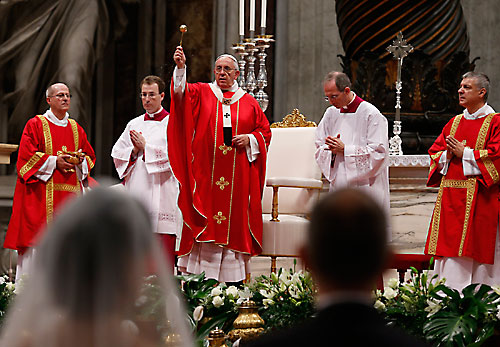 In his homily, Pope Francis reflected on the first reading of the day, and he recalled that when the Israelites were on their journey through the desert, they became impatient (cf. Numbers 21:4). But married couples, too, as they walk together through the journey of life, can become impatient, even with each other. Pope Francis makes this exact point: