September 15 began a month-long celebration of Hispanic Heritage. 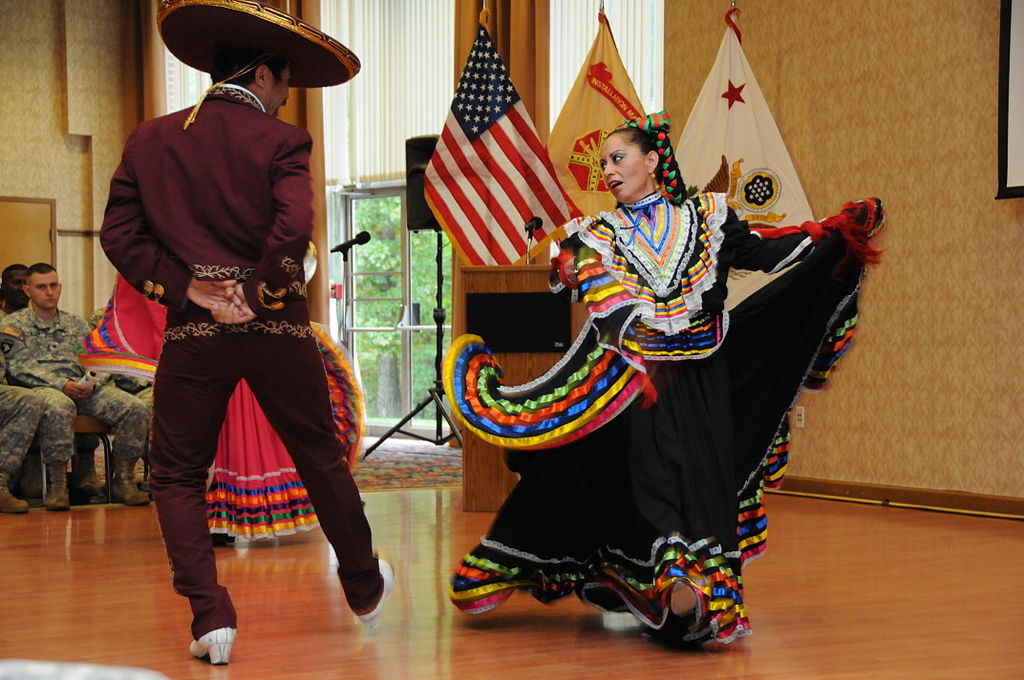 According to the U.S. Bureau of Census, there are 55.4 million Hispanics living in the United States. In other words, Hispanics comprise 17% of the total U.S. population. These numbers represent a blessing and a challenge, pastorally speaking. The following paragraphs attempt to demonstrate this dual reality–the Hispanic presence in the U.S. as a blessing and a challenge.
History informs us that U.S. Hispanics are descendants of those Indians and mestizos who suffered the “discovery of the New World”, along with conquest and colonization. Hispanics are the descendants of those who did not cross a border, but against whom a border was created. Recently, this fact has been brought to the fore through a song popularized by Los Tigres del Norte, “Somos mas Americanos!” At the Latin Grammy Awards last year, they were accompanied by another popular Spanish pop music group, Mana. Both music groups are the descendants of those immigrants who came to this nation looking for a better life and more opportunities. Our country was called “a nation of immigrants” by Mitt Romney, in his speech accepting the GOP presidential nomination at the Republican National Convention four years ago.
U.S. Hispanics who still suffer the struggles of deprivation and discrimination have not lost their strength and identity. Their aguante (unyielding endurance) is grounded in their popular expressions of Catholicism. In their lived faith, the figures of Jesus and Mary are most important. The U.S. Hispanic Jesus is the crucified Jesus, as described by Roberto Goizueta, Hispanic theologian and professor at Boston College. This is the “Jesus made of flesh-and-blood like us. The blood on his face, side, hands, and feet are the signs of his humanity; not the abstract ‘humanity’ of the philosophers and theologians, but the flesh-and-blood humanity of those who dare to kiss his wounds.” Regarding Mary, it is important to note first that in almost each Latin American country, there is at least one image of Mary that is revered. However, there is one which shines forth brightly in its significance. She is Our Lady of Guadalupe. The reasons for the particular devotion to the Virgin of Guadalupe are explained by Orlando Espín, professor of theology and director of the Center for Study of Latino/a Catholicism at the University of San Diego: “For historical reasons, however, there is one Mary who stands out as unique among Hispanics’ Marys, and that is la Morenita, Our Lady of Guadalupe. No other popular religious devotion is as closely linked to a people’s self-identity, or socio-historical context, as is the Mexican devotion to our Lady of Guadalupe; none other is more deeply ‘ours.’”
However, it is not only the Hispanic’s “aguante” that is a significant characteristic, it is also their sense of “fiesta”- a unique theological category. According to Guizeta, “Fiesta” for U.S. Hispanics is not the same as a party. “Fiesta” expresses a deep commitment to social justice and a pledge to resist all forms of instrumentalization and objectification. It is an authentic communal celebration of the U.S. Hispanic’s identity, where “nosotros” does not just have the simple meaning of the English pronoun “we,” but rather, “we others”. These new “we others” are conscious of the historical, cultural and anthropological reality of mestizaje. This latter word is defined by Virgilio Elizondo, the father of U.S Hispanic Latin/a theology and former professor of theology at Notre Dame, as “the process through which two totally different peoples mix biologically and culturally so that a new people begins to emerge.”
Thus, U.S. Hispanics, whose ancestors suffered the “discovery,” conquest, and colonization, have risen to celebrate their original culture. Their aguante is grounded in their popular Catholicism which is rooted in the love of the crucified Jesus and Our Lady of Guadalupe. These central devotions are celebrated through fiesta, which, in turn, are a blessing for the Catholic Church and society in general.
Through “aguante” and “fiesta” Hispanics are a public, religious presence. However, demographics involving Hispanics are a challenge, pastorally speaking. Dr. Hosffman Ospino, Hispanic theologian and professor at Boston College, says: “61 percent of Hispanics are U.S.-born. 37.3 percent of Hispanics 30 and older are in this category. Yet more striking is the fact that 93 percent of all Hispanics under the age of 18 are U.S.-born. Any form of pastoral planning and strategy for evangelization in the church today is to consider these figures, mindful that most of these young Hispanics are likely to be growing up in Catholic households.”
This data reflects the challenge Hispanics and, in particular, young Hispanics pose for Catholic ministry in the U.S. It is important to note that in his research Ospino discovered that young Hispanics are one of the ten signs of vitality in parishes with Hispanic ministry.
This sign of vitality that Ospino speaks of can be seen in the Religious Education programs, schools and parishes in the U.S. where Hispanics attend and celebrate Mass. Ospino found that “two-thirds of the children enrolled in faith formation programs are Hispanics. The large participation of Hispanic children in programs of faith formation suggests the active presence of young families.”
These same young families are the key population to reach out to in order to keep Hispanics participating in and serving within the Catholic Church. Their children need bilingual and multicultural programs to create in them a sense of appreciation for their uniqueness within diversity. They must grow to appreciate their gifts as created in the image and likeness of God.
A bilingual and multicultural religious education program can eventually lead to the flourishing of a new society in which every single person is valued equally. This understanding can help to overcome the marginalization that Hispanics have been suffering in the history of the U.S.
The pastoral challenge presented by the demographics of the Hispanic population in this country requires a bilingual and multicultural religious education which will recognize the unique image of God that this group represents within our Church.
Thus, U.S. Hispanics are a blessing for the society of the United States, but equally a particular pastoral challenge for the Church of the United States
Do you think society in general sees the increasing numbers of Hispanics as a blessing?
What is your parish community offering to the Hispanics living within it?
Nelson Araque teaches History of Latino Catholics in the Church for Saint Joseph’s College Online’s Pastoral Ministry to Latino Catholics Program.
