A Washington Times headline on December 6, 2010 read: “Religious strength tied to well-being” (Wetzstein 2010). The headline is gleaned from a Gallup-Healthways Well-Being survey of 550,000 participants. The survey, as reported by the Washington Times, found a direct connection between “emotional health, physical health, life evaluation and work environment” with praying and studying Scriptures and the sense of belonging to a “moral community based on religious faith.” Additionally, the survey finds that “Christianity, the dominant religion of the United States, embody tenets of positive relationships with one’s neighbors and charitable acts, which may lead to a more positive mental outlook.” Lastly, the Washington Times article, quoting another survey from the American Sociological Review on religious behaviors and well-being, reported that “people who attend religious services weekly and have three to five close friends in their congregation are most likely to say they are ‘extremely satisfied’ with life” (Wetzstein 2010).
Often we hear the statement, “I am spiritual but not religious” which really means the person seeks spirituality aside from a faith community. Interestingly, the surveys conducted by Gallup and the American Sociological Review, connect spirituality and participation in a faith community together as a key ingredient for one to be “extremely satisfied with life.” It appears that a journey of faith within an ecclesial (Church) community of faith really does matter! Expressions of faith, making prayer a part of our daily life and praying in community enables us to discover true and lasting hope.
Fellowship in a faith community matters because we find support for the journey of life. The Gospel of Matthew reminds us Jesus is present wherever two or more are gathered in his name (cf. Mt. 18:20). Community prayer and support help individuals become “extremely satisfied with life” because it ought to lead us to an encounter with Jesus.
Part of our spiritual DNA is the quest for meaning and purpose. So the heart longs for the answers to such questions as “what (or who) are we really made for”or “what is the meaning of life” and “is there more to life than meets the eye”? Other questions unfold before us as we confront life’s situations and world events that perplex us and perhaps cause disquiet within our being. Who of us has not pondered the question, “why do bad things happen to good people,” or “how is it that the ‘innocent’ seem to suffer so much evil?”
Today we begin our annual pilgrimage into the heart of the Pascal mystery. The drama of 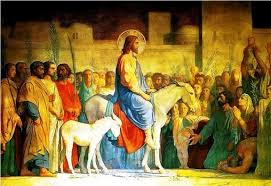 the Passion, death and resurrection of Christ is where we can and ought to bring our questions and our restless heart. Let this Holy Week with all of its readings, prayers, symbols, rites and rituals seep deep within our inner most being. Let the Church’s worship and our meditation become for us the lens through which we examine our actions and interpret life’s events. Reflecting on the crowds laying palm branches before the humble Christ entering Jerusalem on a donkey, St. Anthony of Crete offers this spiritual pearl to us:
Let us run to accompany him as he hastens toward his passion, and imitate those who met him then, not by covering his path with garments, olive branches or palms, but by doing all we can to prostrate ourselves before him by being humble and by trying to live as he would wish. Then we shall be able to receive the Word at his coming, and God, whom no limits can contain, will be within us. (Oratio 9 in ramos palmarum: PG 97, 990-994).
The last line of St. Anthony’s reflection gets at the heart of what it means to be “extremely satisfied with life.” The key to our quest for meaning and satisfaction, our longing for community, and love is found in our encounter with Christ. Our God is a transcendent God who wishes to make his home within us. Holy Week reminds us to what lengths God went to do just that…to make his home within us. Today, on Palm Sunday, let us be present, with all of our questions, hopes, doubts and faith so we can
… spread before his feet, not garments or soulless olive branches, which delight the eye for a few hours and then wither, but ourselves, clothed in his grace, or rather, clothed completely in him. We who have been baptized into Christ must ourselves be the garments that we spread before him. Now that the crimson stains of our sins have been washed away in the saving waters of baptism and we have become white as pure wool, let us present the conqueror of death, not with mere branches of palms but with the real rewards of his victory. Let our souls take the place of the welcoming branches as we join today in the children’s holy song: Blessed is he who comes in the name of the Lord. Blessed is the king of Israel. (Oratio 9 in ramos palmarum: PG 97, 990-994)
Great will our satisfaction be in this life and the next if we open our souls and welcome Christ who is indeed our Savior and the answer to all of our questions and our longings. Let us now be on our way to accompany Christ that he may accompany us.
Lisa Gulino teaches pastoral theology for Saint Joseph’s College Online.
