
Christ is risen! He is risen, indeed!

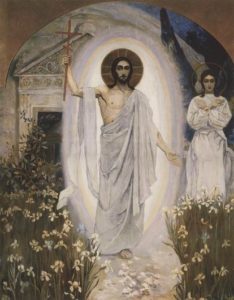
Resurrection by NesterovChrist is risen! He is risen, indeed!

If there is any doubt about the veracity of that acclamation, the “indeed” removes it.

In contemporary academia, awash in moral relativism, the emphasis often is placed on skepticism at the expense of certainty – that is, the divorce of reason from faith. True intellectual engagement, however, need sacrifice neither questioning nor certainties. Faith and reason can and ought to live together in a wonderful and lively union.

When I was in graduate school, I participated in a student forum. It was a diverse group: a few Protestant ministers and a mix of Catholic lay and religious. The faculty mentor was a nominal Christian who described the Scriptures as something scholars must “push up against.” We had a meeting during Holy Week on how to preach on the “resurrection” (quotation marks intentional). One of the students said that if she were to preach an Easter sermon, it would be on the passage in John 20 in which, after the resurrection, Mary “recognizes” Jesus in the gardener. The theme, she said, is that the importance of Easter is that Mary experienced the resurrection, and not that it happened as a matter of fact. Implicit in this statement is that the resurrection may not have happened in-deed. Christ is risen! He is risen, in my experience! Surprisingly, my forum group thought this was a good idea, and anyone who disagreed with this notion kept quiet for fear of embarrassment at being a believer.

A faith that becomes subjective and privatized lacks true transformative power. It is a vanity that leads to despair when the bloom of youth and vigor fail. As Saint Paul preached to the Corinthians, “if Christ has not been raised, then our preaching is vain; your faith also is vain” (1Cor. 15:14). Saint Paul admonishes the Corinthians to the contrary:

Christ has been raised, and because of this, so also shall we: Now if Christ is preached that He has been raised from the dead, how do some among you say that there is no resurrection of the dead? … But now Christ has been raised from the dead, the first fruits of those who are asleep. For since by a man came death, by a man also came the resurrection of the dead. For as in Adam all die, so also in Christ all will be made alive… 

1 Corinthians 15:12, 20-22

And what will Christ’s resurrection mean? Behold, I tell you a mystery; we will not all sleep, but we will all be changed, in a moment, in the twinkling of an eye, at the last trumpet; for the trumpet will sound, and the dead will be raised imperishable, and we will be changed. For this perishable must put on the imperishable, and this mortal must put on immortality. But when this perishable will have put on the imperishable, and this mortal will have put on immortality, then will come about the saying that is written, “Death is swallowed up in victory.”
          “O Death, where is your victory?
           O Death, where is your sting?”
The sting of death is sin, and the power of sin is the law; but thanks be to God, who gives us the victory through our Lord Jesus Christ.
                                                                                                        1 Corinthians 15: 51-57

Every Easter for close to twenty years now, I think back to that forum, and how thankful I am to have had other wonderful faculty mentors who were great scholars and believers in the resurrection, and how grateful I am to be teaching at a Catholic college that marries faith and reason in a wonderful and lively exchange.

Christ is risen! He is risen, indeed!

Patricia Ireland is the Director of Theology Programs for Saint Joseph’s College Online.

Musings on the Practical, or Practical Musings?

On numerous occasions over the years I have been asked to “make a presentation on Scripture”. The settings have been quite varied: a series on the Gospels or a particular Gospel; a talk to a group sponsored by a parish education program; a study group meeting at the homes of parish members; an RCIA program; members of men and women religious, and the like. One common denominator among all is a lack on the part of many of knowledge of the teachings from Vatican II, especially those contained in Dei Verbum.

Without trying to assess the reasons for this vacuum, I believe some suggestions for increasing the knowledge of the faithful regarding Scripture might be in order. One way to approach the problem is to develop an understanding of the various “criticisms” that Scripture scholars have put forth. For the audience intended, this does not have to be full of technical jargon. But as the title of this article suggests, it must be practical.

José A. Pagola, a Spanish Scripture theologian whose numerous books have guided me in this quest of the “practical,” offers the following response to the question:  What are the Gospels attempting to do?

For followers of Jesus, the four gospels are a unique and irreplaceable resource. They are not textbooks, expounding an academic doctrine of Jesus. They are not detailed biographies, tracing his life in history. These stories bring us close to Jesus as the first generations of Christians remembered him, with faith and love. On the one hand, they show us the great impact Jesus caused in the people who first were attracted to him and followed him. On the other, they were written to inspire new disciples to do the same.[i]

Pagola is in no way denigrating the academic study of the Gospels, for he is a scholar. Rather, he is finding a way to “translate” our studies in such a way that the widest audience possible will understand and be inspired.

How do we approach the “practical”; that is, how do we make the concepts real and compelling in the lives of those whom we teach, preach, and offer pastoral care and support? Three words come quickly to mind: gently, firmly, and spiritually.

Gently: It is imperative that we approach our faithful people knowing they are, in the words of Pagola above, disciples who must be inspired to follow in the footsteps of the original disciples. Thus we are to take the approach of Jesus who ministered to those he described “as sheep without a shepherd.” Doing this will require our own studies to lead us to bring the “good news” in a manner that will not frighten these “yearning disciples” away. Our learning and intimacy with Jesus will provide the means to “break open the Word” to our audience. Our prayer to Jesus should be, “Help me, Lord, to tend to your most precious flock whoever they may be and at whatever stage of learning we find them.

Firmly: In this context, firmly is not to emit a negative or frightening connotation. When we bring the word of Jesus to any audience, we must search for an understanding of just “where” the audience is. If they are novices in the study of the Gospels, we must “feed them with the milk of Jesus’ nourishment.” If they are more learned we can guide them to and through the many techniques with which they can continue to grow in the knowledge of Jesus’ message.

Spiritually: We can intertwine the message of the Gospels with the continual understanding that Jesus’ teachings are designed to lead us to the Father. In this regard, our objective becomes to strengthen each person’s relationship with the Lord. As Lectio Divina teaches, we can read, meditate, pray, and contemplate. Perhaps no greater good can come from guiding our audiences to grow in following in the footsteps of Jesus and to teach them to be more than readers and studiers of the Word, but as the wise saying emphasizes “to be doers.”  Jesus came, Jesus taught by word and example, Jesus reconciled us to the Father. What a splendid way he has given us to lead others to his Father.

John Munroe teaches Sacred Scripture for Saint Joseph’s College Online.


[i] José A. Pagola, The Way Opened Up by Jesus : A Commentary on the Gospel of Matthew (Miami: Convivium Press, 2012), p. 24.