Faith and Reason

Worth Revisiting Wednesday! This post originally appeared on May 4, 2014.

The belief that faith and reason are complementary ways of coming to know the truth, rather than antagonistic rivals or competitors for one’s allegiance, has its foundation in the NT itself and, ultimately, in a person rather than a text.
Photo by Leland Francisco

Photo by Leland Francisco

When the earliest of Christian writers were searching for ways in which to articulate the meaning of what we might call the “Jesus Event,” i.e., the life, death and resurrection of Jesus of Nazareth, one of the first associations they made was between Jesus and the ‘wisdom’ [σοφία] or ‘reason’ [λόγος] of God. Drawing from the book of Wisdom, St. Paul refers to Christ as “the wisdom [σοφίαν] of God” (1 Cor 1:24). “All things were created through him and for him,” the Apostle states elsewhere, “He is before all things, and in him all things hold together” (Col 1:16-17).

These latter remarks about Jesus, the identification of him with God’s divine wisdom, NT scholars agree pre-date St. Paul himself. They were, most likely, part of a hymn to Christ which the early Christian community used in their liturgical services. Thus, from the very beginning of Christianity, before the composition of the NT, Christians understood Jesus as the incarnation, the en-fleshment, of God’s divine wisdom; the wisdom by which God created, governs and sustains the natural world. The living embodiment of the ‘plan’ (ratio) according to which the cosmos was designed and functions.

A bit later in Christian history, around the year 90, this belief was given its classic expression in the prologue to St. John’s Gospel: “In the beginning was the Word [λόγος], and the Word was with God, and the Word was God. He was in the beginning with God. All things came to be through him, and without him nothing came to be” (Jn 1:1-3).

The Greek term for ‘Word’ [λόγος] in this translation can have many meanings: word, speech, language, an account or narrative, or an explanation. It can also mean, most importantly, ‘reason’ or ‘thought.’ So if we exchange translations, we can read the same passage as: “In the beginning was Reason and Reason was with God, and Reason was God. He was in the beginning with God. All things came to be through him, and without him nothing came to be.” With his obvious linguistic allusion to Genesis 1:1 [i.e., “In the beginning…”], the author of the prologue is affirming the divine nature of God’s reason and wisdom. A few verses later, of course, the author takes the further step of associating this Reason with the person of Jesus: “And the Word [Reason] became flesh and made his dwelling among us” (Jn 1:14).

For the Catholic, then, as true now as was for these early Christian authors, it is in God, and especially through the person of His Son Jesus Christ, that Wisdom, Reason and Truth have their being. As Jesus said: “I am the way the truth and the life” (Jn 14:6) and “for this I was born and for this I came into the world, to testify to the truth. Everyone who belongs to the truth hears my voice” (Jn 18:37).

Understanding that the world was created according to divine reason, and that the seeds of reason are to be found in the entire created order, the Catholic tradition has long affirmed the human capacity, and supported the human effort, to discover truth in the natural world by the light of human reason. It is true that the early Christian theologian Tertullian famously asked the question: “What has Athens to do with Jerusalem?” (De praescr. haeret. 7). But on that matter, and quite a few others, Tertullian was departing from the established Christian thought of his time. The Catholic tradition, on the other hand, acknowledges that since truth cannot be opposed to itself, the truths of the faith cannot contradict those of science or reason (cf. Aquinas SCG 1.7). Faith and reason are not competitors, but the two complementary ways in which humankind might come to know the truth.

This point has been articulated throughout the Catholic intellectual tradition and, more recently, the Second Vatican Council stated that “methodical research, in all realms of knowledge, if it respects […] moral norms, will never be genuinely opposed to faith: the reality of the world and of faith have their origin in the same God” (GS § 36). Likewise, Pope St. John Paul II stated that faith and reason are two complimentary ways of coming to the truth because “the unity of truth is a fundamental premise of human reasoning, as the principle of non-contradiction makes clear” (FR § 34).

The mutual necessity of both faith and reason is nowhere more evident than in the discipline of theology. In examining the application of reason to matters of faith, St. Augustine once wrote: intellege ut credas, crede ut intellegas (‘to understand so that you might believe, to believe so that you might understand’) (s. 43.9). More than half a millennium later, the Benedictine archbishop of Canterbury, St. Anselm, meditating on St. Augustine’s thought, would famously define theology as fides quaerens intellectum  (‘faith seeking understanding’) (Cf. Pros. 1-2).

In attempting to sum up this intellectual inheritance, this particularly Catholic way of viewing, inter alia, the relationship between faith and reason, many writers have taken to calling this hermeneutic

the Catholic “both/and.” As opposed to looking at the world and seeing a multitude of choices which demand an “either/or” decision, the Catholic “both/and,” being sensitive to false dichotomies, sees the value – and in many instances the necessity – of each choice: nature and grace, action and contemplation, freewill and providence, invisible grace and material signs, and, of course, faith and reason. From the Catholic perspective, therefore, the relationship between faith and reason has never been an antagonistic one. Rather, the Catholic sees the proper use of one’s intellect as an activity which draws us nearer to God by seeking His Wisdom.

Anthony Coleman teaches theology for Saint Joseph’s College Online.
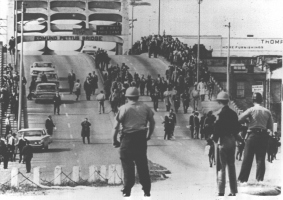
Birmingham, Alabama – Summer, 1965

I have rarely spoken about it, even to my wife or my sons, but I had a minor intersection with a turning point in American history in Birmingham, Alabama, in the summer of 1965.

Birmingham was then known as “Bombingham” and was the epicenter of civil rights demonstrations that began in 1963. Some of us can recall the vivid television images of Sheriff Bull Connor’s police dogs facing down thousands of protestors of high school age, Bloody_Sunday-officers_await_demonstratorsthree thousand of whom were arrested in 1963; the arrest of Martin Luther King and his writing the Letter from Birmingham Jail; the bombing of the 16th Street Baptist Church on September 15, 1963. Partly as a result, the first important civil rights act of the twentieth century under President Lyndon Johnson was passed on July 2, 1964. It was much debated in my senior year in high school. These events led to the march from Selma to Montgomery from March 7 to March 25, 1965, especially the “Bloody Sunday” at the Edmund Pettus Bridge, which was commemorated this year.

Eight weeks after the march, I spent twelve weeks working in Birmingham: June, July, and August of 1965. That was fifty years ago. I was nineteen. I came from Brooklyn, New York. I had attended a Catholic high school seminary for the Passionist religious community in upstate New York, in Dunkirk, right on the shores of Lake Eire. I graduated in May, 1964. For college seminary, I went to Holy Family Seminary in West Hartford, Connecticut. As a freshman on the debate team in October, 1964, I argued for the election of Lyndon Johnson as President—Viet Nam was barely on the horizon.

In March, 1965, at the time of the Selma to Montgomery march, I was tutoring a classmate, Larry Ryder, in Latin. He was a proto-hippy, before there were hippies. He had no family and had toured the country on a motorcycle. He felt free to do what he wanted when he wanted. He lasted only one year in the seminary. He mentioned to me that he was going to Birmingham when school let out at the end of May—he had answered an ad in the National Catholic Reporter for seminarians to help out for twelve weeks for the North Alabama Missions—-street preaching and voter registration. I thought it sounded like fun and would be interesting to do before getting much further along in the seminary. I too answered the ad and was welcomed to come.

In 1961, my family had moved from New York to Houston, Texas. I had not made the move to Texas because I was going to a boarding high school. I got back and forth from New York and Connecticut to visit Houston by Greyhound bus—planes and trains were too expensive. It took forty-nine hours from NYC to Philadelphia to D.C. to Richmond to Atlanta to Birmingham to Jackson to New Orleans to Houston. I had been in Birmingham six times, but only at the bus station in a seedy section of town.

Let me say something about Alabama. It has four regions. (1) The coastal plain around Mobile on the Gulf of Mexico. Its main industries were ship-building and farming, somewhat of an extension of Florida. There were very few Catholics, but most of those in the state were in this region, and a lot of blacks. The fictional town described in Harper Lee’s To Kill a Mockingbird was there. (2) The black belt was around the state capital of Montgomery, so-called because of the black soil, but also because of the large number of blacks that lived there. This had been cotton plantation country. (3) The north Alabama hill country, with very few blacks, was really an extension of Appalachia and of eastern Tennessee. Culturally, it was similar to West Virginia, not as obsessed with race like the rest of Alabama. It had almost no Catholics except for a few in Huntsville, home of rocketry research. One county in the hill country where I worked had even seceded from Alabama at the beginning of the Civil War! (4) Birmingham was Alabama’s largest city at the edge of the hill country, a steel and iron town. It had large ghetto neighborhoods. Churches were everywhere. Birmingham claimed to be the most Protestant city in the United States. Catholics were less than 1%, with separate churches for whites and blacks.

The mission of the North Alabama Missions was three-fold: (1) to serve in little chapels, small groups of white Catholics scattered forty to fifty miles apart in the north hill country; (2) to serve the black Catholics of Birmingham; and (3) to make converts to Catholicism, especially among blacks. There was also, for 1965, a summer project to increase the number of registered black voters in Birmingham. Fr. Foster, a priest from Brooklyn, was in charge, along with three priests from Ireland and one deacon who was working on the early history of the Church in Alabama. For the summer project, there were eight seminarians—me and Larry Ryder from Holy Family Seminary, three major seminarians from the LaSalette Seminary in Fall River, Massachusetts, and three college seminarians from Queens, New York. We divided the day in three—in the mornings we moved from house to house helping blacks to register to vote—in the afternoons we were renovating an old country store about twenty-five miles north of Birmingham into a small chapel; serendipitously it was called the Mount Zion Delicatessen; so we called the chapel, Our Lady of Mount Zion Chapel—in the evenings we did street preaching in the black neighborhoods of Birmingham.

For our morning walkabouts, we wore black pants, white shirt, and black tie, going separately from house to house in the black neighborhoods. We were taken to be Mormon missionaries, or Jehovah Witnesses, or even insurance salesmen. The police took no notice of us and left us alone. There was always someone in each house, mothers and lots of kids, but no men. The television always seemed to be tuned into The Lucy Show or The Price Is Right. Each morning, we would find some who wanted to register, often eighteen-year-olds. Many were very reluctant to register to vote. The voting act of 1964 allowed mail-in registration to prevent the intimidation of blacks by white election officials. Those reluctant did not want their names on our list. It was always very hot and there was no air conditioning. At night, we lived in a renovated chicken coop. Once a week, on a rotating basis, two of us would stay home to clean and make lunches, usually BLTs. In the afternoons, we spent most of the summer ripping apart the old country store. I was good at that.

There were very few Catholics in the area, but some had begun to move in from up north. These tended to be wealthy upscale professionals, doctors and lawyers, with white nannies from Europe. They were also Republicans when Republicans were very rare. I met a Catholic Republican woman who had been elected justice of the peace in the Barry Goldwater sweep in November, 1964. Few knew then that they were the wave of the future for Alabama. Democrats were native white Alabamians, very segregationist, very racist, and very anti-Catholic as well. Blacks who were not yet voting in significant numbers had no role in either party. The small number of native-born Catholics kept a low profile. However, religious sisters were visible in their habits teaching in grammar and high schools [not yet desegregated] and serving at the Catholic hospital. The Catholic hospital was perhaps the most integrated place in all of Alabama with the exception of the army bases. White and black doctors and nurses worked there side by side.

One day, we had lunch with the legendary Bishop Toolan who had come to Alabama in 1927, a time when it was not a pleasant thing to be Catholic in Alabama. In the 1960’s he had gotten a lot of negative publicity from Catholics around the country because he had disapproved of the use of black children in demonstrations in 1963 and 1964, and again in 1965 because he did not want Alabama Catholic priests and sisters to participate in the Selma to Montgomery march. He commented that the out of state Catholic priests and sisters who had marched were all from up north and all had gone home when the march was over. His people had to stay and live there in difficult circumstances. He also had just invited Mother Angelica’s community to his diocese. I remember a joke he told. “Do you know why Governor Wallace has banned the sale of Maytag washing machines in Alabama? Because inside of each washing machine is a black agitator!” Bishop Toolan had also supported, but did not sign, “A Call for Unity,” a statement from eight Birmingham white clergymen asking for black patience and for the cessation of civil disobedience. Martin Luther King, of course, answered this with his famous Letter from Birmingham Jail.

At the end of August, Larry Ryder and I took the bus from Birmingham to New Orleans. We spent a day there because Larry wanted to speak with strippers and find out what made them do what they did. Bourbon Street in 1965 was a very raunchy place, even in the mornings. There were plenty of strippers. Innocent as I was, I was very shocked. At the end of the day we got a bus to Houston. At home, I slept for almost fifteen hours. When Larry told my father what we had been doing, my father was disturbed because I had told him that we would do nothing in Birmingham that had anything to do with politics, or that was dangerous. Larry then shocked my mother a day later when he left. He went out to Interstate 10 and started to hitch to San Francisco. My mother offered him bus fare, which he declined. She did load him up with sandwiches, though. A year later, I heard that he was in Haight-Ashbury, San Francisco, which was the center of the newly emerging flower power movement. I saw him once more in 1967, and have never heard from him again.

Takeaways: what did I accomplish and what did I learn.

  1. I signed up about forty to fifty new voters.
  2. I never personally saw anything that was threatening or dangerous.
  3. I practiced street preaching about six times. I was not very good and was very dull. The black kids wanted to touch my hair, so I asked to touch theirs.
  4. I helped make one convert to the Catholic Church. We used a book from the Knights of Columbus called Father Smith Instructs Jackson.
  5. I met Bishop Toolan, a historically important Churchman in the South from 1927 to 1969. His secretary was Fr. Oscar Lipscomb who later became the archbishop of Mobile. Fr. Foster retired back to Brooklyn in 1989. I don’t know what happened to any of the seminarians.
  6. From 1982 to 1998, my wife MaryAnn and I lived in New Orleans, and had a very different experience of the American South.
  7. In 1998, we moved to Maine, the state in the United States with the highest percentage of whites. The College has a higher percentage of African Americans than Maine does. Many of the blacks here at the College come from New York and Brooklyn, my hometown.
  8. Finally, I would recommend that we all should know how our own history fits into the bigger histories of our time.

Daniel Sheridan is Professor of Theology at Saint Joseph’s College and former Director of the Online Theology Program.