Today is the memorial for St. Charles Borromeo, a patron saint of catechists. St. Charles 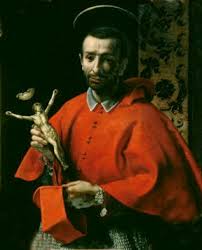 was a bishop during a period of confusion in the history of the Church. He was the archbishop of Milan from 1564 to 1584 while the Protestant Reformation was still young. But St. Charles sought to teach the truth. He was instrumental in the creation of the Confraternity of Christian Doctrine, what would later be called the C.C.D. In order to teach the Faith effectively St. Charles believed that it was incumbent on Catholic Christians to live the Faith that they were preaching. During a famine in Milan he is said to have fed about 3000 people daily for three months (Lives of the Saints 364). On the memorial of this great saint let’s reflect on what Pope Francis can teach us about being a catechist.
In a Mass to celebrate catechists, Pope Francis described the vocation of a catechist as someone who keeps the memory of God alive. The catechist invites others to reflect on God’s presence in their lives. The pope stated,
“A catechist is a Christian who puts this remembrance at the service of proclamation, not to be important, not to talk about himself or herself, but to talk about God, about his love and his fidelity – to speak and to transmit all that God has revealed, i.e. the teaching of Christ and His Church in its totality, neither adding nor subtracting anything” (Pope Francis, Mass to Celebrate Catechists 2).
The catechist speaks about God. You might be thinking: “No, really? Thanks for the tip!” But how often do we invite others to encounter the living God? “Jesus Christ loves you; he gave his life to save you; and now he is living at your side every day to enlighten, strengthen and free you,” is the simple kerygmatic message that Pope Francis proposes (Evangelii Gaudium 164).
This brings us to the second point of what Pope Francis said. A catechist does not add or subtract anything from the teachings of Christ and His Church. A catechist will often have to teach on sensitive issues; the issues cannot be ignored. The pope has spoken out publically on many hot button issues. While speaking in the Philippines the pope warned about “ideological colonization.” He went on to warn: “The family is also threatened by growing efforts on the part of some to redefine the very institution of marriage, by relativism, by the culture of the ephemeral, by a lack of openness to life” (Pope Francis, Speech for Meeting with Families, January 16, 2015).
The pope was calling to mind that marriage is between a man and a woman, a point he raised again in his homily at the opening Mass to this year’s Synod of Bishops. The pope also has described the importance for husband and wife to be open to life. “Openness to life is the condition of the Sacrament of Matrimony. A man cannot give the sacrament to the woman, and the woman give it to him, if they are not in agreement on this point, to be open to life,” he said in an in-flight press conference. But Pope Francis also quipped that Catholics do not have to “be” (insert: breed) like rabbits to be “good” Catholics. Rather they should exercise “responsible parenthood” (cf. Humanae Vitae 16; CCC 2368).
After his visit to the US, on his flight back to Italy the pope reaffirmed “…a sacramental marriage is indissoluble. This is not something the Church can change. It is doctrine; as a sacrament, marriage is indissoluble.” Finally, in the pope’s 2015 encyclical, he stated: “Since everything is interrelated, concern for the protection of nature is also incompatible with the justification of abortion” (Laudato Si 120). We are not being consistent if we express a desire to care for the environment but do not respect human life from conception until natural death.
Pope Francis has taught these Church teachings as we would expect any pope to. He has also surprised many people by his desire to speak and live the truth in love (cf. Ephesians 4:15), something St. Charles did well. From these two men we learn to have compassion for the people we catechize. This means that we will “suffer with” them (Latin compassio) and accompany them on their journey:
“I remember when Saint John Paul II said: ‘Error and evil must always be condemned and opposed; but the man who falls or who errs must be understood and loved… we must love our time and help the man of our time’ (John Paul II, Address to the Members of Italian Catholic Action, 30 December 1978). The Church must search out these persons, welcome and accompany them, for a Church with closed doors betrays herself and her mission, and, instead of being a bridge, becomes a roadblock: ‘For he who sanctifies and those who are sanctified have all one origin. That is why he is not ashamed to call them brethren’ (Heb 2:11)” (Pope Francis, Homily at Mass to Open Synod).
The catechists and the rest of the Church’s faithful (CCC 3) must serve as that bridge to an encounter with Jesus Christ. It’s essential to “meet people where they’re at.” But we don’t leave them there. We accompany them on the journey as we respond to the universal call to holiness together.
St. Charles Borromeo, pray for us.
Edward Trendowski teaches marriage and family ministry courses at Saint Joseph’s College Online.