
The Human Family

We are social beings.  Granted, we require varying amounts of solitude and privacy, but we are “wired” to experience (and need) our bonds with others.  Our kinship with family and our relations with friends extend our arms to embrace the world beyond our immediate environment.  Our instinct to be and create community is so much a part of what it means to be part of the human family.  With the rest of the world, I was horrified by the terrorist’s attacks in Paris. I was, however, edified by the love and humanity that was expressed by people of good will around the world.  “Je suis Paris” seemed to appear everywhere.  What a beautiful expression of global community!
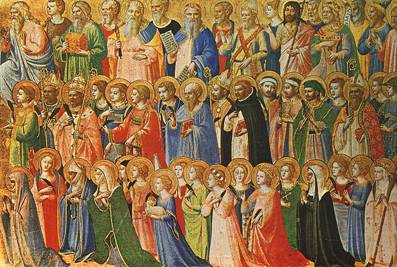
comm_of_saints1We are a human family, a community.  For me, as a Catholic Christian, it is a natural association to consider how my Faith lifts me and guides me.  I love the Liturgical Year and its rhythmic interfacing with the natural seasons.  The month of November, which is dedicated to the Holy Souls, invites us to remember our place in the entire human community…the Communion of Saints.  In my youth, I was introduced to the Church as all the living and the dead: The Church Triumphant, those with God in Heaven; The Church Suffering, those being purified and readied for entry into Heaven; The Church Militant, those on earth still struggling to embrace their holiness in life.

Maybe it’s the connection of the rhythm of the seasons to the embedded metaphors of Robert Frost.  Maybe it is woven into my training as an academic and a catechist.  Whatever the context, I know that it is the beauty of late fall that draws my heart to themes of redemptive suffering and the ebb and flow of dying and rising.   As I walk along the dirt road near my house or through the woods adjacent to the road, I am celebrating and remembering all holy men and women and the lives and souls of the just. These special days of remembrance, All Saints and All Souls and the entire month of November, are an invitation from the Church’s liturgical calendar to enter into that spirit and celebrate Community.

In my role as instructor of Theology at Saint Joseph’s, I am frequently honored and humbled by the personal sharing of my students.  So many of them have suffered almost unbearable wounds.  Some carry lingering questions about the purpose and meaning of their suffering.  While meditating on the Crucifixion, or the entire Stations of the Cross, one can be touched by the ineffable truth and value of suffering.  God’s good grace with our tenacious will can wrestle meaning and purpose from anything.  I’ve recommended Victor Frankel’s “Man Search For Meaning” and Rabbi Harold S. Kushner’s “When Bad Things Happen to Good People.”  I have often sought comfort in a prayerful, meditative reading of the Twenty Third Psalm.  The month of November offers a beautiful opportunity to enter into the heart of the Church and rejoice in the graces that the trials of life offer us.

As members of the Communion of Saints, let us offer our prayers for those who have died…

Eternal rest grant unto them, O Lord, and let perpetual light shine upon them.

May their souls and the souls of all the faithful departed

through the mercy of God rest in peace.

Amen

Susan O’Hara teaches theology for Saint Joseph’s College.

Home, Home Within Range

During his recent visit to St. Patrick Catholic Parish in Washington, D.C. Pope Francis spoke to a group of homeless men and women. “We can find no social or moral justification, no justification whatsoever, for lack of housing.” If the Pope is right that there is no justification for homelessness—or to put the same thing differently, if the homeless have a right to a home—then there must be an obligation to provide them with homes.

The promotion of social justice requires creativity as well as healing. Our efforts to heal are often ad hoc and temporary—what we often call “charity”—not because of ill will but because we don’t know what else to do. But that’s where creativity must enter. I have noticed that Pope Francis has referred several times to the need for creativity in solving problems: at least 17 times in the apostolic exhortation Evangelii Gaudium and 22 times in Laudato Si, the encyclical on the environment and poverty. Here’s one example: “Human creativity cannot be suppressed. If an artist cannot be stopped from using his or her creativity, neither should those who possess particular gifts for the advancement of science and technology be prevented from using their God-given talents for the service of others” (Laudato Si # 131). Everyone is able in some degree to participate in social and economic life, but without a home, the capacity for that participation is severely reduced.

Thanks to a creative social scientist from New York University, there is a method for reducing homelessness that has already proven itself a practical success. As with many solutions, it is startlingly simple: give the homeless homes first—and then offer them free health care, counseling and an income.

The social scientist at NYU is the psychologist Sam Tsemberis. He introduced a new model for helping homeless people. The old model was essentially to prepare homeless people for housing. That meant getting them healthcare and needed treatment as well as leading them through the maze of red tape required to receive services in order to be home-ready. But many of the homeless have problems that make that preparatory phase for getting a home very difficult and so many do not get thorough the process. Tsemberis’ simple but creative idea was to reverse the sequence of events: give them a home first, then work on providing for their other needs. “Why not just give them a place to live and offer them free counseling and therapy, health care, and let them decide if they want to participate? Why not treat chronically homeless people as human beings and members of our community who have a basic right to housing and health care?” Tsemberis recognized that “[g]oing from homelessness into a home changes a person’s psychological identity from outcast to member of the community….You actually need housing to achieve sobriety and stability, not the other way around.”

It worked. Tsemberis tested his hypothesis with 242 individuals and after five years, 88% were still in their homes. In fact, it worked so well that several cities adopted this “Housing First” approach and found significant success. With the help of the Mormons, the state of Utah adopted the model and in the process provided relief for strained social service resources. All of the communities across the nation that have adopted this model have saved money on publically financed social services by providing homeless people homes.

Creative projects such as “Housing First” are not one-way streets, the advantaged helping the disadvantaged. To be itself, to continually constitute itself anew in history, the Church must seek out and embrace intelligent solutions wherever they are to be found, while encouraging the larger society of which it is a part to do the same. Pope Francis again: “Any Church community, if it thinks it can comfortably go its own way without creative concern and effective cooperation in helping the poor to live with dignity and reaching out to everyone, will also risk breaking down, however much it may talk about social issues or criticize governments. It will easily drift into a spiritual worldliness camouflaged by religious practices, unproductive meetings and empty talk” (Evangelii Gaudium 207). All communities risk breakdown if they do not bring their best research and thinking to bear on the needs of their fellow citizens.

Moral decision-making and action require more than good will; we all know how the surface on the road to hell is paved. Promotion of the common good requires intelligent and creative solutions. Wherever intelligent solutions are to be found, well-intentioned Christians should seek them out and cooperate with those who are already implementing them.

David Hammond teaches theology and church history for Saint Joseph’s College.