Think about how many times you’ve worried and fretted over a particular problem or situation in your life. Think about the hours spent in prayer asking God for your desired resolution. Think about those times when your prayers were answered and things seemed to fall right into place. Now, think of the times when your prayers went unanswered, where you felt as if God was quiet, distant, and unmoved by your supplication. Dreams fulfilled and hopes dashed: this is the drama of our human experience, and the test of the Christian life. But the Christian life is not only about how we respond to the obstacles and real suffering in life, but how we handle God’s response to us.
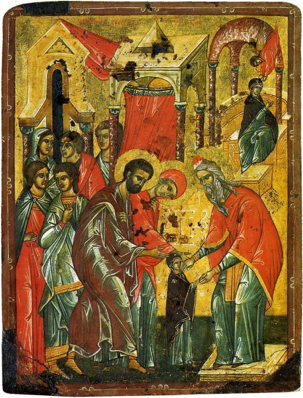
For the better part of their marriage Anna and Joachim suffered through the terrible mystery of unanswered prayers. Longing to be parents and desperate to fulfill their duty to God’s Covenant, the couple prayed fervently and faithfully. Month after month, then year after year, God was silent. With the passage of time Anna must have felt her chances of conceiving grow slimmer. Still she and Joachim praye d, and cried, and undoubtedly wondered just what God was up to, and what He might be asking of them. The apocryphal Protoevangelium of James tells of the unexpected moment in which God broke His silence through the message of an angel: “Anna, Anna, the Lord has heard your prayer….” Anna conceives a daughter, whom she is told will be “spoken of in all the world.” In their shared joy, the couple promise God that the child will be dedicated to Him. They are overwhelmed with gratitude and the realization that this child is not a possession to which they can greedily cling, but a gift to be offered in return to the generous Giver. The child is born and called Mary, and she is loved and cherished. When she is three years old, Anna and Joachim make good on their promise and take little Mary to the Temple. Having waited so long for her, this decision cannot have been an easy one for the couple. Nor was it one mandated by God; He did not make their return of the child to Him a condition of His blessing. So great was their love for Him, and so well did they trust Him, that Anna and Joachim repaid His faithfulness with their own.
Once the child had been weaned, at the age of three, Anna and Joachim brought her to the Temple to be raised by the priests, schooled in faith, and to grow into a daughter of God. The Proto-gospel observes that when Mary is given away by her parents the Priest “set her down upon the third step of the altar, and the Lord God sent grace upon her; and she danced with her feet, and all the house of Israel loved her.” This is a peculiar statement, and one we may be tempted to dismiss as a shade of the esoteric in a “gospel” not even included in the biblical canon (though the Protoevangelium does enjoy a special place in the Tradition.) But it’s a mistake to simply discount this strange idiom because it offers us some insight into that mystery of prayer, and God’s attention to our distress, with which we began. The little child Mary, unaware of prayers and prophecies  and angel visitation (only of her parents’ love and their devotion to God), entrusts herself to the Priest and is content where he places her. The third step may or may not have theological meaning, but perhaps it can serve as a symbol for us of God’s providence. In our expectation, our moments of fear and anguish, and in our fervent supplication, God hears – He knows – and He sets us down right where we’re meant to be. Maybe it’s not always where we want to be, but it’s the place where He can love us and remind us that we are His children. Whatever the “third step” is for each of us, it can become a place of gratitude, a moment to surrender our pride and our fear, and to just “dance with our feet.” This little Mary, innocent of what this moment on the third step would mean for her life going forward, simply delighted in being where God placed her, and she danced. Perhaps the lesson from Mary’s response – the one her parents learned in praying to receive her and then letting her go – is that whatever our journey, wherever we land, God is always with us. He is quietly by our side – though too often we don’t recognize His presence, probably because we’re too busy making our own noise to hear His voice. But God does hear us. He knows our fears and our desires and our longing. God knows what is good for us, and how to make even the most difficult circumstances into opportunities for grace. More than anything God wants to see us dance with our feet. Are we willing to stand on the step where we’ve been set down and be His partner?
Ann Koshute teaches theology for Saint Joseph’s College Online.
 Prayer. Sometimes we make it so difficult. I am not sure why. Maybe we think it needs to be very formal or formulaic? I know that I thought that for a very long time. There is certainly a place for formal prayer, be it communal, such as during the Mass or the Liturgy of the Hours or even private, such when use a formal written prayer. In fact, we Catholics have a love affair with our prayer cards, books, and other sacramentals, including candles, statutes, and icons. This is an excellent thing because “they prepare us to receive grace and dispose us to cooperate with it” (Catechism of the Catholic Church, n. 1670). They are, though, simply means, not ends in themselves. Means to a conversation with God or maybe more precisely, a dialogue. We might not consider it a dialogue. Fervent prayer, ardent prayer, in the way that Pope Francis is calling for is an on-going dialogue with God throughout our day, an awareness of the action and activity of the Holy Spirit permeating our lives. It is a seeking for God and finding God in all things, in every moment and in every place. St. Teresa of Avilaencourages us to be seekers of God and St. Ignatius of Loyola calls us to “find God in all things.” St. Vincent Pallotti puts the two aspects together, as was often his way, and challenges us to: