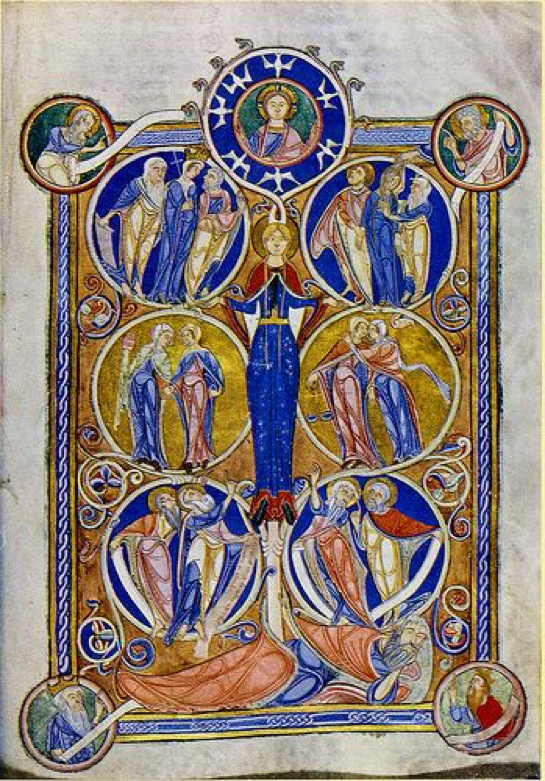
Advent, a season of special grace, is a time set aside to prepare to receive Jesus more fully at Christmas. Advent is about readying one’s heart to cradle the One who will be born anew when the Nativity feast is celebrated once again. Advent is a time of hopeful expectation that Jesus will heed one’s ardent longing that He abide more completely within oneself. If one’s desire for Jesus is great, one’s whole being will become centered in the joy that will accompany His renewed birthing in one’s life. Thomas Merton reflects: “What joy is ours when we find Jesus, the sunshine of the universe. Heaven and earth kiss in Jesus. Jesus is God’s smile on the earth.”[i]
 According to Merton, Advent is a graced period of time when a person can choose to begin to end all that is not Christ-like in his or her life. Contemplating Advent as a season of seeking greater wholeness of living in Christ, Merton writes:
I begin to live in Christ when I come to the ‘end’ or to the ‘limit’ of what divides me
from my fellow man; when I am willing to step beyond this end, cross the frontier,
become a stranger, enter into the wilderness which is not ‘myself,’ where I do not
breathe the air or hear the familiar, comforting racket of my own city, where I am
alone and defenseless in the desert of God. [ii]
In his writings, Merton considers Jesus’ three advents as discussed by Saint Bernard of Clairvaux, the founder of Cistercian monasticism. In the first Advent, the Logos became incarnated in this world ad homines, that is, in order to redeem humankind. Merton notes that, according to Saint Bernard, the virgin Mary’s role in the incarnation is central, since in and through her humanity God chose to enter into our world.
For Saint Bernard, the second Advent is in homines, which means that, through grace, God takes up residence within a person. Regarding this, Merton comments: “Christ comes to us, really gives Himself to us, so that we already possess our heaven in hope.”[iii] During this Advent time, one creates a sanctuary in one’s heart for the Word of God; one grows in humility and makes every effort to use one’s energies to do God’s will.
In his writings, Merton explores Saint Bernard’s third Advent as Christ’s final coming contra homines when He will return to Earth to judge the living and the deceased. According to Saint Bernard, this Advent will occasion Christ making manifest negative judgment on those persons who rejected His saving grace during their earthly lives and positive judgment on those who, in life, were receptive to His salvific grace.
In his work entitled The Nativity Kergyma, Merton provides an exquisite meditation on the meaning of Jesus’ birth. Merton reflects that the Savior’s nativity proclaims His initial historical presence but also His continued epiphany in the now moment. Each Christmas, Christ is born in new ways to be Light and Life in believers’ lives. Jesus’ ardent desire is that His light shine in and through His followers’ works of love of others. In this way, He is able to advent continually in the lives of multitudes of people.
Reflecting on the reality that long ago God chose to empty Godself to be born as a child in the village of Bethlehem, Merton writes:
The Child that lies in the manger, helpless and abandoned to the love
of His creatures, dependent entirely upon them to be fed, clothed, and
sustained, remains the Creator and Ruler of the universe. … He wills to
be helpless that we may take Him into our care. He has embraced our
poverty … in order to give us his riches.”[iv]
The Nativity Child, the God of earth and sky, paradoxically was born in a lowly stable. The poverty that surrounded Jesus’ birth marked the rest of His life wherein He experienced humiliation, insult, opposition, and, finally, rejection that led to His being executed by means of a horrific crucifixion.
For Merton, the message of the Nativity is gaudete: Rejoice for the Lord who suffered death is risen and is truly near! It was John the Baptist who heralded the advent of Jesus’ salvific ministry. Today, Christ’s followers are called to carry forward the Baptist’s mission and to trust that Christ’s continued saving advents in time will eventually give way to an everlasting Christmas when those gathered around the resurrected Christ will feast at the banquet table of eternal blessing.
Sr. Marilyn Sunderman, R.S.M., teaches theology at Saint Joseph’s College.
[i]Thomas Merton, Unpublished: “Advent Reflections, 1st Sunday of Advent,” 4. Accessed in the Saint Joseph’s College Merton Collection.
[ii] Thomas Merton, Seasons of Celebration (New York: Farrar, Straus and Giroux, 1965), 95.
[iii] Merton, Seasons of Celebration, 77.
[iv] Merton, Seasons of Celebration, 109.