Purgatorio, Seinfeld, Saint Francis and Freedom

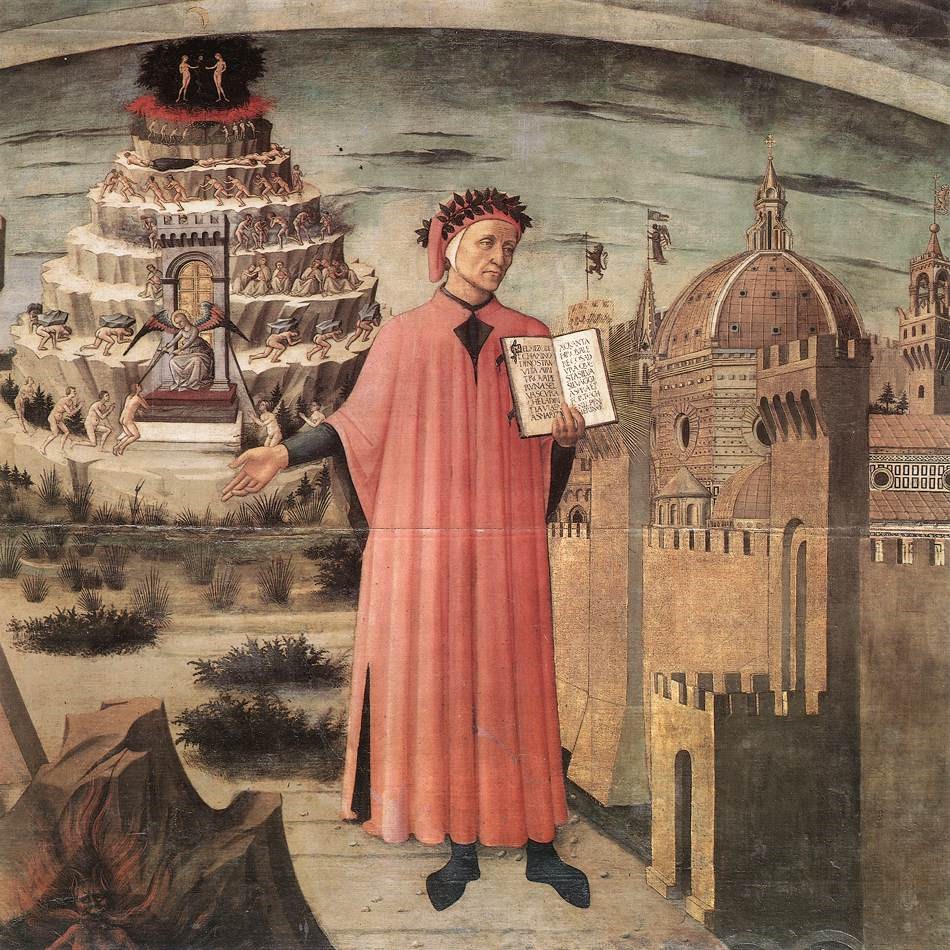
The Divine Comedy is a comedy not merely because it has a happy ending (as distinguished from tragedy) but also because it celebrates the joy of life, even in the midst of its many tragedies. For Dante, one must never show disrespect for the Creator by failing to see the beauty and joy in life itself. In heaven, for example, Dante will dwell on the new religious orders called “mendicant”—they were considered the “clowns of God” because they had, through their poverty, freed themselves to enjoy the beauty and playfulness of creaturehood. Dante presents Francis as publicly marrying Lady Poverty. But this means that Francis marries nothing—he owns nothing and is married to nothing. But the divine irony is that he thereby achieves the freedom to love the entire world.

I can’t help but think of the way it contrasts with the Seinfeld show, which as you know was “about nothing,” yet that’s the goal of the show: nothing. An appropriate goal for a sitcom, of course, but while the show is not about anything, Francis’ marriage to the nothingness of Poverty is for the sake of the love of everything. But in order to love the world, Dante says, we must be liberated from the obsessions and attachments and sins that enslave us. One way of illustrating this basic theme of desire is to contrast Milton’s Satan and Dante’s. Milton’s Lucifer is full of hot anger; he furiously rages against God. For the Calvinist Milton, desire is hatred and a manifestation of sin. Dante’s Satan, on the other hand, is completely passive, cold, and indifferent. He lacks all desire, stuck in the frozen lake of Dis. Even his tears are frozen. He is a parody of Christ, his reverse. He is all about cold revenge and hatred, and he is completely unattractive. Milton’s Satan is at first somewhat attractive because of his passion—at least he cares about something!

The theological background here is the ancient notion that evil is a lack, a deprivation of the good. Just as blindness is a lack of sight, so evil is a lack of the good. Hatred is a lack of love; murder is a lack of respect for life. For Dante, to be sure, love and desire can go wrong in at least three ways: it can be defective (sloth), excessive (greed) or perverted (anger). Still, indifference or spiritual indolence hobbles the desire of the heart. As he climbs Mount Purgatory, the pilgrim and all those climbing the seven story mountain become lighter and movement becomes easier. The desire for God is liberated through humility and gradually the divine image in humanity restored, and more. Saint Francis’ poverty is fullness; Seinfeld’s “nothing” is…? Well, at least we should never underestimate our need to laugh at our foolish egos.

David Hammond teaches theology and church history for Saint Joseph’s College Online Theology Programs.
Transformation in Christ

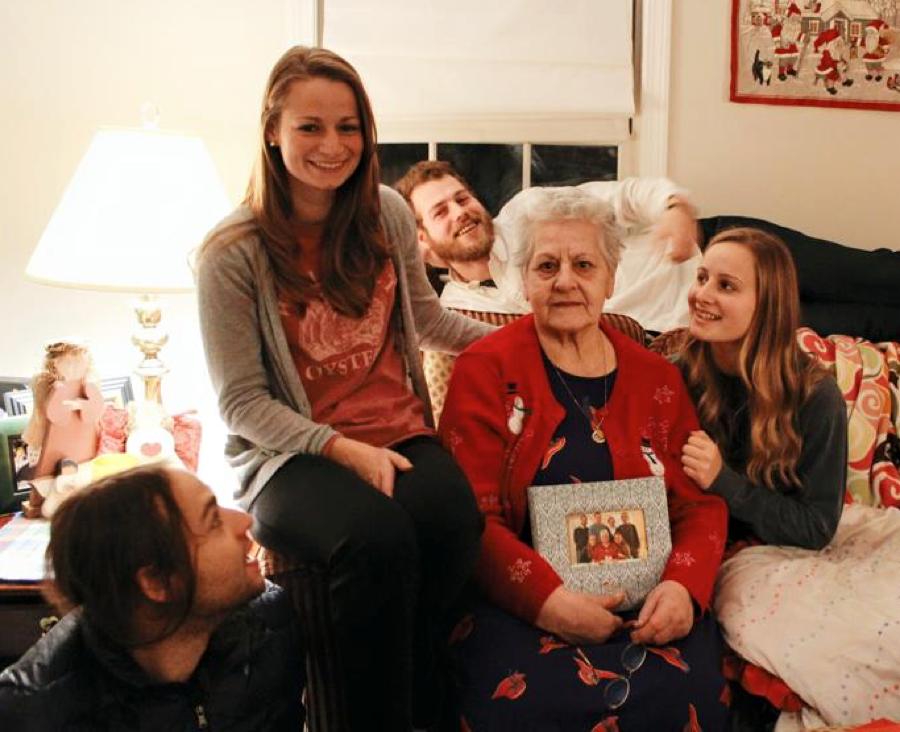
Christmas is exceptionally hard for my family and me this year. We have death on our minds or, rather, the painful longing for a loved one who, although a nonagenarian, was, for us, taken much too soon in 2016. At ninety-one, my mother Mimi Sodano was, in a true sense, the heart of the family—more a “second mother” to my four grown children than a grandmother. She lived with us, and she expressed her love most vibrantly in the sumptuous meals she prepared for us nearly daily.

Advent and Christmas were writ large in Mimi’s mind. The daughter of Italian immigrants, she started preparing for our traditional Christmas Eve “feast of seven fishes” the day after Thanksgiving. She wrote long lists of grocery items and, since we moved to Maine from New Jersey several years ago, sent one or more of the grandkids on road trips to Boston to pick up the Italian seafood delicacies that are nowhere to be found in Maine. Seven is a relative number when it comes to the fish, as we stopped counting at fifteen dishes and nine different fish one year.

Christmas Eve at the Sodano-Ireland household was a regular Babette’s Feast, with Mimi spending seemingly endless prep days of relentless toil and extravagant spending—tremendous sacrifices for a woman living on a fixed income and in constant pain from severe arthritis. Her doctor couldn’t figure out how she could function, let alone walk, cook, clean, mend, sew, and serve like someone half her age. We used to think it was because she had a high threshold for pain, but on her deathbed we knew for sure that she worked so hard because she felt most fully alive when she sacrificed for others. She knew that “suffering is a key to the meaning of life.”*

Suffering doesn’t just refer to physical pain. Suffering—redemptive suffering, broadly speaking, is any sacrifice of oneself for love and for the betterment of another. The late John Downs, who was paralyzed in an accident in his teens, relates the deep and life-giving meaning of suffering:

Suffering without God can crush and destroy. Suffering with Christ can redeem and create. When the Second Person of the Holy Trinity became Man and took on a human body so that He could suffer, human suffering was transformed. It became an instrument for good, both for the individual and for the world at large…

One of the mysteries of life is that suffering is the divinely-chosen means of enabling human beings, wounded and handicapped by original sin, to rise above selfish inclinations and to live, by God’s grace, more fully human lives. It is only in the acceptance of suffering, in the spiritualization of suffering, in the uniting of one’s sufferings with those of Christ, that one can discover the secret to true happiness. Human nature recoils at this reality. But has not God “chosen the weak and foolish things to confound the strong and the wise?” (1 Cor. 3:18).

Indeed, suffering, in and of itself, is not good and serves no useful purpose. It is that which transpires in a human being who suffers that is of paramount importance and value… Only in the mystery of God Himself will we begin to understand how the suffering caused by original sin has been transformed into a blessing by means of the Redemptive Cross of Christ.*

benedetto-adoration

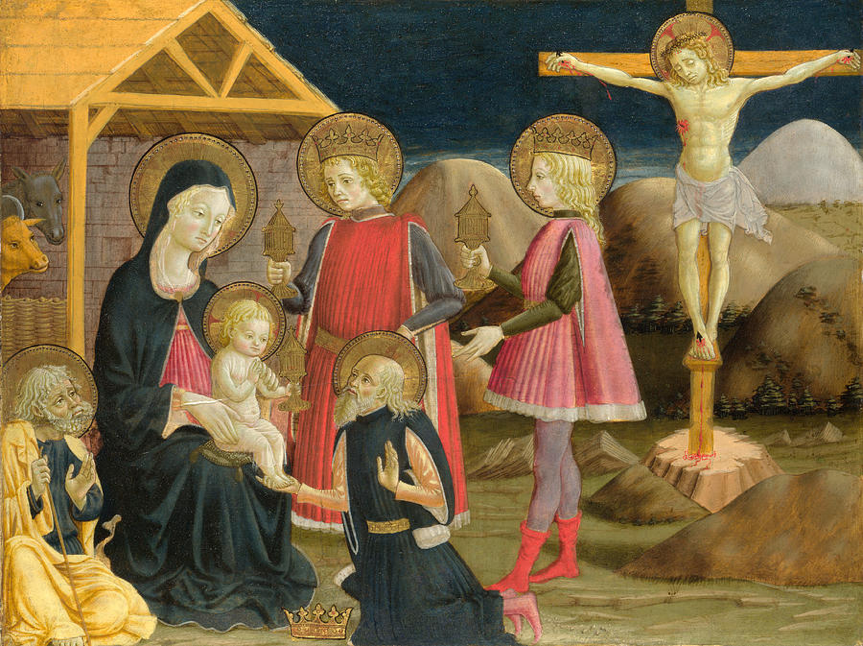
The Adoration Of The Kings And Christ On The Cross, by Benedetto

St. Athanasius instructs us on the meaning of the Incarnation: God became man so that man may become God. Of course, we are not God in our nature, but we are divinized through grace. We are graced through Christ’s suffering love; that is, we are transformed into His own Image, so that with St. Paul, we can say: It is not I who live, but Christ in me.

This first Christmas without Mimi no doubt will be difficult for the children and grandchildren who loved her so dearly. Yet, we can be joyful even as we grieve, for we experienced first-hand the redemptive power of suffering through the sacrificial way Mimi lived her life for us and for others.  Until her last breath, she sacrificed herself for the sake of the good—the salvation—of others.  

In her last earthly days when she no longer could speak, Mimi would greet us by making the sign of the cross. When she no longer could raise her arm to form the cross, she would mouth the words of the Rosary as we prayed aloud or sang “Ave Maria” to and with her. When she no longer could move her lips, she moved her fingers over the beads clutched in her hand. When she could do none of these, she listened as we each spoke to her of our love and gratitude for the immeasurable sacrifices she made for us.

Although my family won’t be sharing a seven fish dinner or exchanging gifts with my mother this year, we remember the priceless gifts that she gave us—first and foremost, the value of redemptive suffering and sacrificial love—the same gift that Christ gave 2,000 years ago. Merry Christmas!

mimi-et-al

Patricia Ireland is Dean of Undergraduate Studies and Program Director of Online Theology Programs at Saint Joseph’s College.

*John F. Downs, Suffering: A Key to the Meaning of Life (Woodstock, Virginia: Apostolatus Uniti, 1991), Pamphlet.

Blog title taken from Dietrich von Hildebrand’s Transformation in Christ, Ignatius Press.