In case you missed it, there was a presidential election earlier this month. The outcome surprised almost everybody—certainly the “experts,” including theologians—and the aftermath has been decidedly traumatic. What will happen over the next two to four years? Which policies will be reversed and which new ones will be established? Like many Americans, I stayed up late watching the election returns. The national media scrutinized every bit of available data. I found myself learning more about counties in other states 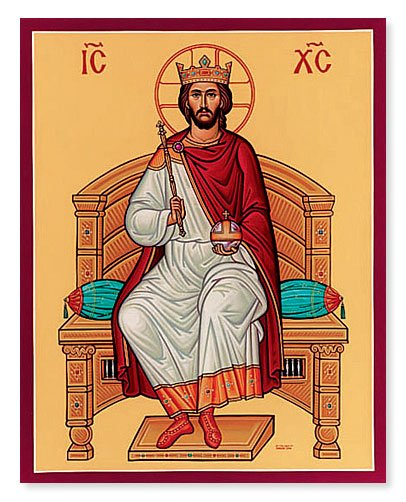 than I had known before. Due to an unavoidably early work schedule, I went to sleep with the election undecided. I woke to a new president-elect, a result very few anticipated. Juggling that news with my regular routine, I ran across a reminder for this blog post’s deadline. A glance at the liturgical calendar told me all I needed to know: today is the Feast of Christ the King.
This knowledge made all the difference as the nation continues to struggle with the election’s aftermath. Before, during, and after any human, earthly endeavor, Jesus Christ is Lord. Stating this does not, despite the Marxist criticisms, relegate one to the realm of naïve spirituality and blithe indifference to the world’s problems. No, God calls us simultaneously to the Church and thus into the world, too. Vatican II states clearly: “God’s plan for the world is that men should work together to renew and constantly perfect the temporal order” (Apostolicam Actuositatem #7). Politics is not some necessarily dirty, utilitarian struggle for hegemony. Rather, political activity along with the whole gamut of economic, social, and aesthetic pursuits can and should foster and advance the good. We need each other to come anywhere near accomplishing that goal.
Here we must always remember today’s feast. Christ’s sovereign kingship transcends the created realm. Our best accomplishments and worst failures occur therein. St. John the Evangelist reminds us: “The Light shines in the darkness, and the darkness did not comprehend it” (1:5). Therefore, regardless of who wins a presidential election or how shocked we are at such results, no human creation—political, social, or otherwise—enjoys ultimate status. We cannot conflate Christ’s reign with our temporary politics. We cannot become, as Rod Dreher puts it, a people who make politics their religion. Christ is king, not us.
This reality holds true forever, of course, but we enjoy this reminder at the very end of the liturgical year. Next Sunday begins Advent, and so once again we prepare for the arrival and birth of that very King we celebrate today. This feast appeared rather late, historically speaking. Pius XI instituted the Feast of Christ the King in 1925. As blogged earlier here, I think Pius XI’s pontificate offers remarkable resources, both spiritual and political, for our twenty-first century reality. This plenitude concerns us especially today:
Pius XI himself recognized the shift [towards secular totalitarianism] in 1925 with his encyclical Quas Primas. Released on December 11, 1925, the encyclical established the Feast of Christ the King, now celebrated on the last Sunday of the liturgical year. In so doing Pius XI returned to his papal motto and asserted Christ’s spiritual and temporal authority (see #s 15 & 17). Christian faith is necessarily embodied, and thus the Church stands in the world, but free from control by the secular state (see #31). The laity especially stand to benefit from meditation upon Christ’s kingship. If Christ died for all, then, Pius concludes, “it must be clear that not one of our faculties is exempt from his empire” (#33). Christ must reign in our minds, wills, hearts, and bodies. Each faculty contributes to both spiritual sanctification and social justice, and serves, Pius XI prays, as evangelical examples to all non-Catholics. The peace that passes understanding, if authentic, moves beyond the individual to include others, not just Catholics but all peoples. After all, each person possesses intrinsic dignity given by God alone.
Christ’s kingship lays claim to our entire selves—and this includes our relationships with all others: marital, parental, emotional, social, economic, political, etc. Today’s readings spell this out in great detail: David’s ascendency, Psalm 122’s celebration of royal Jerusalem, and then St. Paul’s exhortation to the Colossians that Christ
He is the image of the invisible God,
the firstborn of all creation.
For in him were created all things in heaven and on earth,
the visible and the invisible,
whether thrones or dominions or principalities or powers;
all things were created through him and for him.
He is before all things,
and in him all things hold together.
He is the head of the body, the church.
He is the beginning, the firstborn from the dead,
that in all things he himself might be preeminent.
For in him all the fullness was pleased to dwell,
and through him to reconcile all things for him,
making peace by the blood of his cross
through him, whether those on earth or those in heaven.
The Gospel passage from St. Luke (23:35-43) depicts this in the most graphic terms. From the cross Jesus promises the repentant criminal they both will enjoy paradise that very day. Interestingly, the Extraordinary Form readings—the ones Pius XI worked with himself when he declared the Christ the King feast—take a different path with St. Matthew 24: 13-25. After prophesying apocalyptic signs of His return, Christ reassures the disciples: “Heaven and earth shall pass away, but My words will not pass away.” Following this presidential election, this passage might speak to some believing voters more immediately! Exemplifying the well-known Catholic “both/and,” these readings together draw out fully the immanence and transcendence of Christ’s kingship. In proclaiming the Year of Mercy, Pope Francis speaks to this balance:
We will entrust the life of the Church, all humanity, and the entire cosmos to the Lordship of Christ, asking him to pour out his mercy upon us like the morning dew, so that everyone may work together to build a brighter future. How much I desire that the year to come will be steeped in mercy, so that we can go out to every man and woman, bringing the goodness and tenderness of God! May the balm of mercy reach everyone, both believers and those far away, as a sign that the Kingdom of God is already present in our midst! (Misericordiae Vultus #5)
The Feast of Christ the King concludes the Year of Mercy, one in which we have sought to realize our spiritual convictions where we find ourselves. This itself requires mercy, for we will make mistakes. Our sovereign Lord’s presence in the Church and the Eucharist repairs these errors.
God calls us to, and we should always seek, this proper alignment. Then the wins and losses of our lives—personally and politically—regain proper perspective. After the inauguration the nation will see new endeavors and probably others continued from the previous administration. Just as with Obama, the Trump presidency will offer several opportunities to work with all people of good will to build and defend the common good. Sometimes that pursuit will involve cooperating with government, sometimes perhaps not. Regardless, we would do well to remember today’s solemn feast and readings and thereby recognize that only Christ reigns supreme. All other political claims are, ultimately, temporary. To paraphrase St. Thomas More, we are the president’s loyal citizens—but God’s subjects first.
Guest blogger Jeffrey Marlett blogs at Spiritual Diabetes.