After the ferocious winter many of us have weathered, the arrival of Spring and this brilliant month of May has beckoned us outside to dig in the dirt, plant some new flowers, and blow the leaves away while thanking them for keeping the bushes and shrubs warm and protected through the dark, cold days of Winter. In the midst of this and as I gaze up at the glorious blueness of the sky, I find myself in a kind of reverie, remembering the blessings of my Faith and how much I love Our Lady, the Mother of God. It is a joy to remember that May is traditionally dedicated to her.
The first decade of my life was the beautiful Marian Era. To say that Mary, the Mother of God, was a constant presence would not be overstating my experience. I was welcomed into this world the same year as the proclamation of the Assumption by His Holiness Pope Pius XII (Munificentissimus Deus). How profoundly appropriate to proclaim this mystery of faith on the feast of All Saints, November 1, 1950! Then, just a few years later, we observed the celebration of the centenary of the Immaculate Conception (Ineffabilis Deus) proclaimed by His Holiness Pope Pius IX on December 8, 1854. As proud Americans, we claim Our Lady as our particular patron under her title of The Immaculate Conception and celebrate that partonal feast as a national Holy Day of Obligation on December 8th. Our Lady has been so much a part of my education and spiritual development. I was baptized at Our Lady of Peace; educated by the Sisters, Servants of the Immaculate Heart of Mary in elementary school at Our Lady of Charity School; and high school from Notre Dame High which was proudly lead by the Sisters of Notre Dame.
There are so many reminders and observances that give our faith and its practice a special Marian sensibility. Some mistakenly believe that we Catholics are the only ones who revere and honor her. Although there may be a particular affection that we Roman Catholics demonstrate, we surely are not the only ones who love and honor her. Many Christian denominations do honor her and Moslems do as well. She is honored in the Holy Qur’an as the mother of the great prophet, Jesus.
While the so-called golden age of Marian Devotion may be a distant memory from my youth, there are happy signs of a renewal of Marian Devotion. Parishes, schools, RCIA programs, and religious education programs are encouraging May Processions, Novena Devotions, Marian art, Miraculous Medals, and of course, The Rosary. His Holiness Pope Saint John Paul II introduced the Luminous Mysteries in October of 2002, and helped many to rediscover this precious contemplative devotion. October is traditionally dedicated to the Most Holy Rosary and the feast of Our Lady of the Holy Rosary is celebrated on October 7th.
Some of the most magnificent architecture bears her name, for example the Cathedral of Notre Dame in Paris. Our own national basilica in Washington, D.C. is dedicated to her under title of The Immaculate Conception. Even in the secular arena, we find her. No woman has had nearly the number of Time magazine covers. The first one was December 25, 1938 and the latest one on March 21, 2005. There are many, many postage stamps that honor her…(for sports fans, I don’t know if a “Hail Mary” pass or the “Immaculate Reception” counts) .
Finally, Mary, the Theotokos, the Mother of Jesus, is the recipient of so many titles that there are Litanies that list and celebrate her names. She must have been a powerful presence in the course of her earthly life. After all, she is such a presence in our faith, our spirituality now. One might expect that a person like that would have been a powerful speaker and while she may have been, her voice is curiously silent in Sacred Scripture. Surveying the New Testament we find her speaking only seven times, and some of those are different Gospels quoting the same words, while others are really Mary quoting the Old Testament (the Magnificat is Hannah’s Song of Praise). I am reminded of the old expression that “Actions speak louder than words”. One can be heard without words.
The last time we hear her voice in Scripture is at the Wedding Feast of Cana when she turns to the wine steward and says, “Do whatever He tells you”. She always directs us to her son. She always tells us to follow him. For us Catholics, it is our joy to be directed by her to Jesus…Ad Jesu per Mariam (to Jesus though Mary).
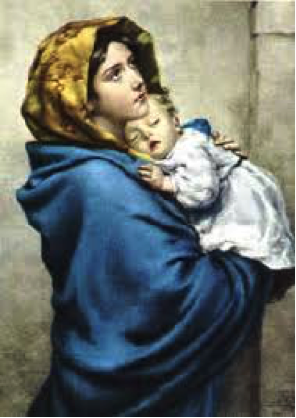 Images of Mary in sculpture, paintings, tapestries abound. I offer you two of my favorites that represent two distinct frames of reference in Marian Theology and they partner similar frames in Christology. The first is Our Lady of the Streets. She is so young and while quite ordinary, she is beautiful. She may be at prayer while she holds her sleeping child. She repents a parallel to Christology from Below or Antiochene Christology which highlights Jesus’ Human Nature.
The second is the icon of Our Lady of Perpetual Help. She is other worldly looking and provides a kind of throne for an alert older Jesus who is regal and who may in fact be speaking to an angel. This image depicts the Christology from Above or Alexandrian Christology which highlights Jesus’ Divine Nature. Marian Theologians argue that Marian Art should always show her 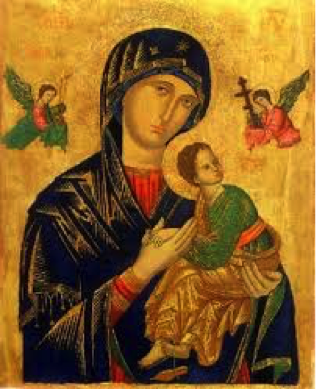 with the Son. Artists don’t always agree and certainly have produced some beautiful art in spite of the disagreement. The Bishops at the Second Vatican Council had their own version of this conversation when they had some difficulty deciding whether Mary should be treated in her own document or placed within the context of another. Of course, famously, the grace-filled compromise was to present her in Chapter VIII of the Dogmatic Constitution on the Church (Lumen Gentium) promulgated by His Holiness Pope Paul VI on November 21, 1965. This, I suggest, places her within the very heart of the Church. The title of the chapter expresses this so beautifully, “The Blessed Virgin Mary, Mother of God in the mystery of Christ and the Church”.
I wish you a beautiful May, a happy Mothers’ Day and I close with the words of the oldest known prayer to Mary, The Sub Tuum.
We fly to thy patronage, O Holy Mother of God, despise not our petitions in our necessities and deliver us from all dangers, all Glorious and ever Blessed Virgin.
Susan O’Hara teaches theology for Saint Joseph’s College Online.