In addition to our regular Sunday posts, Sr. Marilyn Sunderman, RSM, offers a weekly Lenten Reflection on the thought and spirituality of Thomas Merton, to be posted mid-week during Lent.
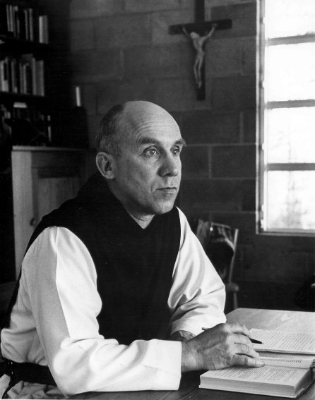 Thomas Merton wrote voluminously about contemplation, which he stresses is part of normal development in the spiritual life. According to Merton, contemplation is the rendezvous between God and a person in which one gazes on God in silent adoration and tastes the very goodness of God. Merton writes: “Contemplation, by which we know and love God as He is in Himself, apprehending Him in a deep and vital experience, which is beyond the reach of natural understanding, is the reason for our creation by God.”[i]
In his writings, Merton emphasizes that silence and solitude are integral to the development of the life of contemplation. The contemplative person belongs to silence and lets it soak into his or her being. In the solitude of silence, the contemplative listens expectantly for and to God and experiences the “presence of the Three Divine Persons: the Father, the source and giver of Love; the Son, the image and glory of Love; and the Spirit who is the communication of the Father and the Son in Love.”[ii]
The contemplative enjoys the first-hand experience of God’s abiding presence in, to, and for all that exists. Regarding this, Merton declares: “There is no awareness like the awareness of the contemplative who suddenly wakes up to the fact that … all of reality is full of God, and that the universe is swimming in meaning.”[iii]
Since God is ineffable Mystery, no quantity or quality of words can ever adequately communicate the fullness of God’s Reality. In Figures for an Apocalypse, Merton insightfully asserts:
Not in the streets, not in the white streets
Nor in the crowded porticoes
Shall we catch You in our words,
Or lock you in the lenses of our cameras,
You Who escaped the subtle Aristotle,
Blinding us by Your evidence,
Your too clear evidence, Your everywhere.[iv]
In and through the intimate experience of God in contemplation, a person comes to know his or her true self. In the following way, Merton articulates the profundity of this truth:
Contemplation is a mystery in which God reveals Himself to us as the very center of our most intimate self – interior intimo me, as St. Augustine said. When the realization of His presence bursts upon us, our own self disappears in Him, and we pass mystically through the Red Sea of separation to … find our true selves in Him.[v]
In his writings, Merton points to experiences of music, art, literature, and nature as possible contemplative entryways. Gardening, gazing at paintings, walking in the woods or by the sea, savoring poetry, and meditative listening to a concert can be ways to become aware of God’s presence. Highlighting the contemplative solitude one can find at dawn, Merton reflects:
Besides, the dawn is by its very nature a peaceful, mysterious and contemplative time of day – a time when one naturally pauses and looks with awe at the eastern sky. It is a time of new life, new beginning and, therefore, important to the spiritual life: for the spiritual life is nothing else but a perpetual interior renewal.[vi]
Merton’s writings offer insights into the nature of both active and passive (infused) contemplation. Active contemplation involves the experience of God’s presence in the ordinary activities of life. This kind of contemplation entails the “deliberate and sustained effort to detect the will of God in events and to bring one’s whole self into harmony with that will.”[vii] Merton notes that vocal prayer, meditation, and the sacraments (especially celebration of the liturgy) nourish the life of active contemplation.
Merton describes passive contemplation as a person’s groping in darkness toward God and God’s seeming darkness becoming brilliant light. During this experience that is beyond thoughts, words, or concepts, the contemplative is conscious that she or he is at-one with God in the embrace of intimate love. Merton suggests that one can prepare to receive the gift of this type of contemplation by seeking solitude, not being anxious about the progress of one’s prayer, and accepting trials and crosses in life.
The contemplative seeks to integrate experiences of contemplation and action. Love is the hinge that unites action and contemplation. Regarding this, Merton reflects: “Action is charity looking outward to others and contemplation is charity drawn inward to its own divine source.”[viii] Contemplative persons who embrace God’s love in faith understand that they are responsible for sharing their faith in God by loving others.
Aware of the interdependence of all that exists, the contemplative seeks to respond to the needs of others and the concerns of the world. Merton stresses that the socially responsible contemplative prayerfully critiques the “war machine, bombs, violence, racism, materialism, and physical and spiritual poverty in contemporary Western life.”[ix]
To conclude, according to Thomas Merton, through contemplation one who journeys in faith experiences the freedom that comes from becoming more and more centered in God. Life simplifies; one’s focus becomes God alone. The most important thing in the life of contemplation is desire to receive God’s gifts. Those who enjoy experiences of contemplative communion with God need to offer their utmost gratitude for the grace of tasting the truth that the universe indeed swims.
Sr. Marilyn Sunderman, RSM, Ph.D., is professor of theology and chair of the on-campus undergraduate theology program at Saint Joseph’s College.
[i] Thomas Merton, Seeds of Contemplation (New York: New Directions, 1949) 144.
[ii] Merton, “The Inner Experience: Kinds of Contemplation (IV),” Cistercian Studies 18.4 (1983) 54.
[iii] Thomas Merton, “The Gift of Understanding,” The Tiger’s Eye 6 (December, 1948) 41.
[iv] Merton, The Collected Poems of Thomas Merton (New York: New Directions, 1977) 179.
[v] Thomas Merton, The New Man (New York: The Noonday Press, 1996) 19.
[vi] Ibid.
[vii] Merton, “The Inner Experience (IV),” 45.
[viii] Thomas Merton, No Man is an Island (New York: Harcourt Brace & Co., 1978) 70.
[ix] Anne E. Carr, A Search for Wisdom and Spirit: Thomas Merton’s Theology of Self (Notre Dame, In.: University of Notre Dame Press, 1988) 6.