
On Divine Mercy Sunday, two extraordinary men were canonized: Pope St. John XXIII and Pope St. John Paul II. When these two heavenly friends sat on their papal thrones, they looked towards another extraordinary man to provide them—and the world—words of wisdom and hope: the Venerable Fulton J. Sheen, whose birthday we commemorate tomorrow.
From John XXIII
During Archbishop Sheen’s first visit with Pope John XXIII, the Pope presented Sheen with a small silver gondola. During his second visit, the Holy Father asked Sheen to visit his brother and relatives in his home in northern Italy. When Sheen went there, the entire town turned out to bid him welcome. At that same audience, John XXIII told Sheen “You have suffered much…Is there anything I can do for you?” Sheen replied that there was nothing he wanted except to do the will of God. To that the Pope replied, “That makes it very easy for me.” On another visit with John XXIII, Sheen went to the Pope’s private residence, and John XXIII gifted him some autographed books he had authored. Sheen was surprised at the simplicity of the papal private chapel. After they prayed together in the chapel, they returned to his office downstairs, John XXIII called in a photographer and told Sheen.“Come, let us have our picture taken. It may make some in the Church jealous, but that will be fun.” (https://www.facebook.com/FultonJSheen).
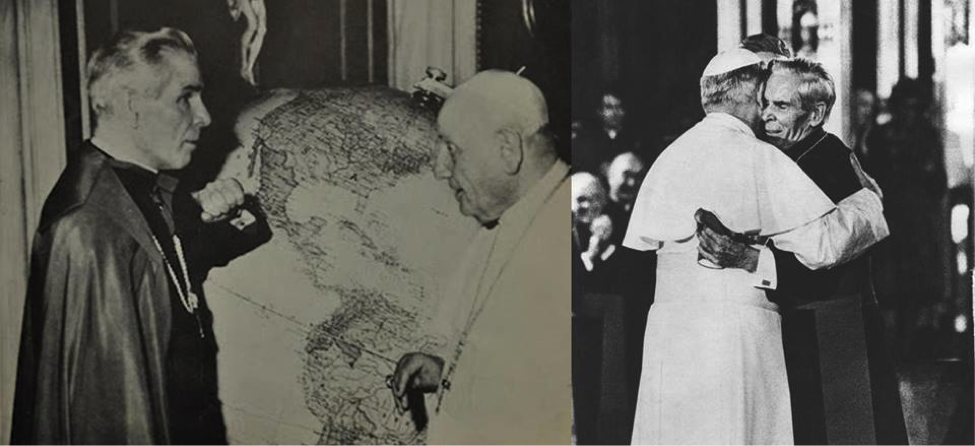
From John Paul II
Shortly before Sheen’s death in 1979, Pope John Paul II reached out to him in a personal letter.
God called you to proclaim in an extraordinary way his dynamic word. With great zeal you accepted this call, and directed your many talents to spreading the Gospel of Jesus Christ. Thus, in these six decades of your priestly service, God has touched the lives of millions of the men and women of our time. They have listened to you on radio, watched you on television, profited from your many literary achievements and participated in spiritual conferences conducted by you. And so with Saint Paul, “I thank my God whenever I think of you; and every time I pray for…you, I pray with joy, remembering how you have helped to spread the Good News.” (October 11, 1979.)
In his inimitable wit, Sheen summed up the essence of the Church’s teaching on the papacy and not only that, but the means and meaning of our salvation:
No chain is stronger than its weakest link, and the weakest link of the chain of Popes was the first. But that weak link was held in the hands of Christ. That is why the papacy will never fail. (Through the Year with Fulton Sheen)
This excerpt from Archbishop Sheen’s television show in which he offers a teaching on the life of Pope John XXIII provides a window into Sheen’s gift of oratory, his love for the papal office, and of the man, John XXIII. Prepared to be amazed and humbled.
Speaking personally about my own spiritual growth, “nobody does it better” than Sheen. His audio talks were my constant companion during my long and solitary commute to and from work; the cadence of his voice mesmerized my young children on family trips, and they never once asked to “switch the radio station.” During down times, I find myself searching YouTube for clips of his television show. Interestingly, when I have used his writings in undergraduate classes, the students respond favorably, and they tell me they can understand him.
Saint Joseph’s College has acquired the complete Sheen audio files. SJC students can access them all here. If you are not a student, you can purchase them for under $30. I even have the app on my iphone – the portable Sheen! If you haven’t already done so, I would encourage everyone to become a friend of Archbishop Fulton J. Sheen. Listen to his talks; watch his videos; get fed a daily quote by “friending” him on Facebook; watch a movie on his life; pray for his canonization.
Heavenly Father, source of all holiness, you raise up within the Church in every age, men and women who serve with heroic love and dedication. You have blessed Your Church through the life and ministry of your faithful servant, Archbishop Fulton J. Sheen. He has written and spoken well of Your Divine Son, Jesus Christ, and was a true instrument of the Holy Spirit in touching the hearts of countless people.
If it be according to Your Will, for the honor and glory of the Most Holy Trinity and for the salvation of souls, we ask you to move the Church to proclaim him a saint. We ask this prayer through Jesus Christ, our Lord. Amen.
Patricia Ireland is Director of Theology Programs for Saint Joseph’s College Online.