
The New Martyrdom

Everyone is talking about the New Evangelization. In the spirit of the Second Vatican Council (the reason for the Council, in this author’s humble opinion), it is a missionary effort to bring the Gospel to a modern, secular world which has, for the most part, rejected, ignored, or at best, compartmentalized it for its own purposes.

I love Pope John XXIII’s image of “opening the windows”. Some have interpreted this as the Council’s blessing on bringing the modern world into the Church, on updating its teachings and practices to “better fit into” the modern world that the Church finds herself in. These same people have been gravely disappointed that the Church has remained consistent in its teachings, especially the ones that prove difficult for the modern mind to accept. If the Council was not about bringing the modern world into the Church, then what do we do with this image of the open window?

I say, “Fly!” Yes, the New Evangelization is about flying out of the window with the Gospel in hand (and heart!) and living it radically, encountering the world at every turn, bringing the light of Christ to it. I say flying because human beings cannot fly of their own power. The New Evangelization requires a complete trust in God’s providential care. A radical living of the Gospel demonstrates that trust. It will bring about a transformation of the world, not a “better fitting into” it.

The Christian views the world through the eyes of the Gospel, not the Gospel through the eyes of the world. Just like the first Christians, a person radically living the Gospel, radically loving as God loves, will be misunderstood, labeled an outcast at best or a threat at worst, and ultimately rejected or persecuted. The Christian is not of the world, and will be hated by the world (John 15:9). Thus, the New Evangelization is a call to a New Martyrdom.

This martyrdom is not to be sought, nor is it a rejection of the world. It is simply the response the world will have to the Christian, who is loving for the world’s sake, in order to transform it. If the world is considered “the enemy”, the Christian loves the enemy, making friends (even brother and sisters) in the process, and bringing about the kingdom of God. We fight the enemy with love, not so the enemy dies, but so that he may have life.

Both Pope Emeritus Benedict XVI and his successor Pope Francis understand this. Two ways the contemporary Christian lives out this martyrdom is by loving God and loving one’s neighbor – regardless of the worldly consequences. In a modern world, where human reason is god and wealth is the measure of success, faith in a transcendent God and life that first concerns the welfare of one’s neighbor put one in opposition to the way things work. Benedict spent much of his papacy tending to the celebration of the liturgy, the worship of God. His papacy culminated in a Year of Faith, celebrating faith in the resurrected Jesus and the consequences of having a personal relationship with Him (which is, of course, to know unconditional love in one’s life and to be able to recognize the lack of it in the world). Pope Francis has followed up with a focus on how human beings are to treat each other in light of this faith, placing a spotlight on the poor of the world, our neighbor.

We might come to an awareness of how our actions – economic, political, environmental, etc. – affect other people (even future generations), but we will only care about these effects if, by faith, we are united to all people in the love of God. Only with the faith of which Benedict speaks can the Church of Francis come to fruition. The witness of the New Martyrs will bring the world to Christ, for they will prove the truth of the Gospel.

Carmina Chapp teaches theology for Saint Joseph’s College Online.
A Work of Missionary Discipleship

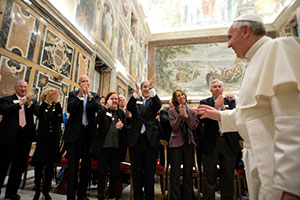
Pope Francis with UND coalition

Pope Francis with UND delegation

Recently, Pope Francis greeted a delegation from the University of Notre Dame.  He offered the following exhortation to his guests, but more broadly, to be received by Catholic colleges and universities everywhere.  He said:

In my Exhortation on the Joy of the Gospel, I stressed the missionary dimension of Christian discipleship, which needs to be evident in the lives of individuals and in the workings of each of the Church’s institutions.  This commitment to “missionary discipleship” ought to be reflected in a special way in Catholic universities, which by their very nature are committed to demonstrating the harmony of faith and reason and the relevance of the Christian message for a full and authentically human life. 

This “missionary discipleship” is the impetus for Saint Joseph’s College Theology blog, which arose out of the desire on the part of the faculty for the Online Theology Programs to foster intellectual engagement among each other and in the wider arena of the Church in which our students and graduates live out their vocation of discipleship in many and various ways, such as religious educators, pastoral associates, hospital chaplains, college professors, campus ministers, just to name a few.  The topics discussed in this blog reflect the varied interests of the bloggers, and so the topic of our inaugural blog on this Ash Wednesday is Confession.

The Medicine of Confession

It is thanks to the medicine of Confession
that the experience of sin does not degenerate into despair.
Augustine, Sermon 82

It is fitting that a blog’s debut on Ash Wednesday be devoted to Confession.  It may, however, seem odd that a college sponsored blog kick off with sinAfter all, in the ever increasing competitive market, many universities are clamoring to attract students by highlighting the warts-free ideal.  It goes something like this:  You, prospective student, are terrific.  We, the college for you, are terrific.  Together, we are perfect.

Maybe so, but since this is a blog of Catholic theology, sin and redemption are foremost in our minds.  Catholics – theologians or otherwise – view those they encounter as souls in need of salvation.  That is to say we see others and ourselves as possessing an immortal soul and that human actions are for the good or the ill of others, not just here and now, but eternally.  When a teacher of Catholic theology remembers that core truth and teaches in sincerity and with humility and joy – all the while sensitive to the diverse needs and backgrounds of his or her students—the extraordinary happens.  The student who doesn’t “feel” terrific and may be on the brink of despair, experiences something wonderful:  hope.  For Catholic students, the Sacrament of Reconciliation may seem like a wonderful starting point, for in the confessional, “hope springs eternal,” as the saying goes.

After my son made his First Confession at age seven, he ran to me and blurted out, “Mom, I feel like I have never sinned in my entire life.”  While we are reluctant to speak of “feelings” in relation to faith—as feelings come and go–what he really was conveying was an experience of grace that involved his entire being.  When not even ten minutes later he started fighting with his brother, I was tempted to say, “So, do you remember now what it feels like to sin?”  Of course, I bit my tongue and refrained from sharing the proverbial parental “gotcha.”  It was well I did keep silent because that initial grace of the confessional stayed with him, and later when the experience of sin became more profound as one matures and grows, Confession was a home to which he could return, a respite from the crushing weight of sin and guilt, and a place of hope from which to set out on the path of True North again and again.

Patricia Ireland is the Director of Theology Programs for Saint Joseph’s College Online.