
Several critiques and defenses of the value of a liberal arts education have found their way to my desk and computer screen in recent days. First is the 2013 report composed by the Commission on the Humanities and Social Sciences (“The Heart of the Matter”) concerning low enrollment in the humanities. This report came amid the increasingly vocal questioning of the value of a liberal arts education by public figures, our own president included. More recently, in an Inside Higher Ed book review of Michael Roth’s Beyond the University, Glenn Altschuler (Cornell) addresses many of the common criticisms one hears concerning the liberal arts.
In his analysis of Roth’s book, Altschuler states that “Roth does not specify how liberal learning might ‘pull different skills together in project-oriented classes.’ Nor does he adequately address ‘the new sort of criticism’ directed at liberal learning. A liberal arts education, many critics now claim, does not really prepare students to love virtue, be good citizens, or recognize competence in any field. As Roth acknowledges, general education, distribution requirements, and free electives are not effective antidotes to specialization; they have failed to help establish common academic goals for students. And, perhaps most disturbingly, doubt has now been cast on the proposition that the liberal arts are the best, and perhaps the only, pathway to ‘critical thinking’ (the disciplined practice of analyzing, synthesizing, applying, and evaluating information).”
Against this critique, a number of defenses of the liberal arts have also appeared recently. The NY Times’ David Brooks, a member of the aforementioned commission, has defended the value of the humanities in pieces which range from explicit advocacy (“The Humanist Vocation”) to subtle leitmotif (“Love Story”). Elizabeth Corey (Baylor) has also written an excellent piece in First Things (“Learning in Love”) which emphasizes the affective dimension of a liberal arts education both in relation to the material being studied and the guide (professor) one encounters. “I am convinced,” Corey writes, “that the personal element in liberal learning cannot be valued highly enough.”
Apropos of this debate, I am currently reading – in free time which I do not possess – a book which recounts a seasoned writer’s adventure of going back to school and re-reading the classic canon of Western Literature by taking two Humanities classes at Columbia University (David Denby’s Great Books). Almost immediately, in the first chapter of this book, the author senses a conflict, a conflict which emerges over how to read these texts. On the one hand, one can read them from an intellectualist perspective; i.e., these texts do indeed form an intellectual canon and in order to be an “educated person” one has to be familiar with the words and thoughts of these “wise men.” On the other hand, one can read these texts from a post-modern perspective; i.e., these texts form a canon because people with the power to establish a literary canon have said “let it be” and it has been so. There is no greater or lesser value to these texts written by dead white males than any other texts, but one should be familiar with them – if for no other reason – than they have shaped the culture in which we now live.
There is, however, a third way of understanding education, and liberal education in particular.
In a lecture originally delivered to the Buenos Aires-based Christian Association of Businesspeople (“Educating in the Context of Culture”), Pope Francis proposes a vision for education “in which the fundamentals remain, and which remains foundational. Truth, beauty, and goodness exist. The absolute exists. It can, or rather, it should be known and perceived.” In other words, at the heart of liberal education is the pursuit of transcendental realities. A truly liberal education strives to lead the student towards his/her fulfillment by fostering a desire and capacity to attain perfections which cannot be divorced from their source. The third way of liberal education, therefore, is an ordering of the human person towards the transcendent.
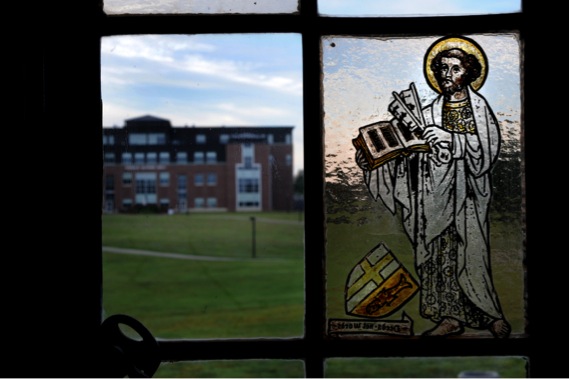 It is increasingly apparent today that universities without fidelity to an expressly Christian mission simply cannot provide this foundation. They are caught up, as the above author demonstrates, with either an intellectualist or post-modern perspective towards liberal education. At Catholic colleges and universities we have the privilege of building upon the foundation about which Pope Francis speaks. Preparing students to pursue virtue, to seek wisdom, and to love beauty can only take place from within a context which acknowledges their existence. If virtue, wisdom and beauty are merely ideas, then they are no more inherently worthy of pursuit – and perhaps far less so – than an economically rewarding career, the esteem of one’s peers, and the immediate satisfaction of one’s appetites.
A ‘liberal education’ means, quite literally, ‘to lead out’ (educere) to ‘freedom’ (libertas); not a freedom which is simply the multiplication of choices, but a freedom which allows one to pursue excellence. Those of us who are fortunate to teach from within the context of a Catholic education ought to be mindful of this great gift. The gift of being able to share, with our students, this journey towards authentic freedom and the transcendent source of all virtues.
Anthony Coleman teaches theology for Saint Joseph’s College Online.
