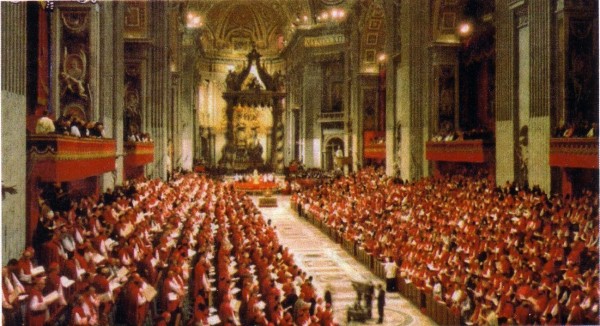
 The Second Vatican Council met in the autumn months between 1962 and 1965. Therefore, some fiftieth anniversaries have already come and gone: the Council’s opening, the death of Pope St. John XXIII, and the election of Paul VI. Saint Joseph’s College has contributed its own recognition. This year and next, though, will mark the real fiftieth anniversaries—the passing of conciliar documents like Lumen Gentium, the Dogmatic Constitution of the Church, and Gaudium et Spes, the Pastoral Constitution of the Church in the Modern World. When you hear or read somebody comment “Vatican II revolutionized the Church,” these documents provide the sparks for that change. We do not suffer a shortage of accounts detailing the changes of Vatican II and their impact throughout the Church. As many of us know, conciliar enthusiasm has not swept everybody off their feet. Perhaps that is why these fiftieth anniversaries of the Council are so important. We are still, as Peter Huff has said, “on the sacred mountain,” seeking to make sense of the Council and its legacy.
Another conciliar document witnessing its golden anniversary this November is Unitatis Redintegratio, the Council’s decree on ecumenism. St. John’s Gospel includes Christ’s prayer to the Father that all His followers may be one, just as He and the Father are one (17:21). So, after the Church’s self-assessment (Lumen Gentium) but before turning its attention to the modern world, the Council duly considered the readily evident fact that Christianity stood torn asunder, represented by many churches instead of one, true, unified Church. Addressing and correcting this sad reality figured among Pope St. John XXIII’s inspiration for the Council. While he did not live to see its promulgation, Unitatis Redintegratio aptly addressed Pope John’s hope. Non-Catholic Christians were recognized as possessing some, but not all, elements of the Gospel (#3). Furthermore, the Catholic faithful—lay and clergy—are called to “recognize the signs of the times and to take an active and intelligent part” in ecumenical work (#4). Honestly studying the beliefs of other Christians is no longer the purview of a specialized academic few, but now expected of everybody (#9).
Each conciliar document poses so many questions and new avenues of discovery, and Unitatis Redintegratio does not disappoint. A simple one might be: Do we thus give up everything for the Council’s vision? Out with the old, in with the new? Within twenty years of the Council’s conclusion some Catholic theologians called for a complete reorganization of the Church’s perception of itself and other churches and religious traditions. From now on, the argument went, being truly Christian meant de-emphasizing uniquely Christian elements and eschewing many proudly Catholic expressions. So it seemed that Roman Catholic Christian renewal involved dissolving oneself, or at least one’s ecclesiology and theology.
True to form, though, Unitatis Redintegratio contains answers to the very questions it has prompted. The Council fathers made very clear that while common prayer might foster unity, common worship services could often give the wrong impression. Catholics should remain Catholic, while Baptists, Presbyterians, and Pentecostals attended their own affairs (#8). Common concerns such as feeding the poor and serving those afflicted by disaster, though, demonstrated to the world that unity for which Christ had prayed (#12). Finally, almost twenty years ago Pope St. John Paul II addressed the Council’s call to ecumenical dialogue. The papacy, so long a visible obstacle to Protestants, still could serve the pursuit of unity. Some critics seemed dismayed that Catholic intransigence had, once again, reared its ugly head. But John Paul’s reaffirmation of the Council should not have surprised many. Unitatis itself had declared: “Every renewal of the Church essentially consists in an increase of fidelity to her own calling” (#6). That call included the realization that God alone can bring about true Christian unity (#24). Therefore, the road to reunion runs right through the heart of the Church itself.
Guest blogger Jeffrey Marlett blogs at Spiritual Diabetes.