Today is World Mission Sunday in the Church’s liturgical calendar. In upstate New York and Quebec, though, October 19 marks another memorial: the feast of the North American Martyrs. These are eight Jesuit priests and lay brothers who died in the seventeenth century while evangelizing among the Iroquois and Huron. Parts of their stories provide the basis for the 1991 film Black Robe. My home diocese of Albany thus features an interesting pilgrimage destination: the North American Shrine in Auriesville standing over the Mohawk village of Ossernenon. Here three saints met their death (Rene Goupil in 1642, and then Isaac Jogues and Jean Leland in 1646) and then ten years later, in 1656, St. Kateri Tekakwitha was born there. Canonized this month two years ago, St. Kateri received baptism in nearby Fonda, endured persecution from her own family and husband, and then made her way to Quebec where she died in 1680. The Jesuit martyrs didn’t make it that far. Goupil, Jogues, and Leland all suffered torture before being tomahawked. (The 2010 article by Father Martin SJ includes some graphic descriptions of St. Jean de Brebeuf’s 1639 martyrdom.) Their remains were often discarded in the nearby woods.
Just remember: whenever you see televangelists in round churches, American Catholics got there first.
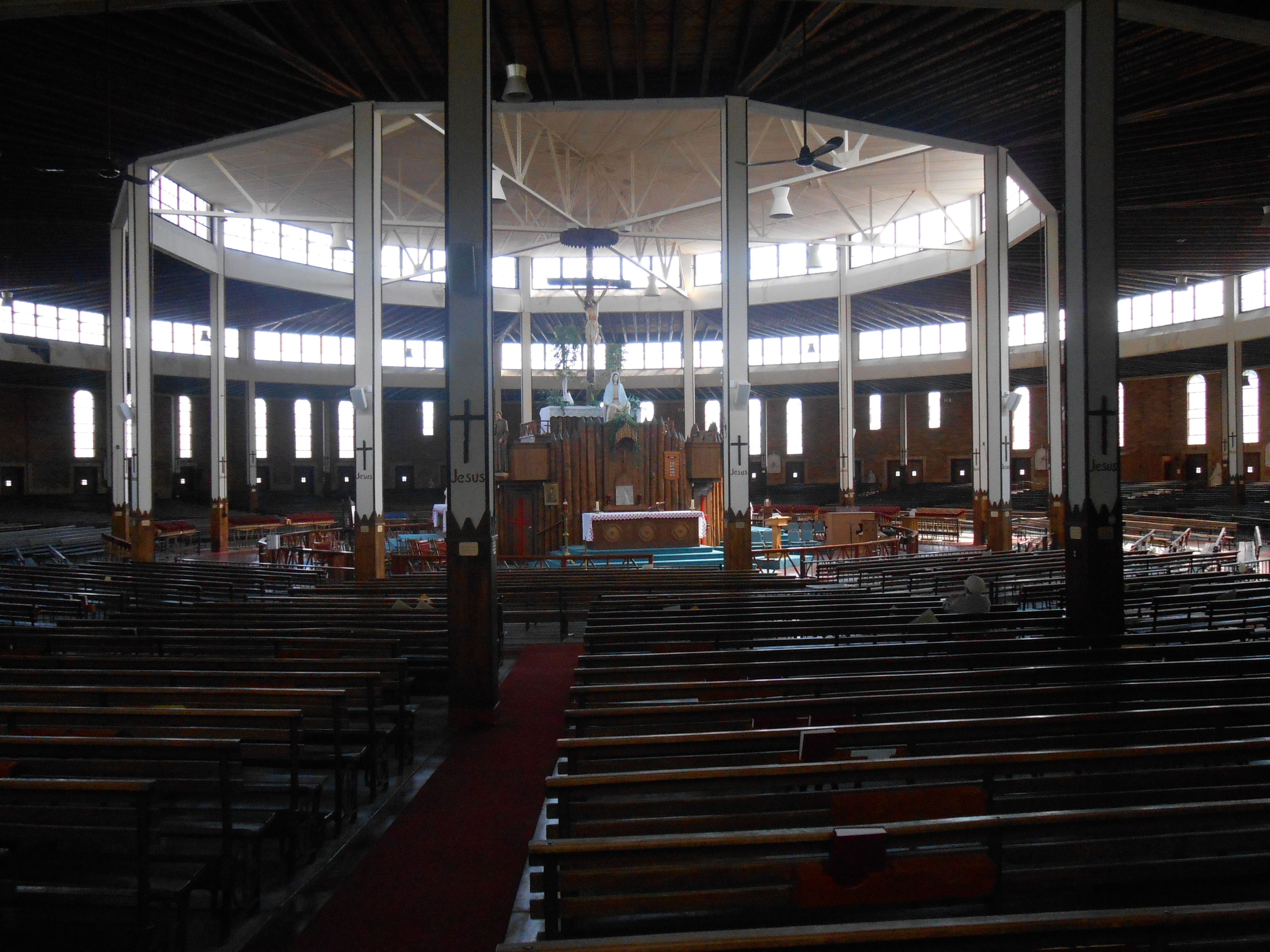
The Martyrs’ Shrine in Auriesville celebrates all this history. Catholics older than forty from all over eastern New York have memories of parochial school day-trips there. Scout troops still camp out there every September, a pilgrimage now in its 64th year. Dominating the shrine grounds is the Martyrs’ Colosseum , one of the first “church-in-the-round” buildings in the United States.
More to the point, the Colosseum church celebrates the Jesuit martyrs and the native Americans they served. The high altar stands atop a log palisade reminiscent of the Mohawks’ own protective wall at Ossernenon, and the crucifix (which also provides essential support to the roof!)The crosses adorning the columns refer to those carved on nearby trees by both St. Isaac Jogues and St. Kateri Tekakwitha. Around the walls light streams through seventy-two windows which recall Christ’s commission of disciples in Luke 10:1-24. Of course, the name and architectural style recall the early Christian martyrs in the Roman Colosseum.
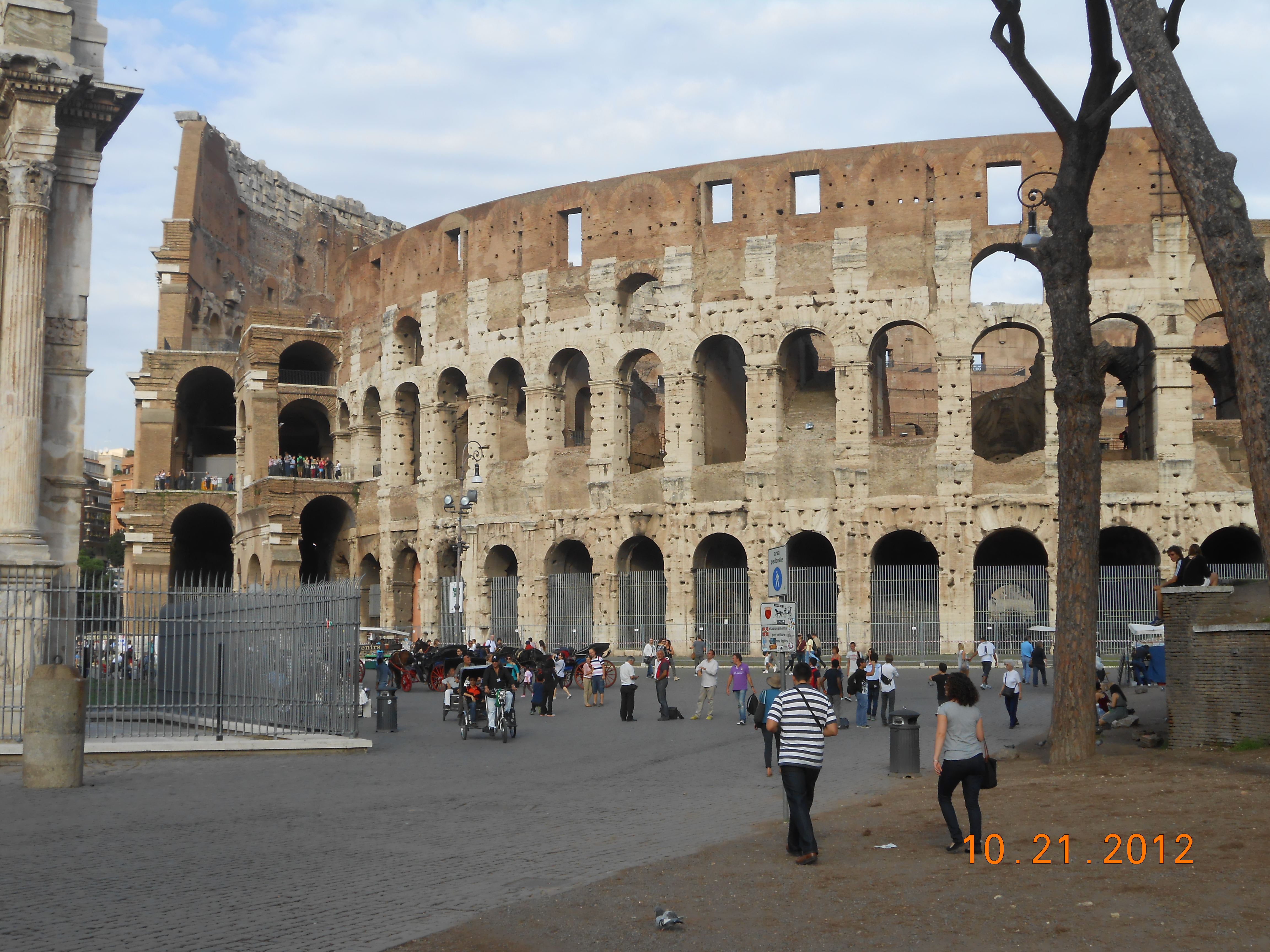 So often our histories and experiences emphasize the distance, the chasm, between Rome and the United States. The Auriesville shrine recalls an earlier time when American Catholics looked at their own, comparatively short, history and built their own spaces to recall the Church’s simultaneously rooted yet universal origins. In this view the insignificant, the remote, the overlooked (three adjectives unfortunately attached frequently to the Martyrs Shrine) possess their own spiritual significance in Christ because their connotations—through architectural space as well as martyrdom—to Rome. Fittingly, the Jesuits still maintain a cemetery on the ridge above the Shrine. There lie the graves of Cardinal Avery Dulles, SJ, and Pete Corrigan SJ of On the Waterfront fame.
If that were not enough, October 19 will also see the beatification of Pope Paul VI. Born Giovanni Battista Montini, Paul VI reigned from 1963 to 1978. To make a long story (his fifteen year pontificate still ranks as the second longest since Pius XII’s!) short, Pope Paul embodied a different sort of martyrdom. His quiet, studious demeanor departed significantly from his predecessor, the popular (and now canonized) John XXIII, and his smiling, even cheery, successors: the short-lived John Paul I (who reigned for only 32 days) and the long-reigning St. John Paul II (whose pontificate lasted longer than all but Pius IX’s). Paul pledged to continue the Second Vatican Council that Pope John had inaugurated. In fact, the Council’s major achievements all occurred under Paul’s watch. Still, his pontificate seemed to bear a lingering sorrow throughout. Even a Presbyterian college student visiting Rome in 1989 (your humble author) understood the difference. Deep in the Vatican grottos I saw several eldery women bring flowers to Pope John XXIII’s tomb, but nearby Paul’s seemed forlorn.
Perhaps it is not surprising, as Peter Hebblethwaite’s biography (itself now over twenty years old) shows, that Paul’s pontificate seemed exhausted by 1970, if not earlier. The overwhelming negative reaction to Humanae Vitae , the 1968 encyclical that reaffirmed the Church’s opposition to artificial birth control and abortion, clearly played a role (and figures prominently in Hebblethwaite’s biography). Part of it was the culture, which lumped Paul’s papal authority into a widespread rejection of all authorities. Paul’s Ostpolitik of rapprochement with Soviet Communism and its satellites likewise did not bear the fruit Paul expected. It took a pope from the Warsaw Block, who knew its realities and brutalities, to bring that down.
That history still offers rich resources for the revitalization of Catholic life today. The question remains: what prompts Paul’s beatification? Because, it seems, his pontificate—and his quite successful clerical career before—offers a more ordinary, readily-at-hand, martyrdom. Despite widespread ridicule, Pope Paul stood by Humanae Vitae as well as other positions that many, religious or not, often accept unthinkingly. “If you want peace, work for justice” adorns bumper stickers and felt banners, and it comes from the same pope who gave us Humanae Vitae. For all of the furor swirling around the Extraordinary Synod of Bishops, both sides might be seen as embodying Pope Paul’s quiet, committed spirituality: proclaim the Gospel, come what may. The North American martyrs certainly greater physical pain, but Paul’s spiritual and psychological pain surely approximated their own. Paul’s path and the struggles it brought him offer a more familiar road to American Catholics than the red-hot tomahawks the Jesuit martyrs faced. In other parts of the world, though, other Christians still confront them.
Guest blogger Jeffrey Marlett blogs at Spiritual Diabetes.