Forget the Past and Push On to What is Ahead

During my doctoral studies in Rome, when the going got rough, I would head over to the church of Sant’Agostino near Piazza Navona to ask Saint Monica’s intercession. Monica is buried at the church named for her son, and she is for me a source of inspiration for what it means to grow in holiness.
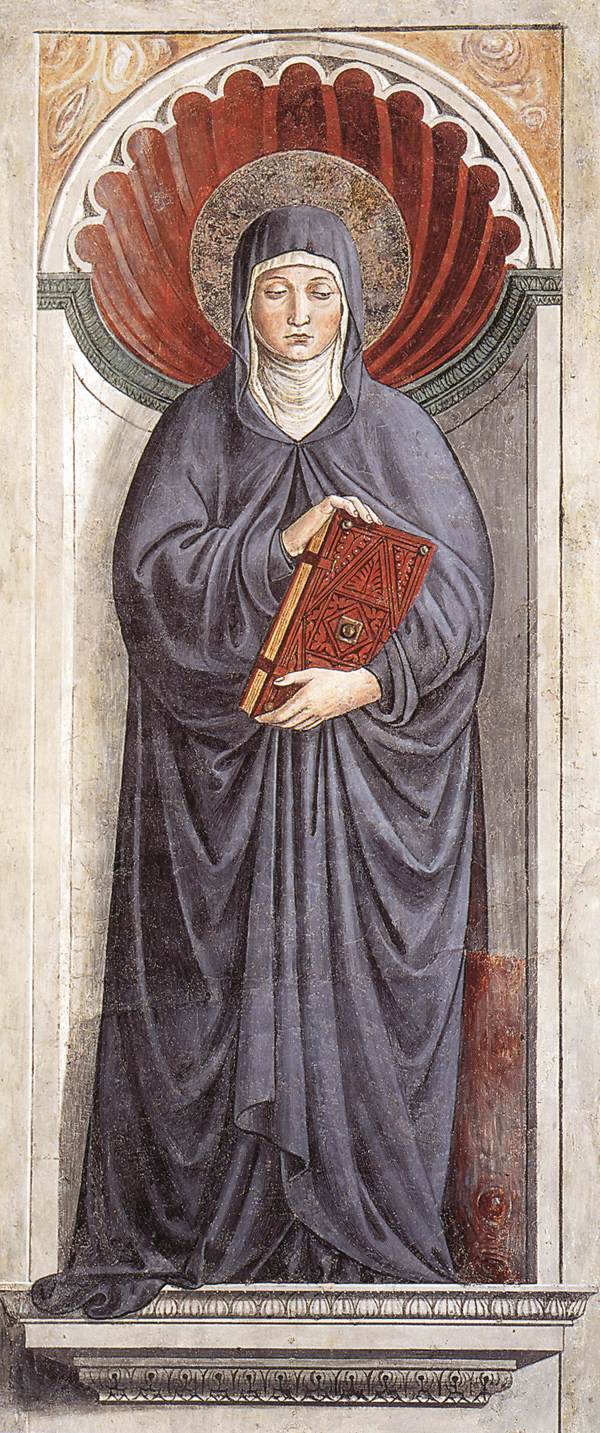
Monica_of_Hippo_by_GozzoliWhat I learned from Monica is why the church honors many of its sons and daughters with the title of “saint.” Their lives really have a timeless dimension that teaches, inspires and encourages Christians in every age. Monica, whose feast we celebrate today, is a testimony to the strength that comes in keeping God at the center of one’s life and making God one’s reference point in all things—in other words—never losing sight that holiness is the journey of life.

Whenever I am asked to lecture on the theme of the universal call to holiness, I begin by asking people to name people who they think are models of holiness. Always, always, Mother Theresa is the first or second to be named (no surprise there)! As names are added, we move from saints, to loved ones, to friends, but never does anyone ever name themselves! And yet, by virtue of baptism, all of us are called to holiness. We are much better at naming what disqualifies ourselves than recognizing that holy is what we are in the process of becoming. Monica teaches us that we need only to fix our gaze on God and holiness becomes possible.

From what little we know of Monica’s life, it would not be on any list of optimal environments for holiness to flourish. She discovered the enticement of alcohol as a teen, she married a man who was a drinker and known to be violent and unfaithful. She had a son who was too smart for his own good and a difficult mother-in-law who tried her patience. One could understand if the mark of Monica’s life was that of despair and yet her story is quite different.

Monica was raised in a Christian family. Her strong sense of self was grounded in her relationship with God. She was devout and committed to serving others. It is said that her husband, not a Catholic when they were first married, would criticize her for her piety and generosity, but she continued to be faithful, to be true to herself. She was faithful in the face of infidelity; she was kind in the face of ridicule. She loved her children with the love we learn only from God. In her love for her son, Augustine, we see that she saw something in Augustine that he did not see in himself. Trusting God’s providence, she prayed and prayed! She stayed close to Augustine, reminding him of what he could be rather than what he was. Monica entrusted him to God, knowing that she could only do so much. Tomorrow, the church celebrates how the story of Augustine ends!

Like, Augustine, Monica’s husband also saw the authenticity of Monica’s faith and her love for him and their children. He began to see the power of a faith that never wavered. He too converted. Monica’s patience and love and realization that she had God on her side became an irresistible invitation for her family.

Augustine writes in his Confessions, that shortly before his mother died, they were enjoying a conversation in the presence of The Truth–that is God– and speaking about the promise of eternal life. Augustine writes that in the conversation, “They were forgetting the past and pushing on to what is ahead” (Phil. 3:13). It is a good reminder to us that God is not as interested in our past as he is in our future. In Monica, we learn that we are most true to ourselves when our lives are oriented toward God and trusting of his providence.

Susan Timoney is the Assistant Secretary for Pastoral Ministry and Social Concerns for the Archdiocese of Washington and teaches spirituality for Saint Joseph’s College Online.

Ancient Faith – Contemporary Devotion

For me, ancient faith and contemporary devotion pair beautifully on this upcoming Feast of the Assumption of Mary.

For some, the Assumption of Our Lady is a difficult theological notion to understand. As catechists, it is important for us to be faithful to the doctrine without overwhelming the student. That reminds me of this little story…

The pastor was quizzing the third grade. “Can anyone tell me what the Assumption is?” An enthusiastic little boy raised his hand. Encouraged, Father called on him, “What can you tell us, young man?” The little boy stood and proudly announced, “Mary was Jesus’ Mother and we assume she went to heaven.” Now, as cute and humorous as that is, it doesn’t sufficiently address or define the mystery of the Assumption of Mary.

Among the Marian doctrines, the dogma of the Assumption stands with the dogma of the Immaculate Conception as a kind of contrast of balance and scope of God’s power and goodness in His loving regard for the human condition. By that I mean that in the Immaculate Conception, we see that God has intervened in human history with a miracle that has an essentially spiritual core, that is, sin and the efficaciousness of God’s mercy/grace. Mary is preserved from sin from the moment of her conception “in view of the merits of her Divine Son”, as the definition of the doctrine proclaims. On the other hand, the mystery of the Assumption is a miracle whose core is a physical reality. Her body and soul are the locus of God’s grace and power. Since no one could bear the idea that Mary died, or worse, decayed after death, the commonly held and persistent faith of the people has been that God took the Blessed Mother to Himself whole and entire, body and spirit when, as the solemn definition declared, she had “run the course of her life”. Even though the proclamation of this beautiful dogma is so recent, the belief in the Assumption of Mary is ancient. At the time when it was being considered for solemn definition some argued that there was no need to formally declare it since it was a prevailing and universal belief.

The dogma of the Assumption, promulgated as the wave of Marian devotion was cresting in 1950, stands as an expression of faith and devotion for some and as a stumbling block for reunion and interfaith dialogue for others.   Among our friends in the East, this holy mystery and feast day is expressed and celebrated as the Dormition of Mary, the Mother of God. As a dogma of our faith and as a holy day of obligation, we observe the Feast of the Assumption on August 15th.

HolinessMarian devotion today is fostered and fed by the modern voices of contemporary writers and artists.   Nowhere is this clearer or more powerfully illustrated than in the works of the contemporary artist Janet McKenzie. Most prominent for me is the evocative effect her Marian imagery has had on contemporary women. Her voice is one that speaks what so many would say if only they had the words, the talent. Janet McKenzie’s images of Mary resonant with the faith, spiritual sensibilities and experience of so many of the voiceless and marginalized of our world. This is profoundly evident in two recent works. The first book is Holiness and the Feminine Spirit–The Art of Janet McKenzie (Orbis, 2009). This wonderful book of paintings by Ms. McKenzie is graced with the pithy evocative essays of many contemporary writers, including Sister Wendy Beckett, Sister Joan Chittester, and Sister Helen Prajean. The second is the profoundly inspiring Way of the Cross by Sister Joan Chittester and Janet McKenzie (Orbis, 2013). The power of Sister Joan’s words is perfectly paired with the images of Ms. McKenzie.  It is a real meditation. My personal spirituality is continually stirred by Ms. McKenzie’s images. I recommend them to all who love to pray with images and experience them as channels of grace and meditative dialogue. I can think of no better way to celebrate the Marian Feast of the Assumption of Mary, the Mother of God.

Susan O’Hara teaches theology for Saint Joseph’s College Online.