Sometimes the liturgical calendar delivers punches in such succession that we find it difficult to keep up. Today is the feast of St. Ignatius Loyola (1491-1556), founder of the Society of Jesus. And what could be said about the Jesuits that has not already been said? There’s no time to rest, though. Tomorrow is the feast of St. Alphonsus Liguori (1696-1787), founder of the Redemptorists, an order with its own proud history of apostolic work. It is, after all, a good thing that the Church thinks in centuries, not minutes, days, weeks, and certainly not tweets! (Pope Francis is, though, an accomplished Twitter user.) We need the liturgical cycle to bring before us this unceasing stream of saintly exemplars. We do our best to emulate them, knowing that next year we hope to glean a little more insight from the saints as they become familiar friends. For me, it’s St. Ignatius Loyola (and St. Alphonsus), but my colleague Carmina Chapp attends instead to Dorothy Day. Somebody else might appreciate St. Charles Lwanga or a saint known only to a few people and God.
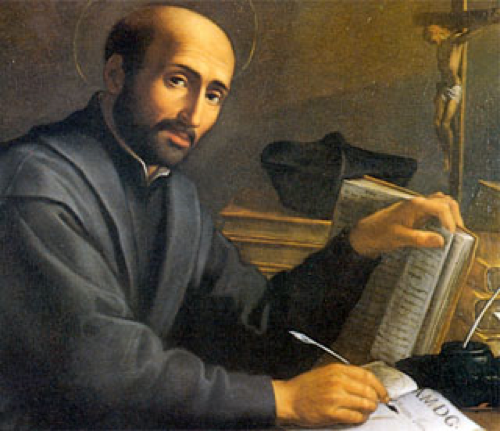
St. Ignatius of Loyola
Source; Marquette University
St. Ignatius ranks among those Catholic greats—St. Augustine of Hippo, Cardinal Newman, Dorothy Day, Thomas Merton—who generate such interest that simple internet searches threaten to melt down servers. Still, Ignatius’ life seems almost operatic, even movie-worthy. Born to a wealthy family, Ignatius’ military career broke amid cannon fire at Pamplona, Spain. His wounded leg had to be broken twice in order to set properly. Bedridden, Ignatius began reading the lives of the saints. St. Ignatius thus understood fully St. Luke’s depiction of Christ’s injunction to treasure God, not earthly things.
But God said to him,
‘You fool, this night your life will be demanded of you;
and the things you have prepared, to whom will they belong?’
Thus will it be for all who store up treasure for themselves
but are not rich in what matters to God.”
Providentially, that Gospel reading appears today, St. Ignatius’ feast day. Having endured what he had, earthly possession surely seemed frail indeed. As one blogger, working with Dom Gueranger, puts it: “It dawned on him that the Church also has her army which, under the orders of the representative of Christ, fights to defend here below the sacred interests of the God of hosts.” An army for God—in the days of the Reformation, that stirred Ignatius to action. Ignatius founded the Society of Jesus—the Jesuits—in 1534, headquartered in Rome. From there Ignatius sent missionaries all over the work: China, Japan, India, and both North and South America. As he did, he charged them: “Go, my brothers, Inflame the world and spread everywhere the fire which Jesus Christ came to kindle on the earth.”
There’s an image: setting the world afire for God! Yet St. Ignatius’ best-known venue to recognizing that same fire in ourselves came through a most prosaic book: The Spiritual Exercises. Like much of the Catholic tradition I first met St. Ignatius Loyola while studying at Wabash College, led by a host of devout Presbyterian scholars. They loved the Church and thus they taught its history, even the Catholics who opposed their beloved reformers Calvin and Luther. William Placher’s description (p. 176) of the Spiritual Exercises always stuck with me: “Much of it has all the literary eloquence of a cook-book, and a similarly practical intent, designed as it is for spiritual directors to use in guiding people through a religious retreat.” Bill liked to cite St. Ignatius’ “Rules for Thinking with the Church,” the thirteenth of which requires: “To keep ourselves right in all things, we ought to hold fast to this principle: What I see as white, I will believe to be black if the hierarchical Church thus determines it.” For Protestants suspicious of Rome, that’s a great line, but it paints a paltry picture of the saint himself. E.g., Bill rarely mentioned the other rules which extoll a medieval piety of saint veneration or the preceding “Rules for Distributing Alms” (or, more fundamentally, the thoroughly Scriptural foundation for the entire Exercises). Loyalty to Rome came as part of that inflaming fire the first Jesuits found God had given them through St. Ignatius. Jesuit identity certainly involves ecclesiastical fidelity, but not only that.
At one level, of course, Placher is right; cookbooks are meant to be used. Which is the better cookbook: the slick production with recipes requiring several odd, rarely used ingredients or the one that bears clear signs of frequent, sustained use? After all, if stained with sauces and flour, that cookbook has been used. The recipes work—cooks can follow and make them and, this is important, those consuming like the offerings. St. Ignatius’ spiritual direction certainly fits this. It works and has done so over the centuries. St. Ignatius’ Spiritual Exercises describe a retreat to be taken over thirty-one days. Jesuits take the entire retreat at least twice during their lives, and today the laity often seeks St. Ignatius’ retreat-director advice episodically—whether seeking insight on prayerful examination of the day or extra encouragement to lose self in order to gain Christ. The Exercises still generate widespread consideration far beyond the Jesuits’ own members. The Jesuit cookbook still contains much that satisfies.
Like some diets, though, that draw criticism, not everybody likes it. In Victorian England both Jesuits and Redemptorists—there’s tomorrow’s saint again—particularly stirred up anti-Catholic sentiment among Protestant elites. Not content with merely advancing popery, the legacies of both St. Ignatius and St. Alphonsus celebrated suspiciously loose spiritualities. Both seemed willing to contort the Gospel to fit the apostolic situation. This adaptability, though, should be seen in the context of St. Ignatius’ charge: ignite the world. Sometimes, as any camper knows, you need more than one match to start that fire. St. Ignatius, having lived quite a life before he came to God, developed a reformed Catholic spirituality that provided that ignition. Through the Exercises’ simple prose have come a plentitude of paths, all through the Church, back to God.
Guest blogger Jeffrey Marlett blogs at Spiritual Diabetes.
