My Vocation is Love!

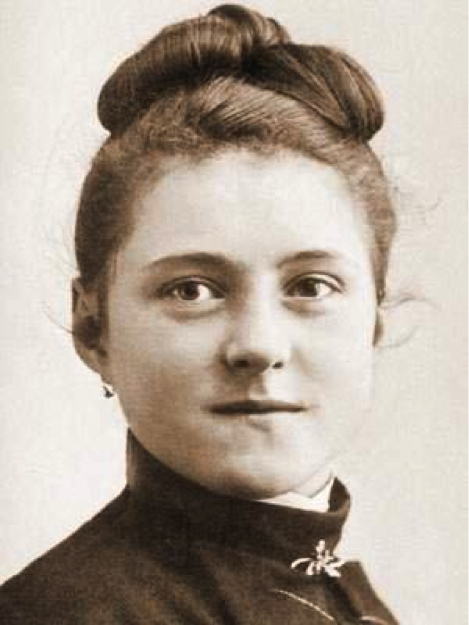
St. Therese at 15 just prior to joining the Carmel at Lisieux

St. Therese at 15 just prior to joining the Carmel at Lisieux

I am always delighted to see that, especially among younger Catholics, Thérèse Martin (1873-1897) is increasingly becoming one of the Church’s more “popular” saints. I am sure that many of us are already familiar with the broad outlines of her life. That she was one of five children, of Louis and Zélie (Guerin) Martin, all of whom entered the religious life. That, during a family pilgrimage to Rome, she implored Pope Leo XIII to grant her a dispensation to allow her to enter the Carmel at Lisieux at age 15; which, though not due to the pope’s intervention, she in fact did. That, after dying at the tender age of 24, her reputation grew largely due to the posthumous publication of her spiritual diary Histoire d’une Ame [Story of a Soul]. And, that she was canonized in 1925 by Pope Pius XI and proclaimed a Doctor of the Church in 1997 by Pope St. John Paul II.

In my household, moreover, the feast day of St. Thérèse (October 1st) holds a particular significance. My wife and I, quite deliberately, selected that day on which to be married; thereby making St. Thérèse the patron saint of our marriage and family. (Just as an aside, our son was born on the feast of Our Lady of Mt. Carmel. I think the LORD is trying to tell us something about the spiritual direction of our family.) One portion of St. Thérèse’s Story of a Soul has always resonated with my wife and me in particular. In fact, we placed this text on the last page of our wedding programs.

Charity gave me the key to my vocation…I understood it was love alone that made the Church’s members act, that if love ever became extinct, apostles would not preach the Gospel and martyrs would not shed their blood. I understood that love comprised all vocations, that love was everything, that it embraced all times and places… In one word, that it was eternal (chapter 9).

St. Thérèse was prompted to write this passage based on her meditation of 1 Cor 13:1-13, and it illustrates well why she is truly a Doctor of the Church. St. Thérèse had a great desire to join the ranks of the martyrs of the Church. “Martyrdom was the dream of my youth,” she writes “and this dream has grown with me within the Carmel’s cloisters.” She also had the ambition to be a Carmelite missionary which, because of her ill health, she was not allowed to fulfill. But reflecting upon St. Paul’s great exhortation to love, St. Thérèse realized that love is the vocation of every Christian; it is the universal vocation. Much like holiness, all Christians are called to live out their particular vocations in love; whether one is called to the married life, or the consecrated religious life, or to some other particular vocation. Further, and this is one St. Thérèse’s great insights, if one lives out perfectly this universal vocation to love, one is embracing all of the particular vocations. In other words, the saint who loves perfectly is, in the realm of love, an apostle, and a prophet, and a martyr, etc. “Thus I shall be everything,” writes the Little Flower, “and thus my dream will be realized.” In a way, the Church has formally endorsed the Little Flower’s theology on this point. For, while she never left the confines of the Lisieux Carmel during her religious life, upon her canonization St. Thérèse was made co-patron – along with St. Francis Xavier – of missionary work. By doing “all the smallest things and doing them through love,” St. Thérèse lived perfectly her, and every, vocation.

And that is the great reminder which St. Thérèse gives to my wife and me as the patroness of our married life: that every particular vocation is lived through the universal vocation to love. And, in knowing this, we should all exclaim with St. Thérèse: “O Jesus, my Love…my vocation, at last I have found it…My vocation is love!”
Therese 2

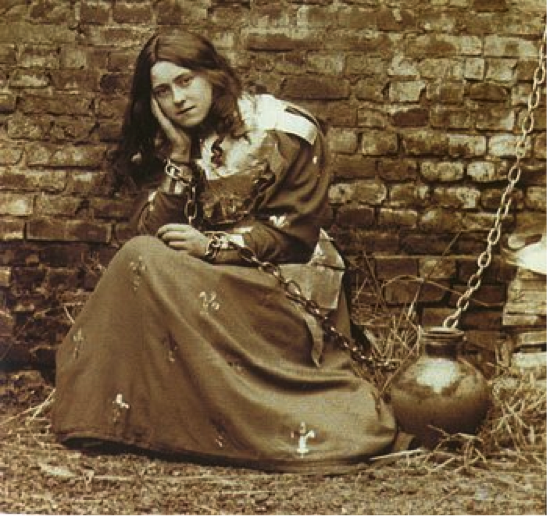
St. Therese as St. Joan d’Arc in a play at the Carmel

Anthony Coleman teaches theology for Saint Joseph’s College Online.
Mary’s Prophetic Witness as Our Model

100_0107(rev 0)This work week begins with our September 8 liturgical celebration of the birthday of the Blessed Virgin Mary. We may echo the words of her divine Son in the Gospel of John (18:37) and apply them to His Mother: the Virgin Mary came into the world to bear witness to the Truth, to Jesus Christ. All who are on the side of truth listen to His voice—this is Mary’s directive to us, also: “Do whatever He tells you” (John 2:5).

The Virgin Mary and her prophetic mission really resonate with today’s September 10 readings. The first reading from 1 Corinthians begins with St. Paul’s reference to virgins and ends with his assertion that “the world in its present form is passing away.” The Virgin Mary’s detachment from worldly attractions, and her focus on “what is above” (Colossians 3:1-2)—on embracing God’s will (Luke 1:38)—underscore the transiency of this world. Today’s Responsorial Psalm, drawing from Psalm 45, addresses the “king’s daughter.” The high Christological tone is obvious: the king above kings is God, and His God has anointed Him (45:7-8). The name of the king’s daughter will be renowned through all generations (45:18): Mary’s Magnificat alludes to this—“from now on all generations shall call me blessed” (Luke 1:48).

The Blessed Virgin certainly embodies the teaching of Jesus in His Sermon on the Plain, imparted through the Gospel reading according to St. Luke. Jesus tells us, “Blessed are you who are poor, for the Kingdom of God is yours.” Mary is blessed by being poor—materially poor, yes (e.g., Luke 2:24, offering the poor person’s sacrifice), but more importantly, spiritually poor, or humble. She demonstrated her humility so profoundly by embracing God’s will in all things, including accepting the humbling, humiliating, and devastating circumstances that befell her.

Mary of Nazareth had to place her newborn Son in a manger because there was no room for the Holy Family in the inn. She lived in the Nazarene community in which citizens—some of whom Mary probably knew quite well—rejected her only Son and disdained Him enough to try to hurl Him down the brow of the hill upon which Nazareth was built. (Luke 4:29). Not too long afterward, the leaders of His own people delivered Him to betrayal, torture, and execution. Mary was there. She felt His pain and shared in His rejection.

The Virgin Mary fulfilled Simeon’s prophecy: “And a sword shall pierce your own soul, too” (Luke 2:35). Simeon seems to prophesy about Mary in continuity with and in partial fulfillment of Zechariah 12:10: “And I will pour out on the House of David and on the inhabitants of Jerusalem a spirit of grace and supplication. And they shall look upon me, whom they have pierced; and they shall mourn for him as one mourns for an only child, and grieve bitterly for him as one grieves for a first-born son.” [This is my own translation from Biblical Hebrew into English. Notice, from the Hebrew translation, the identity of the object pronoun—“they shall look upon me”! Many translations change the pronoun from first masculine singular to third masculine singular.] As Jesus, the first-born and prophesied Shepherd (Zechariah 13:7-9) is struck and pierced by the sword/lance as a sign of contradiction, so too Mary’s soul is pierced by the sword, metaphorically. Her pain, in union with her Son, is emotional and spiritual.

In the Sermon on the Plain, Jesus tells us, “Blessed are you who are now weeping, for you will laugh. Blessed are you when people hate you and when they exclude and insult you…on account of the Son of Man…your reward will be great in heaven!” The Blessed Virgin exemplifies this blessed and exalted one of whom Jesus speaks. Her fidelity and obedience to God’s will in her life is our standard for authentic discipleship and prophetic witness. With the Virgin Mary’s example and powerful intercession for divine grace, we may be light in darkness, love in a world gone cold, setting the earth ablaze by the love of Christ!

Mark Koehne teaches moral theology for Saint Joseph’s College Online.