
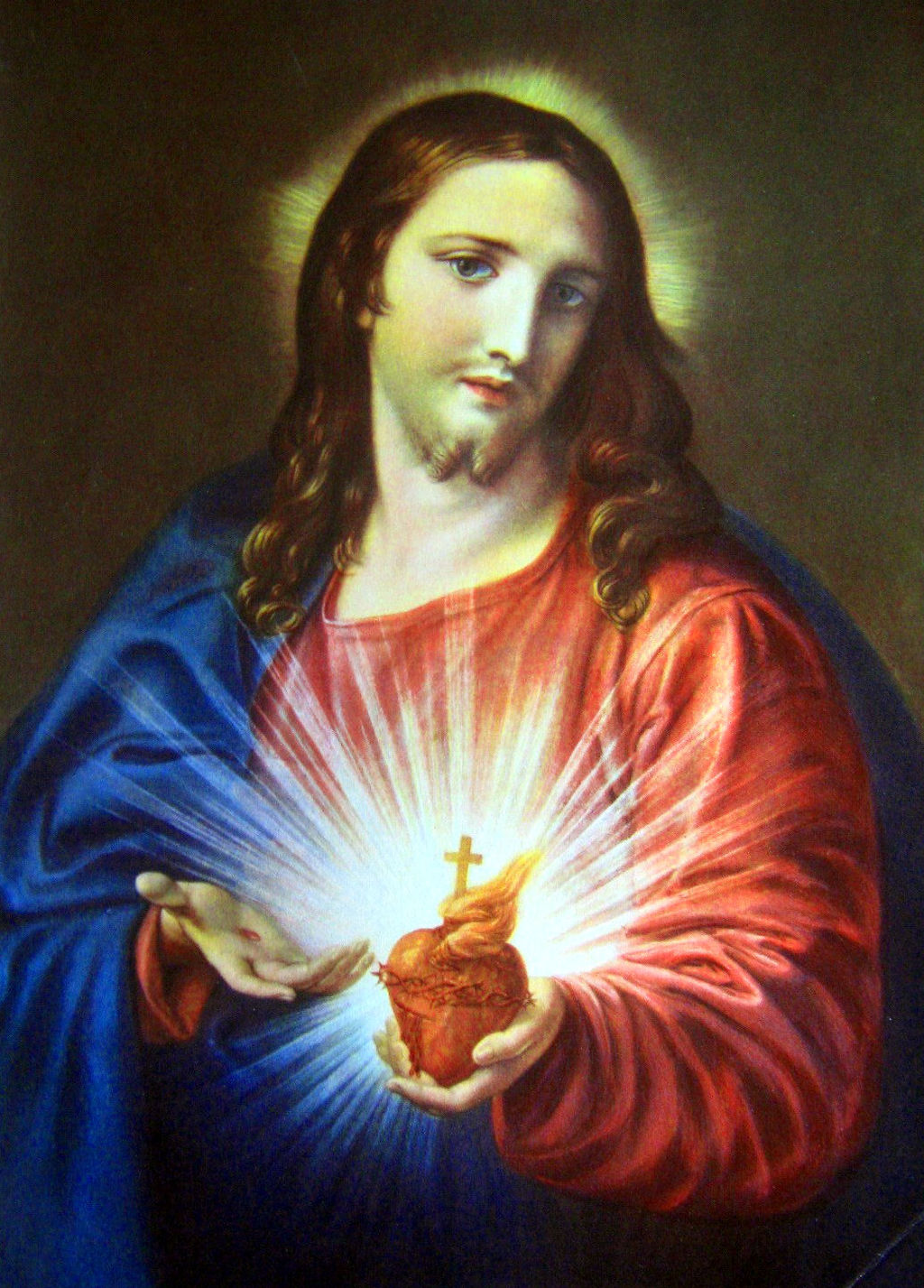
Sacred Heart of Jesus by Pompeo Batoni
The Feast of the Sacred Heart of Jesus is celebrated each year by the Universal Church 19 days after Pentecost Sunday. This year, the feast day falls on June 27. Since June is traditionally dedicated to the Sacred Heart of Jesus, let us take some time this month to reflect on this wonderful gift given to the Church through the private revelation of Saint Margaret Mary Alocoque in the small village of Paray-le-Monial, France in 1673.
The Sacred Heart of Jesus is not simply one devotion among many – it is the subject of all other devotions to Jesus Christ.
We know that private prayer is essential to growth in the spiritual life. Often, this includes particular devotions, whether to particular saints, to Our Lady in her many apparitions and with her many titles, or to the Persons of the Most Holy Trinity. When we pray to Jesus, we might do so with particular devotion to Him as the Healer, the Miracle Worker, the King, or the Good Shepherd. Devotion to the Sacred Heart of Jesus is not simply one devotion among many – it is the subject of all other devotions to Jesus Christ. It is the person of Jesus Himself.
Many people came to Jesus during his earthly ministry, drawn to him by his immense love for them. He healed them, taught them, and showed his power over nature and over the evil that had entrapped them. When we encounter the Sacred Heart of Jesus in prayer, we encounter the person who heals, teaches, and conquers evil in his essential being as the person who, first and foremost, loves. He is able to heal, to teach, and to conquer only with the love that he willingly pours forth from His Sacred Heart. It is not a devotion to one aspect of Jesus’ ministry. The Sacred Heart is His very person.
Christ offers us an intimate union with his Sacred Heart through the sacramental life of the Church. By the grace of our baptism, we can love as Christ loves. We are capable of a love that is infinite, if only we cooperate with the sacramental graces to remain united to His Sacred Heart. Frequent confession and reverent reception of Holy Communion offer the most intimate of encounters with His Sacred Heart, which is truly the Eucharistic Heart of Jesus.
The intimacy between Jesus and his priests is an intimate union of the heart.
Saint John Vianney, patron saint of priests, describes the priesthood as the “love of the heart of Jesus.” The object of devotion of the Sacred Heart is the real, physical heart of Jesus, which is sacramentally present, really and truly, in the Holy Eucharist. The Eucharist is Christ’s body and blood given for us on the cross, the body that contained His Sacred Heart.
For the priest, then, devotion to the Sacred Heart is a most certain meditation on his own identity, given to him on his ordination day. The intimacy between Jesus and his priest is an intimate union of the heart. The ontological change that occurs as a result of the sacrament is one of being – not of physical appearance or personality, but of the heart. This change in the heart gives it the capacity to love as Jesus loves, with an omnipotent love, because he is loving with the Eucharistic heart of Jesus.
The capacity for love and the way it manifests itself in ministry will reveal itself over and over again throughout a priest’s lifetime, and will often surprise him. The priest is called upon to minister in a wide variety of ways, but the one source of all these ministries is the heart. The priest teaches, heals, counsels, and absolves sin first and foremost as one who loves with the love of Jesus. He has a responsibility to be ever mindful of this heart he now has, and to be in constant and conscious relationship with this Sacred Heart of Jesus so he will remain aware of its capabilities and use them fully.
When people see a priest, they expect to meet Christ. If they don’t, they may move away from the Church, or feel justified that they already have. The priest must be an embodiment of the Sacred Heart. It is not by accident that the words of consecration and the words of absolution are in the first person. It is at these moments when the priest is most himself in his ontological being, in his heart. In these moments, he is Jesus saving souls with his omnipotent love, reuniting them to God the Father in heaven as the Sole Mediator.
We can bring this presence of Jesus into every aspect of our lives by being especially conscious of the presence of Jesus in His Sacred Heart and the means by which we encounter it. Enthronement of the Sacred Heart in the home, the Nine Consecutive First Friday Masses, the Consecration to the Sacred Heart, and reception of Holy Communion in reparation for those who do not love Him, are but a few ways to show love to the Sacred Heart, who loves us so much, and whose love gives us life itself.
Carmina Chapp teaches theology for Saint Joseph’s College Online.