“Naked, follow the naked Christ,” counseled St. Jerome. Physical nakedness would be much simpler (if rather awkward): we understand and can accomplish that, even daily. For most of us, spiritual nakedness is quite another matter. And yet, spiritual nakedness before God, what we usually call humility, is surely the requisite to hearing and following Christ. Our Jewish forefathers and mothers in scripture can give us insights into that humility when they respond to God with the simple answer, “Here I am.” If we look carefully at only a few of these instances, we see that each provides for us example of qualities necessary to the humility that enables us to listen to God’s voice.
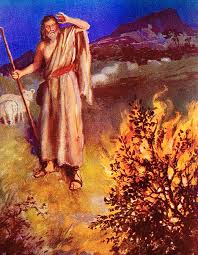 When Moses, innocently tending his flock (and probably bored stiff), came upon an angel “in a flame of fire out of a bush,” a bush that remained unconsumed, he said, “I must turn aside and look at this great sight, and see why the bush is not burned up.” And “when the Lord saw that he had turned aside to see, God called to him out of the bush, ‘Moses, Moses!’ And he said, ‘Here I am’” (Ex 3.1-3). We learn here that curiosity, the desire to know and to question, is a key to an openness that leads to the humility to hear and obey God.
Samuel, dedicated to God by his mother Hannah, serves under Eli. Samuel is lying down in the sanctuary: “Then the Lord called, ‘Samuel! Samuel!’ and he said, ‘Here I am!’ and ran to Eli, and said, ‘Here I am, for you called me.’” And we know the story. At the third repetition of this hilarious episode, Eli understood that it was God who was calling Samuel, and he told Samuel to say, “Speak, Lord, for your servant is listening” (1 Sam 3.1-10). Like Samuel, we need to listen to the wisdom of others, often our elders, to open ourselves to hear the voice of God.
Isaiah is in the temple when he is granted a vision of the Lord enthroned in the Holy of Holies, a vision that inaugurates Isaiah’s commission as a prophet (6.1-8). “Then I heard the voice of the Lord saying, ‘Whom shall I send, and who will go for us?’ And I said, ‘Here am I; send me!’” (One wonders if he had the same enthusiasm when commanded to walk around Jerusalem for two years quite literally naked!) Sometimes our openness begins in bowing before the wisdom of the generations in our inherited traditions, including those of ritual and symbol, to hear how God speaks to us through them.
And last but never least, there is the famous visit of the angel Gabriel to Mary of Nazareth (Lk 1.26-38). At his greeting, Mary “was much perplexed at his words and pondered what sort of greeting this might be.” Gabriel goes on with the typical angelic statement “do not be afraid,” apparently too fully in traditional messenger mode to notice that she has shown no fear! At Gabriel’s announcement of the role of her future son, Mary shows little of the impetuousness of her forefathers. Instead, she calmly asks the further reasonable question: “How can this be, since I am a virgin?” Only when Gabriel gives her a satisfactory explanation does she give the famed answer we tend to jump to when we recall this story: “Here am I, the servant of the Lord; let it be with me according to your word.” Humility does not necessarily mean immediate acquiescence; the gift of reason is given by God, and careful discernment often involves painstaking thought and many questions.
The desire to know, a willingness to accept the wisdom of others and of our tradition in story, symbol and ritual, and fearlessly asking the hard questions and being ready to think differently than we have before: these are not the totality of humility, but they are preconditions for it, the beginnings of recognizing “God’s humble love and our response to that love” (Sr. Ilia Delio).
Pamela Hedrick teaches Sacred Scripture for Saint Joseph’s College Online.