
The past 25 years have witnessed a dramatic-and tragic-effort to organize societies by violence. Networks and societies that associate themselves with Islam are the most  prominent today, but one could find earlier historical examples, such as revolutions inspired by the Communist Manifesto. The Al Qaida network led to the Islamic State of Iraq and Syria (ISIS), which has encouraged affiliations such as Boko Haram.
The efforts of these groups to organize society by violence necessarily attack the family, which by nature strives for peace. Catholic Social Doctrine helps us understand the harm done by these attacks on the family because it recognizes the family as the foundation of society.
Many people think that Catholic Social Doctrine is primarily concerned with activism concerning human rights, especially regarding the poor. It is that, but it is more. Catholic Social Doctrine really provides a view of society –how it is composed, its fundamental principles –that is compatible with the Gospel and the existence of the Church. Catholic Social Doctrine emphasizes that society is primarily a spiritual, not a material reality. We might be tempted, especially in a wealthy society, to think of society primarily in terms of its economic resources. But in paragraph 1886, the Catechism points out that authentic society forms around true spiritual goods, when they are valued and pursued together as a common goal. For this reason, we interpret the “common good” not merely in terms of the material, economic conditions of human flourishing, but primarily in terms of the spiritual goods that people pursue together and the virtues and practices by which they attain them.
The little society we call “family” is based on the very practical yet spiritual “goods of marriage”: the lifelong, sacred bond between the spouses, having and educating children, fidelity and exclusivity, the spouses’ mutual help in the pursuit of virtue and holiness as well as in the running of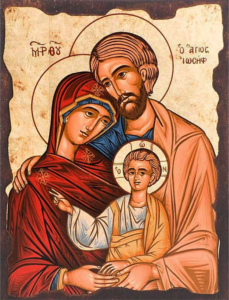 a household and in the parenting of children, and finally, for two baptized Christians, the spiritual (and practical!) sacramental good of their marriage as a sign of Christ’s union with the Church (CCC 1643-1654). The well-being of Society means recognizing and protecting the common goods of the marital and familial community. The Catechism also uses the word “communion” to describe the little societies called marriage and family (CCC 2205).
We can take each one of these goods of marriage and explain how spouses contribute to society, as well as build their own families, by pursuing those goods. Human love seeks the kind of permanent relationship established by the bond of marriage. By establishing this bond between them, a man and a woman show that special kind of love called “marital” exists in their society. A society without children disappears. A society benefits from educated people, and education begins with intimate knowledge of the kind that parents have for their children. Similarly, a society benefits from mature adults who can accept responsibility. Spouses can use their intimate knowledge of each other to promote their common growth in virtue and holiness (CCC 2206). Finally, spouses lead their families in organizing the material wealth of the society. For this reason, the Catechism calls the family “the original cell of social life” (CCC 2208).
Those who would organize society through violence pursue these social goods for their families while denying them to others. One of the most striking examples took place a year ago when Boko Haram kidnapped 270 girls and, according to news reports, began forced conversion to Islam. By killing or kidnapping, these groups deprive families of their own children. Where they systematically destroyed the family, they will succeed in destroying the society.
Recently the Nigerian Bishops Conference responded with Catholic Social Doctrine. In February of this year, their Plenary Meeting for 2015 developed the theme “Good Families Make Good Nations” and spoke about the nation as a “family of families.” They help us to recognize that violence not only deprives families of their children, but also deprives society of all the social goods that depend upon families.
Grattan Brown teaches Ministry to the Sick and Dying for Saint Joseph’s College Online.