Two Sundays for the price of one blog post! Last Sunday was Pentecost Sunday, a feast for the Church to recognize Christ’s ever new call to renewal. The Scripture readings for last Sunday present an interconnected web inaugurating a new reality. Like so much in Christianity, Pentecost has its roots in Judaism. The Jewish festival celebrates the Lord’s gift of the Torah to Moses. That is why, when the Holy Spirit descends and inspires the Apostles to speak in new tongues, Jews throughout the Diaspora recognize their own languages.
And they were all filled with the Holy Spirit
and began to speak in different tongues,
as the Spirit enabled them to proclaim.
Now there were devout Jews from every nation under heaven staying in Jerusalem.
At this sound, they gathered in a large crowd,
but they were confused
because each one heard them speaking in his own language.
They were astounded, and in amazement they asked,
“Are not all these people who are speaking Galileans?
Then how does each of us hear them in his native language?
We are Parthians, Medes, and Elamites,
inhabitants of Mesopotamia, Judea and Cappadocia,
Pontus and Asia, Phrygia and Pamphylia,
Egypt and the districts of Libya near Cyrene,
as well as travelers from Rome,
both Jews and converts to Judaism, Cretans and Arabs,
yet we hear them speaking in our own tongues
of the mighty acts of God. (Acts 2:4-11)
Jews and converts, the native and newly-arrived, Parthians, Romans, and Libyans—each heard his own language. What they hear the other readings illuminate: the Lord’s spirit sustains the world (Psalm 104), the Mystical Body of Christ (I Cor. 12), the spiritual foundations for new life in Christ (Galatians 6), and Christ’s promise of the Spirit—which proceeds from Him and God the Father—to the Church (John 15 & 20).
So at one level the Spirit’s presence at Pentecost recalls previous knowledge—God’s omnipresence. Yet Andrew Kim reminds us the list of nations in Acts 2 declares a new reality: that God’s other people fall within the divine vision, too. Kim:
This is the God who transforms those that society deems to be “no people” into a chosen people. This is the God of a universal covenant and a salvation so far reaching and complete that it flows through and beyond the simplistic binaries of human schemes as a great river crushing through straw or a mighty thunder overcoming a guilty silence. This is the God who is author of the human person.
The “no-people” category is a product of human limitations. In reality, there are God’s people and God’s other people, and even these two categories, I suspect, merge to form a unity the more closely one approaches the divine point of view. Admittedly, the reality of unity remains greatly obfuscated by the conditions of the world. However, this is the fault not of religion, but of sin.
St. John’s gospel indicates this as well as the new spiritual reality that is the Church. Not merely a collection of people, the Church because of and through the Spirit includes all. Therefore, the Church is made ever new because the very notion of its membership—who’s “in” and who is not—the Spirit itself remakes. This inclusivity recognizes differences instead of obliterating them. That is the gift of St. Paul’s message to the Corinthians. We are all parts of Christ’s body and we necessarily do not all do the same thing. Our gifts and talents must be brought to the Church’s service, but it stands to reason that what my colleagues accomplish might differ noticeably from what I can do. Kim’s commentary concludes the point—it is human sinfulness that prevents us from recognizing this intrinsic unity. It is already there—we just cannot yet see it fully. God already does, and thus, as John 20 indicates, the Spirit convey God’s Word to us.
Yet how might we keep this vision and Scriptural witness before us? Back in my Calvinist days I suppose I would have reiterated some vague point about divine sovereignty: God keeps in faith whom God will. Now a Catholic (since 1992!) I see a much more practical and quite frankly universal way to recall the Spirit’s inclusivity and novelty: the Rosary. Twice a week—Wednesday and Sunday—the Glorious Mysterious are recited. The third of these is…the Descent of the Holy Spirit. Following meditations on the Resurrection (there’s something new!) and the Ascension (wherein Christ leaves the earthly realm), the meditations on Pentecost lend themselves to the consideration of novelty and the Spirit’s invigorating presence. Vatican II and The New Evangelization inspired by the Council demonstrate on the macrocosmic level what the Rosary reiterates at the microcosmic: that the Spirit ever renews, and thus the hum-drum of our daily lives radiate with God’s presence. As one post-Rosary prayer beseeches, that through our Rosary meditations: “may we imitate what they contain and obtain what they promise.” Unity and the spirit of discovery provide the foundations for evangelization and charity.
This Sunday is the Solemnity of the Most Holy Trinity Sunday. The Spirit’s persistent call to, and offering of, the new—new ways of speaking, hearing, and acting—finds wonderful expression in Christianity’s most recognizable, yet inscrutable, teaching. Yet, again, the Scriptures make this very clear. God can, has, and does speak directly to people He chooses (Deuteronomy 4:32-40). The Psalmist (#33) celebrates both those whom God chooses to be His Own as well as all creation. Through ways general and specific God’s presence and power are made known. In a reference that surely recalls Pentecost Sunday, St. Paul reminds the Romans that through adoption we in Christ’s spirit are God’s children, too (Romans 8:14-17). (Jews, Paul thus implies, remain God’s children, too, thus brushing aside any concerns about possible contradictions between Christian Trinitarianism and Jewish monotheism.)

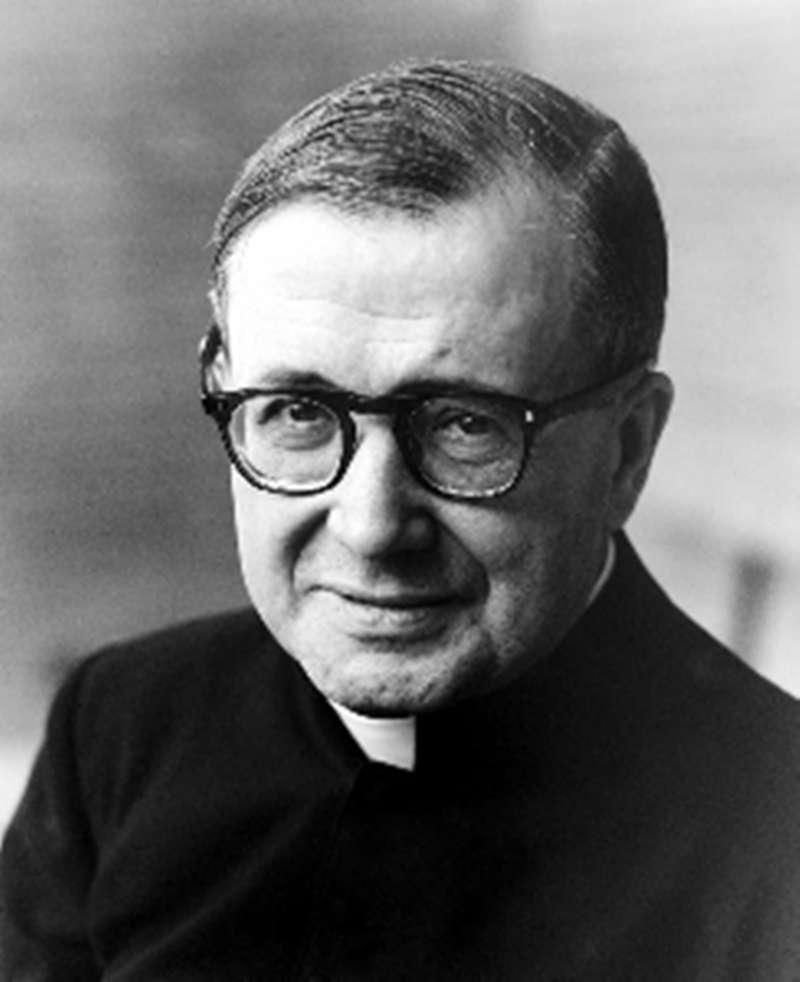
St. Josemaria Escriva built Opus Dei around the notion of “divine filiation,” i.e., how recognition that we are God’s children sparks continual conversion…and confidence. The Way #860 reads:
Before God, who is eternal, you are much more a child than, before you, the tiniest toddler.
And besides being a child, you are a child of God. — Don’t forget it.
Don’t forget it. This echoes Trinity Sunday’s Gospel: Matthew 28: 16-20. The disciples go to and worship Jesus, “but they doubted” Matthew records. Then:
Then Jesus approached and said to them,
“All power in heaven and on earth has been given to me.
Go, therefore, and make disciples of all nations,
baptizing them in the name of the Father,
and of the Son, and of the Holy Spirit,
teaching them to observe all that I have commanded you.
And behold, I am with you always, until the end of the age.”
Don’t forget…that you are children of God…because 1) I give you an absolutely essential task; and 2) you are not alone. Thus the Church goes forth, inspired and consoled by Christ’s own spirit. Thus Pentecost continues ever anew as the Church goes about its task which, as Pentecost Sunday told us, overcomes the boundaries between them and us. We will not always succeed, but that’s why St. Josemaria reiterated his insight about divine filiation. Just like any good parent, God the Father will never ceases to love the child. It is wise as children, though, to remain close to our Father. With the Holy Spirit, who proceeds from the Father and the Son, guiding us, though, how could we do otherwise?
That the one God exists in three Persons—Father, Son, and Holy Spirit—still inspires faith while confounding the wise. And “wise” in this case could mean anyone who simply refuses to break from conventional thinking. During graduate studies in Nashville, Tennessee, one of my jobs involved unloading delivery trucks. One hard-working guy, an evangelical Protestant, captured several centuries of consternation by recounting a Bible study (on Matthew 28!) he and his wife had attended: ‘She read “Father, Son, and Holy Spirit” and tells me that’s all one God. But, Jeff, when I read that same passage, that says to me three. Now how can that be?” Facing a fully-loaded truck, I took the easy way out, muttering something like “that very question has confused people for years.” That isn’t an exaggeration or a lie, but it doesn’t offer much, either. There are many resources for understanding the Trinity’s reality. However, at some point almost all attempts fall far short. The Trinity—Father, Son, and Spirit—unifies Christianity’s messianic narrative, which with Jesus’ crucifixion and resurrection challenges our rationality, with the past, present, and future. The same God who chose the Jews also became human in Jesus who died and rose again and that same God’s spirit, now shaped by the Incarnation, remains with us now. Thus the Trinity offers the foundations for both theodicy (why bad things happen to good people) and ethics (how we act towards ourselves and others). The Spirit abides with us throughout. Yet grabbing this requires more than mere rational assent. St. Augustine of Canterbury’s dictum still holds true: credo ut intelligam—I believe so that I might understand. Sometimes this faith needs something traditional like the Rosary to assist the acquisition of such knowledge.
Guest blogger Jeffrey Marlett blogs at Spiritual Diabetes.
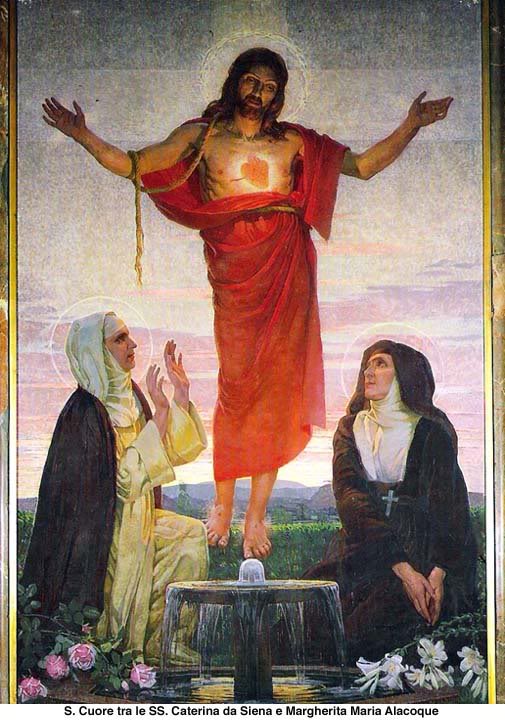 Today begins the Novena to the Sacred Heart of Jesus, whose feast we will celebrate next Friday, June 12. Jesus revealed the devotion to Himself in His Sacred Heart to St. Margaret Mary Alacoque in Paray-le-Monial, France between the years 1673 and 1675. It is a very powerful devotion, with overwhelming effect. Many of the saints have come to know and love Jesus in His Sacred Heart. Pictured here are St. Margaret Mary with St. Catherine of Siena, two of my heroines in faith.