
Marriage and Family: The Original Cell of Social Life

The past 25 years have witnessed a dramatic-and tragic-effort to organize societies by violence. Networks and societies that associate themselves with Islam are the most Boko Haramprominent today, but one could find earlier historical examples, such as revolutions inspired by the Communist Manifesto. The Al Qaida network led to the Islamic State of Iraq and Syria (ISIS), which has encouraged affiliations such as Boko Haram.

The efforts of these groups to organize society by violence necessarily attack the family, which by nature strives for peace. Catholic Social Doctrine helps us understand the harm done by these attacks on the family because it recognizes the family as the foundation of society.

Many people think that Catholic Social Doctrine is primarily concerned with activism concerning human rights, especially regarding the poor. It is that, but it is more. Catholic Social Doctrine really provides a view of society –how it is composed, its fundamental principles –that is compatible with the Gospel and the existence of the Church. Catholic Social Doctrine emphasizes that society is primarily a spiritual, not a material reality. We might be tempted, especially in a wealthy society, to think of society primarily in terms of its economic resources. But in paragraph 1886, the Catechism points out that authentic society forms around true spiritual goods, when they are valued and pursued together as a common goal. For this reason, we interpret the “common good” not merely in terms of the material, economic conditions of human flourishing, but primarily in terms of the spiritual goods that people pursue together and the virtues and practices by which they attain them.

The little society we call “family” is based on the very practical yet spiritual “goods of marriage”: the lifelong, sacred bond between the spouses, having and educating children, fidelity and exclusivity, the spouses’ mutual help in the pursuit of virtue and holiness as well as in the running ofHoly Family a household and in the parenting of children, and finally, for two baptized Christians, the spiritual (and practical!) sacramental good of their marriage as a sign of Christ’s union with the Church (CCC 1643-1654). The well-being of Society means recognizing and protecting the common goods of the marital and familial community. The Catechism also uses the word “communion” to describe the little societies called marriage and family (CCC 2205).
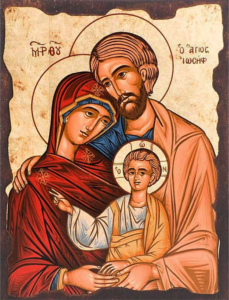
We can take each one of these goods of marriage and explain how spouses contribute to society, as well as build their own families, by pursuing those goods. Human love seeks the kind of permanent relationship established by the bond of marriage. By establishing this bond between them, a man and a woman show that special kind of love called “marital” exists in their society. A society without children disappears. A society benefits from educated people, and education begins with intimate knowledge of the kind that parents have for their children. Similarly, a society benefits from mature adults who can accept responsibility. Spouses can use their intimate knowledge of each other to promote their common growth in virtue and holiness (CCC 2206). Finally, spouses lead their families in organizing the material wealth of the society. For this reason, the Catechism calls the family “the original cell of social life” (CCC 2208).

Those who would organize society through violence pursue these social goods for their families while denying them to others. One of the most striking examples took place a year ago when Boko Haram kidnapped 270 girls and, according to news reports, began forced conversion to Islam. By killing or kidnapping, these groups deprive families of their own children. Where they systematically destroyed the family, they will succeed in destroying the society.

Recently the Nigerian Bishops Conference responded with Catholic Social Doctrine. In February of this year, their Plenary Meeting for 2015 developed the theme “Good Families Make Good Nations” and spoke about the nation as a “family of families.” They help us to recognize that violence not only deprives families of their children, but also deprives society of all the social goods that depend upon families.

Grattan Brown teaches Ministry to the Sick and Dying for Saint Joseph’s College Online.
Who Said This Was Going To Be Easy?

Lenten discipline requires the reconsideration of our spiritual state.

Deacon Scott Dodge (a great blog to follow after the St Joseph’s College Theology blog!) provides a thoughtful connection between popular culture and classic Christian art, specifically Grunewald’s Isenheim altarpierce, here. Deacon Scott: “The failure of our own words, of our ability to comprehend and articulate the greatness, the height, length, and depth of love of God’s great love for us should drive us to God’s word.” He then quotes Romans 5:6-9, but I would rather reflect on today’s Gospel, Matthew 5:11-17:

Jesus said to his disciples:
“Do not think that I have come to abolish the law or the prophets.
I have come not to abolish but to fulfill.
Amen, I say to you, until heaven and earth pass away,
not the smallest letter or the smallest part of a letter
will pass from the law,
until all things have taken place.
Therefore, whoever breaks one of the least of these commandments
and teaches others to do so
will be called least in the Kingdom of heaven.
But whoever obeys and teaches these commandments
will be called greatest in the Kingdom of heaven.”

Each of the four Gospels brings its own voice, comforts, and challenges to the story of Jesus Christ’s life, death, and resurrection. Among Matthew’s many gifts (e.g., 16:18-20), I find most rewarding and provocative Chapter Five’s intensifications of the Jewish Law. Thou shall not murder? Well, even if you’re angry with somebody, stop what you’re doing and seek reconciliation. Thou shall not commit adultery? That’s not enough—do not even look another lustfully. So much for the nice, domesticated Jesus we like to tell ourselves we already resemble. No, in Matthew’s gospel Jesus holds us to a higher, not lower, standard. And this is the Word of God to which Lent inexorably drives us, not a Jesus who confirms our smugly-held opinions, nor a Jesus who simply ignores our sins. As G. K. Chesterton so aptly put it, “the Christian ideal has not been tried and found wanting. It has been found difficult and left untried.” Who said this was going to be easy?

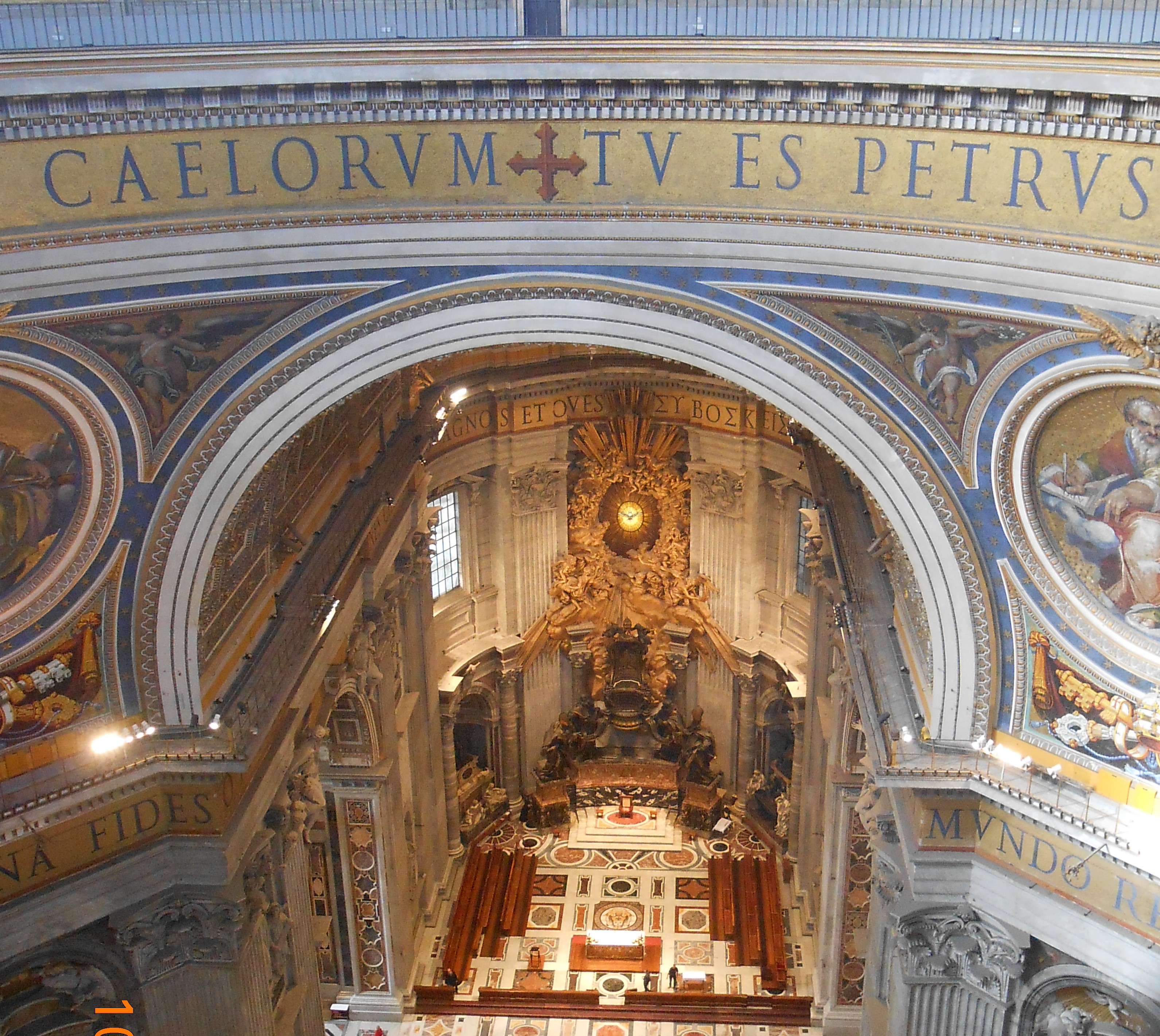
Bernini from St Peters domeThe Lenten stereotype depicts the unwillingly ascetic Catholic wallowing in self-abnegation. I, though, found Deacon Scott’s words about God’s greatness reminded me of the Swiss Reformed theologian Karl Barth (1886-1968). Barth often stood quite opposed to Roman Catholic theology, even as he avidly read St. Augustine and St. Anselm (among others). Good Calvinist that he was, Barth began his theology with the absolute sovereignty of God. Mankind cannot save itself; only God can do that. Barth asserted God’s NO! to all human pretensions to religious agency and self-direction. The YES that comes in the Incarnation overcomes that negation, but, Barth believed, the NO still remained. That, in part, was made grace what it was—thoroughly unmerited.  While he spent far more time and ink lambasting fellow Protestants, Barth always considered standard Roman Catholic spirituality a target of that divine NO! Thus it is seems rather ironic that Wikiquote welds Barth’s famous words of YES and NO to…Gian-Lorenzo Bernini’s Holy Spirit stained-glass window gracing the western wall of St. Peter’s Basilica.

Gone are the days when I accepted prima facie everything Barth wrote. Deo gratias! However, occasionally a little Barth reinvigorates the theological project. Barth’s insistence on divine sovereignty resonates with the Gospel image of Jesus declaring the Law’s enduring presence. Not only that, but the NO! extends to our own teaching. Since the Law remains valid, we simply cannot invent what we want and disregard what we dislike. Knowledge of the Law implies teaching the whole Law. We can’t blunt the sharp edges to make it “nicer.” With his customary brevity and sharp insight, Father Robert Barron critiques this facile presumption that being Christian means being nice. Father Barron doesn’t mention Barth—he doesn’t need to—but the point remains: God calls us to something greater than merely being nice to each other.

While it wanders off to once-current issues, this post from my own blog addresses the same point through the lens of an Augustinian critique of American evangelical eschatology. It wasn’t until I had read St. Augustine that I began to understand my dislike for Protestant eschatologies: they were too easy and too self-assured. Chapter Five of Matthew’s gospel offers the initial, damning criticism: this will not be easier—quite frankly, it will be more difficult than before! That is a tough message to hear, which perhaps is why Christian history is filled with those seeking waivers. Christian theology is filled with so many false starts because of the failure to confront honestly today’s gospel: Jesus comes not to abolish, but to uphold, the Law which, by the way, remains very much in effect. It is to such stark reminders that Lent calls us.

Quite frankly, we don’t always start where we should. I started with St. Augustine, and then only later realized that St. Augustine himself points us all back to the Gospel (and thus the Gospels). And there we find both the negation of our human pretensions and yet simultaneously the reaffirmation of God’s love for us—in the same person, Jesus. So will the Way of Jesus be an easy ride? More than likely no—in fact, it can be quite bumpy and crooked. What was that about not abolishing? Yet Jesus also tells us: “I AM the Way, the Truth, and the Life” (John 14:6). So it is not easy, but it will be worth it—and along the way we receive life itself.

Guest blogger Jeffrey Marlett blogs at Spiritual Diabetes.