Immigration and the Kingdom of God

Worth Revisiting Wednesday! This post originally appeared on March 26, 2014.

Recently, I was fortunate to attend a lecture on the theology of migration by Fr. Daniel Groody (Notre Dame) at St. Peter’s Church in Charlotte, NC. The following quotation from his article in Theological Studies indicates the themes:

The visio Dei [vision of God] also challenges people to move beyond an identity based on a narrow sense of national, racial, or psychological territoriality. It holds out instead the possibility of defining life on much more expansive spiritual terrain consistent with the kingdom of God. Corresponding with the positive dimensions of globalization that foster interconnection, it challenges any form of ideological, political, religious or social provincialism that blinds people from seeing the interrelated nature of reality. http://www3.nd.edu/~dgroody/Published%20Works/Journal%20Articles/files/TSSeptember09Groody.pdf

I began thinking of how the Gospel of Luke explores similar issues. On Gabriel’s announcement of her upcoming pregnancy, Mary’s response is to ask an intelligent question to this oddly invasive and unsolicited migration of God. “The angel said to her, ‘The Holy Spirit will come upon you, and the power of the Most High will overshadow you’” (Lk 1:35), the same image as the presence of God filling the tent of meeting (Ex 40.34); in other words, Gabriel uses the image of God migrating with the Hebrew people after leaving Egypt. Only then does Mary make a commitment to the kingdom of God rather than to social custom. The requirements to build the kingdom of God, foretold in covenantal theology, trump the local laws of humans.

This commitment sets a tone for the Gospel, in which we see various examples of those who will, and who won’t, migrate with the kingdom of God. We find, for example, a parable of a man with excess grain. Surprised by unexpected bounty, the man asks himself (not God, not his priest, not his neighbor): “What should do, for have no place to store my crops…” (Lk 12.12). His first person soliloquy continues; then he is condemned as a fool by God. This man won’t budge an inch from his own concerns, and by staying stationary in every way, refuses to see “the interrelated nature of reality” and thus rejects all covenant relationships. In contrast, outcast and tax collector Zaccheus breaks strict social rules in several ways, and Jesus responds in like manner. The encounter outside the boundaries creates conversion, and salvation came to that house (Lk 19.10).

Pamela Hedrick teaches Sacred Scripture for Saint Joseph’s College Online.
“What’s love got to do with it?”

In my own prayer this summer, I’ve been using a collection of prayers from the great American Catholic writer, Flannery O’Connor. The prayers were part of a journal that was recently found among her papers. They are the prayers of a young struggling writer who wants her faith to inform her writing and her writing to be a work of faith. The collection is called A Prayer Journal.

In one of the journal entries she is writing about the importance of a thread in writing a novel. The thread, she writes is “a view of the world behind it & the most important single item under this view of [the] world is the conception of love—divine, natural, & perverted” (O’Connor 30). She continues to reflect on how many of our great writers, Freud, Proust, Lawrence “have located love in the human & there is no need to question their location; however, there is no need either to define love as they do—only as desire, since this precludes Divine Love, which while it too may be a desire, is a different kind of desire—Divine desire—and is outside of man and capable of lifting him up to itself” (O’Connor 30).

O’Connor saw this way of defining love as primarily an emotion as a real problem for the modern heart, which was becoming increasingly “divorced from faith” (O’Connor 31). She writes “The modern man isolated from faith, from raising his desire for God into a conscious desire is sunk into the position of seeing physical love as an end in itself” (O’Connor, 31). This, though written more than 50 years ago, is at the heart of the debate today on the definition and meaning of marriage.

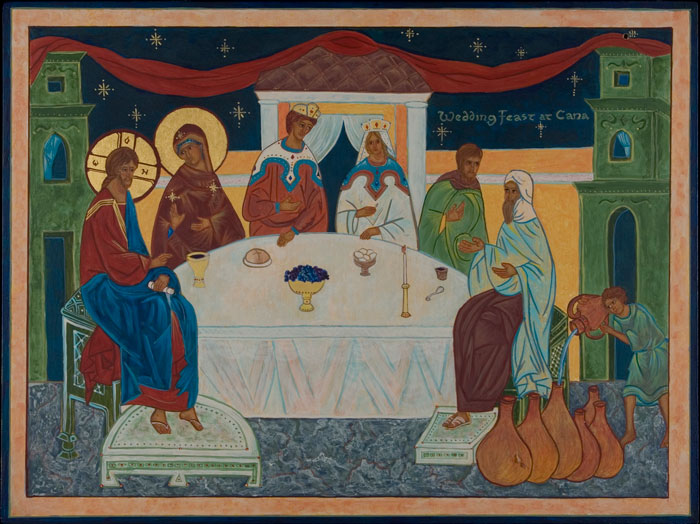
Wedding-Feast-at-Cana1Recently, I was asked to be part of a panel at the Catholic Information Center reflecting on the impact of the Supreme Court’s decision to legalize same-sex marriage. I was asked to address the theological and pastoral implications of the decision. One of the pastoral implications is both a challenge and an opportunity to give witness to that which makes a sacramental marriage different. I suggest what makes a sacramental marriage different is the way in which the Church understands love. As Flannery O’Connor writes, the love we are called to share in marriage is a divine love. Married love is a self-sacrificing and self-giving imitation of Jesus’ self-giving love. The married love of man and woman couple is a visible sign for the world of God’s faithful and fruitful love. What made this presentation so interesting was the centrality of defining what love means and what love has to do with marriage.

Please follow this link to view the complete presentation which includes President John Garvey of The Catholic University of America and Helen Alvaré, of George Mason University.

Susan Timoney is Secretary for Pastoral Ministry and Social Concerns for the Archdiocese of Washington and teaches spirituality for Saint Joseph’s College Online.