Joy and Suffering: Living with ALS

In January 2011 I was giving a presentation on bioethics at my parish, and just after the presentation started a man hobbled in on a cane. A few months later I was giving another presentation on the same topic, and a man entered the room in a motorized wheelchair. I puzzled for a few moments because it looked like the same man. As I continued with the presentation I realized that it was indeed the same man. It was rather unnerving to be able-bodied, in good health, and speaking about ethical issues so closely related to the suffering of the sick, while this man, who was clearly suffering from a debilitating disease, was there listening intensely. I couldn’t help wondering what it was like to be grappling with these issues “from the inside”—so to speak.

Marty and I met soon afterwards. We discussed our common interests and goals: we were both striving to be good husbands and fathers. Marty recounted stories of work and play around the horse farm where he and his family live. He spoke about arranging horse jumps for his daughter Cecilia, clearing brush from the woods behind the house, laying up firewood for the winter, cleaning out the horses’ stalls, and myriad other chores. In our discussions about bioethics he drew upon his medical expertise, built up over eleven years as a successful, interventional radiologist.

Marty was also interested in my literary and theological background. He asked me to read the rudiments of his spiritual autobiography. I asked questions that prompted him to think more deeply about the meaning of the joys and sufferings he was experiencing. At times I felt as though I was giving him “work” to replace the professional life lost to ALS. And what a “worker” he has been! His spiritual autobiography, Joy and Suffering: My Life with ALS, was dictated through an iPhone into emails, initially, and then into a document that was edited by Christian Tappe of St. Benedict Press.
D'Amore

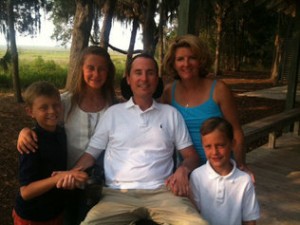
Photo of D’Amore Family at Lou Gehrig’s Disease – ALS website

In many ways, Marty is a typical American guy, but there is definitely something special about him. He is inspired by the meaningful lives other people lead, for example, by the doctors who first showed him the beauty of a medical career and motivated him to pursue it. He has been given given plenty of natural intelligence and talent, and as a young man he struggled to discover and develop himself. He worked hard at his profession, marveled at the good he could do with it, and reaped its rewards. He has been wildly successful—by American standards—in his profession, family, and lifestyle.

More importantly, Marty demonstrates a kind of spiritual excellence. Not the spiritual excellence of the great ascetics of history, who master temptation with an iron will honed through self-denial. Rather the spiritual excellence of one who has prayed with a child’s trust for a good life, lost himself in the confusion of growing up, found the way his talents could lead to success, and finally, as he achieved success, recognized something missing even before detecting the first symptoms of ALS. ALS focused his heart and mind on another kind of success: developing spiritual maturity. By slowly eliminating his physical mobility, ALS forced Marty to find new ways to love his wife, children, and friends. His book offers Marty’s explanation of what he has learned in the hope that his family can discover, with him, some joy within the tragedy that has befallen them all.

Spiritual conversion is the stuff of great literature and epic poetry, but we are not usually given the privilege of a guided tour of this process unfolding in the lives of our neighbors and friends. We all change profoundly as we move through life, and know that our neighbors change in similar ways, but rarely do we get the opportunity to understand that change from the inside. In Joy and Suffering: My Life With ALS, Marty describes the experience of suffering with ALS, depicting not only the intricacies of the disease but also the hard-won meaning of the suffering it has brought him and his family.

This blog post was adapted from the Foreword to the book Joy and Suffering: My Life with ALS by Martin J. D’Amore.

Grattan Brown teaches Ministry with the Aging, Sick, and Dying for Saint Joseph’s College Online.

Update: Marty D’Amore died on January 28, 2015 surrounded by friends and family.  He was laid to rest in Belmont Abbey monastery cemetery, a few 100 yards from the chapel where he often prayed.


Top Ten Lessons Learned on My Camino

Last week I introduced why, during the Year of Faith, I decided to take a pilgrimage on the Camino de Santiago. This week, I would like to share the lessons I learned. I chose to walk 130 kms during my time on the Camino. They say that the Camino is symbolic of the journey of life.

Day One: I saw people of every nation drawn to this pilgrimage and would, as my walk unfolded, find out many of the reasons why people made this journey. Most pilgrims that I met, like myself, were journeying alone and, like myself, wanted time to reflect and find solitude from a very busy life. The hours of quiet reflection, prayer, and the rhythm of walking opened a bigger space for God. On the journey, I deepened my understanding of perseverance, virtue, trust, confidence, community, belief, doubt, fear and hope.

Days One through Three were days that I walked on my own, at my own pace and taking2013-08-14 09.52.13 in the beautiful sights and sounds of pure, undeveloped countryside. I met very few pilgrims. Due to the physicality of these three days, doubts crept in, and I wondered about the possibility of finishing. I realized I had packed too much and kept divesting myself of needless items. So began my Top Ten Life Lessons:

10. Take time to enjoy the beauty and the richness of the moment.  It does not return to you.  Allow all the senses to be engaged in the journey of life.

9. Work hard but also along the way take the moment for a siesta or moments of rest and rejuvenation because it is truly renewing and gives a whole new perspective. Find rest for the soul, mind and body.

8. Pack only what is needed for the day, God does provide both the strength and the necessities. Often the necessities come from those whose path you cross. As pilgrims, we shared the little we had and at the end of the day somehow one’s provisions seemed to have increased rather than decreased.

Recall that I shared that I had brought several pounds of prayer intention envelopes.   I promised that I would bring the envelopes back, unopened, so that the intentions would remain private. I had asked however, that a Scripture verse or inspirational saying be written on the outside. The weight of these intentions bore down on me as body aches increased. I was, on more than one occasion, tempted to leave them behind. I felt responsible to fulfill the promise and to pray for these intentions entrusted to me.   These envelopes and the people they represented became for me a living word. The Scripture verses and the inspirational messages became my spiritual nourishment along the way (having left all my spiritual books behind on day two). High above the plains, watching the rolling hills become visible as the sun drove the morning fog away, I pulled out an envelope and read 46:11 ““Be still and know that I am God!” In the moments I thought I could go no further, Mother Theresa’s words were before me, “Be faithful in small things because it is in them that your strength lies.” My marching song became what my eye doctor wrote on his envelope, “Holy Spirit, live in me, possess my mind, my heart, and my soul.”

Day Four. I prayed for companions to walk with as it was going to be my longest day of 2013-08-17 12.54.45walking and a rather strenuous terrain. The prayer was no sooner out of my lips than four women said “buen camino”, which means “good way” and in Spanish asked if I would like to walk with them! The envelope that I read this day had this beautiful prayer: “Gracious God thank you for the gift of today. Refresh me! Invite me to discover your presence in each person that I meet, and in every event I encounter.” I continued learning lessons:

7. If walking is like virtue… the more it is practiced, the stronger we become and the easier it is for me to practice a particular virtue.

6. Like the walking staff, lean on God. Leaning not on my strength but on the staff (God) I kept my footing when I’d trip against a stone. In the pilgrimage of life, look to God to find guidance and help up the big hills along the path.

The final part of the Camino becomes much busier with pilgrims who are walking the minimum required for the “compostela,” a signed certificate of completion.   These last remaining days spoke to me about life’s journey, our destination, the joys and struggles of life. Somehow, this stage of the journey gave me pause to think of the last stages of life. More people, commercialization, and less silence began to edge into my solitude and take my focus off my purpose for this journey. The path markers which were so very clear and visible along the way seemed to become less so closer to the end of the pilgrimage.

5. It is work to maintain silence and solitude. Silence and solitude is necessary to hear God’s voice and to discern his will. Don’t get caught up with the stream of harried people without focus on the true meaning of the journey.

4. When one is older the challenges of life are more difficult, what was once easy to accomplish, due to fatigue and weakness, becomes harder. Every aspect of our journey matters and prepares and strengthens us for how we will finish the pilgrimage.

3. Like the markers along the path, we must be certain that we keep looking for the sign-posts of life, keeping always before our eyes what is needed for the journey: Christ, the Sacraments; the commandments and beatitudes, prayer, and community. Thus we can be assured that we are on the right path.

2013-08-22 12.52.11My last day of walking seemed endless, so often I thought I was there, and then I realized I still had miles to go. I yearned to see the sight of the Cathedral. It was so close yet it seemed so far, uncertainty and doubt crept in challenging my trust in God and my peace. Then suddenly there was the Cathedral in all her magnificence larger than life!

Exhaustion invading every fiber of my being, the sight was so radiant, so welcoming, so consoling. Doubt is cast out, hope restored. I run (permit me my delusion here,   I walked faster anyway) towards the Cathedral with sheer joy. I hear in my mind Isaiah 40:43 (written on front of one of the envelopes), “But those who hope in the Lord will renew their strength. They will soar on wings like eagles, they will run and not grow weary, and they will walk and not grow faint.” I entered the Cathedral and on the side altar, placed my many, many intentions on it and had an overwhelming sense of the living reality of the communion of saints. While I carried the intentions of many, the many who gave me their intentions carried me with their prayers and the words they had written for me to meditate upon. During my journey, I met eight people, who were significant to my journey. It was during my time in the Cathedral that I again, without any plan, saw these eight people in the Lord’s house. My final two lessons:

2. Let us go rejoicing to the house of the Lord. Because of my relatives and friends
I will say, “Peace be within you!” Because of the house of the LORD, our God,
I will pray for your good. (Psalm 122). Our destination is to the Lord’s house and we do not make the trip alone. We will be greeted by those who have gone before us.

And the number one lesson I learned…..

1. God is my true, everlasting Companion and He will not leave me orphaned.  

Lisa Gulino is Director for the Office of Evangelization and Faith Formation in the DIocese of Providence and teaches ministry for Saint Joseph’s College Online.