
What’s the difference?

The Gospel reading for today (Mk 1:40-45), the last Sunday before Lent begins, provides a direct link to what Pope Francis discusses in his Message for Lent 2015.

While the title of the Message is “Make Your Hearts Firm,” Francis writes from his greatest concern over a “globalization of indifference. … a problem which we, as Christians, need to confront.” The whole salvation message, that Jesus came, was incarnate, lived, breathed, taught, and healed, was crucified, died, was buried, and rose from the dead, leads us to believe that God is not indifferent to us and to our world.

In today’s Gospel reading, a man with leprosy essentially says to Jesus, “if you care, you can make a difference in my life.” Jesus was not indifferent; he was moved with pity and reached out his hand – a movement of caring, compassion, personal risk, and desire to make a difference in the life of another person. “Christians are those who let God clothe them with goodness and mercy, with Christ, so as to become, like Christ, servants of God and others.” (n. 1)
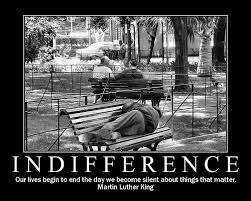
indifference3The world is big, her problems are many, and with so much information instantly available to us, it can be overwhelming. “What difference can I make?” I ask myself. As I write this, it is snowing yet again. Each individual snowflake might seem insignificant, but the combined effect of the snowflakes makes mountains of snow – stops traffic, bends trees, and sags roofs – and who is to say that it isn’t just one more snowflake that would cause the tree or roof to break? While the effects of snow might be destructive (if not merely inconvenient!) it provides a good example of the impact of the efforts of each of us. We make a difference every time we choose to act with intentionality – with compassion.

The call to Consecrated Persons this year is to live the present with passion. Passion is as far from indifferent as one can get! In this Lenten Message, Pope Francis says, “how greatly I desire that all those places where the Church is present, especially our parishes and our communities, may become islands of mercy in the midst of the sea of indifference!” (n. 2)

How do I witness the indifference of society? Do I feel that my efforts are of no use and fall into the safety of indifference? “As individuals too, we are tempted by indifference. Flooded with new reports and troubling images of human suffering, we often feel our complete inability to help. What can we do to avoid being caught up in this spiral of distress and powerlessness?” Pope Francis asks (n. 3). With this question, he offers us three answers:

  • First is the call to prayer. To pray is not to do nothing! To truly pray for the needs of my brothers and sisters means that I have allowed their need to enter into my heart, that I recognize an injustice, that I acknowledge our interconnectedness – our communio.
  • Second is the call to action. “We can help by acts of charity,” the Pope tells us (n. 3). We cannot solve every problem on our own, but we can help and contribute to organizations that work for the good of our sisters and brothers both near and far. During Lent, what if I decide what to give out instead of what to give up?
  • Third is the call to conversion. The recognition that members of my family, my human family, are in need, “reminds me of the uncertainty of my own life and my dependence on God and my brothers and sisters.” (n. 3) This balance of needing both God and others is to keep my feet on the ground – I am not the savior of the world, nor am I the savior of myself!

I am limited and needy and therefore can find that vulnerable place of communion with those whose need might be a little more obvious – the person with “leprosy” who crosses my path and says to me, “if you care, you can make a difference in my life!” The choice, to not be indifferent, to make a difference is enough to change the world one person, one encounter, at a time. What will you give out this Lent?

Sr. Kelly Connors teaches Canon Law for Saint Joseph’s College Online.
The Jesus Effect

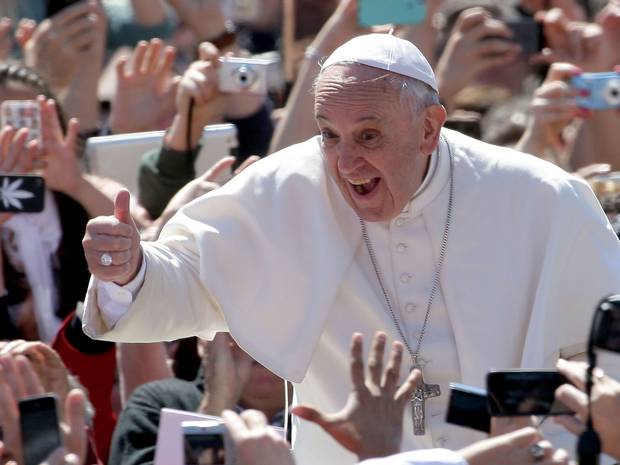
pope-francis-vaticanMuch has been made of the so-called Francis Effect in the public relations game the secular media plays with the Church. At first, it seemed a boon to the Church, though the jury is still out as to its lasting impact. But even Pope Francis himself would agree that it is not the Francis Effect that we want in our lives. It is a genuine encounter with Jesus Christ, the Son of God. We want the Jesus Effect.

The name Jesus means “God saves”. We hear these phrases often – “Jesus saves” or “You must accept Jesus as your personal Lord and Savior.” And these things are true. Jesus does save us from the power of sin, and he is very, very personal. He knows each one of us intimately, and longs for us to know him just as well.

In coming to know Jesus, we come to know our true selves. We are made in the image and likeness of God. We know this God has revealed himself to be nothing other than LOVE itself. God is love – we read it in John’s Gospel. We are made in the image and likeness of LOVE. When you look in the mirror, do you see LOVE looking back at you?

We all try to be loving people. And we know from experience that when we love, we are happier. If we are made in the image of LOVE, then, when we love, we are being our true selves. This is why the more we get to know Jesus, the more we come to know our true selves. We are made to love. We are made to love and to be loved. We are always loved by God – this is what enables us to know how to love others (and to actually do it!). The power of this love is far more powerful than the power of sin. Both powers are more powerful than we are. We easily become “slaves to sin” because, without the power to overcome it, we can only give in to it. But with the power of love – AH. We are no longer slaves – we are free to love, free to be our true selves. You can see why it is so important to be in relationship with Jesus always, to seek him out, and to value every encounter with him.

I struggle to find words that adequately describe the power of this love experienced in an encounter with Jesus. Powerful, yes. Safe and secure. Energizing. Liberating. I think depending on where we are in our lives and what challenges we are facing, this love will have a different effect on us. It is interesting to look at some examples from the Scriptures of people who encountered Christ, and ponder the Jesus Effect in their lives.

John the Baptist (Luke 1:39-45/ Matthew 3:13-17)

visitation-1John the Baptist first encounters Jesus while both are still in their mothers’ wombs! When Mary arrives for her visit to Elizabeth, John leaps in her womb – he leaps for joy. He recognizes the presence of Jesus, and is happy – so happy he can’t control himself. He wants to come out and play with Jesus. The joy present in that moment is immense.

Can you think of a moment when you encountered Jesus and simply experienced pure and utter joy?

This same boy who recognized Jesus from his first encounter becomes the one who facilitates the beginning of Jesus’ ministry to the world. John was baptizing people as they acknowledged their sins, but he was always fully aware that he was merely preparing people for their encounter with Jesus – calling them to repentance so that when the One who could forgive sin and conquer it –really take its power away – arrived, they would be ready to hand over their sins and be purified with love. John knows that Jesus does not need to be baptized for the sake of forgiving his sins – Jesus doesn’t have any! But Jesus tells him to do it anyway. The humility of John to do as he is told by Jesus, even without understanding, is rewarded with the voice of God affirming Jesus’ identity. His encounter with Jesus resulted in a trust in his way.

Can you think of a moment when you did something you felt God was calling you to do, even though it didn’t make any sense to you?

In our baptism, we die and rise with Christ – united to his Paschal Mystery. Our original sin is washed away – our lives controlled by sin dies, and a new life – freed by love – rises. Our dying and rising is united to Jesus’ death and resurrection – our lives become witnesses to the power of love over sin. Baptism is first a personal union with God – but in becoming personally united to God, we become joined to all the others who are united to God, and we love who are not yet united to God as God loves them. We desire that they, too, will come to know the love of God that we know. We become a community; we become church.

Now, just because we are baptized does not mean we are all loving and never sin. We know that’s not true! But God’s love for us is so great that he gives us many opportunities to become reunited to him. The most powerful opportunities are those we are given by participating in the sacramental life of the Church. Baptism brings us into the loving embrace of our God – the rest of the sacraments sustain us in that love. They are genuine encounters with Christ, and they have a Jesus Effect on us.

The Jesus Effect is not always one of joy. In Luke’s gospel, we meet someone who encounters Jesus and, instead of leaping for joy, breaks down in tears.

The Pardon of the Sinful Woman (Luke 7:36-50) is one of my favorite Scripture passages. Imagine what it must have been like to meet Jesus while he walked the earth. This woman’s response to meeting Jesus was one of utter humility and repentance. The two go hand in hand. You can’t really be repentant without being humble first. Humility enables us to acknowledge that we are not perfect. Humility is the greatest form of honesty, I think. We acknowledge who we are in front of God – not in front of anyone else, not compared to anyone else. It is just our true self – and how well we are being that (or not). Her response to Jesus was so beautiful because in it, she is saddened by her own sinfulness, while being completely overwhelmed by the forgiveness offered to her. Her focus is completely on Jesus. She is not distracted by the others present who speak ill of her. The power of the love of Jesus is so strong that it overshadows their sneers. Imagine that!

Can you think of a moment when you encountered the love of God so strongly that it silenced all the negative voices around you, at least in your ears? Now – can you think of a moment when you were that love of God to another?

The sacrament of reconciliation is an intense moment of this kind of love, and the season of Lent of a perfect time to encounter Jesus in this way. We can bring anything to confession, and Jesus will give us graces to overcome these temptations. He judges us only to save us – he judges what it is in our lives that is keeping us apart from him – and he tells us to stop doing these things – AND he gives us the grace to do so. He doesn’t leave us hanging. He wants to be intimately united to us. He gives us all we need to do it. This is the Jesus Effect – and it is everlasting.

Carmina Chapp is Associate Director of Online Theology Programs for Saint Joseph’s College Online.