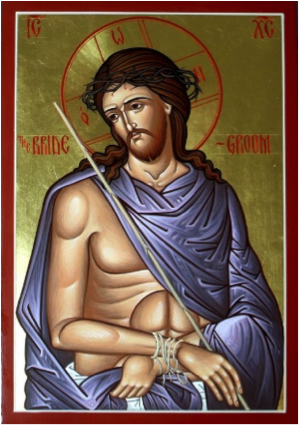
The Ultimate Model of Sacrificial Love

The gospel reading for Palm Sunday tells about Jesus’ glorious entry into Jerusalem. The Jewish authorities were afraid that the people would declare him king, and with that the power of their leadership would be threatened. So the Sanhedrin plotted to put Jesus to death and Judas conspired against him. Palm Sunday is all about the passion of Christ that’s about to take place, all about sacrificial love.

The passion of Jesus was announced in John’s gospel when he said, “The hour has come for the Son of Man to be glorified.” In this statement there is a tremendous paradox because to many of the Jews, the title “Son of Man” stood for an undefeatable world conqueror sent by God. So when he said that, they believed that the triumph-call of all eternity had sounded, that the might of heaven was on the march, and the campaign of victory had begun.

This is not at all what Jesus meant by “glorified”. By glorified, he meant “crucified.” When the “Son of Man” was mentioned, they thought of the conquest of the armies; he thought of the conquest of the cross.
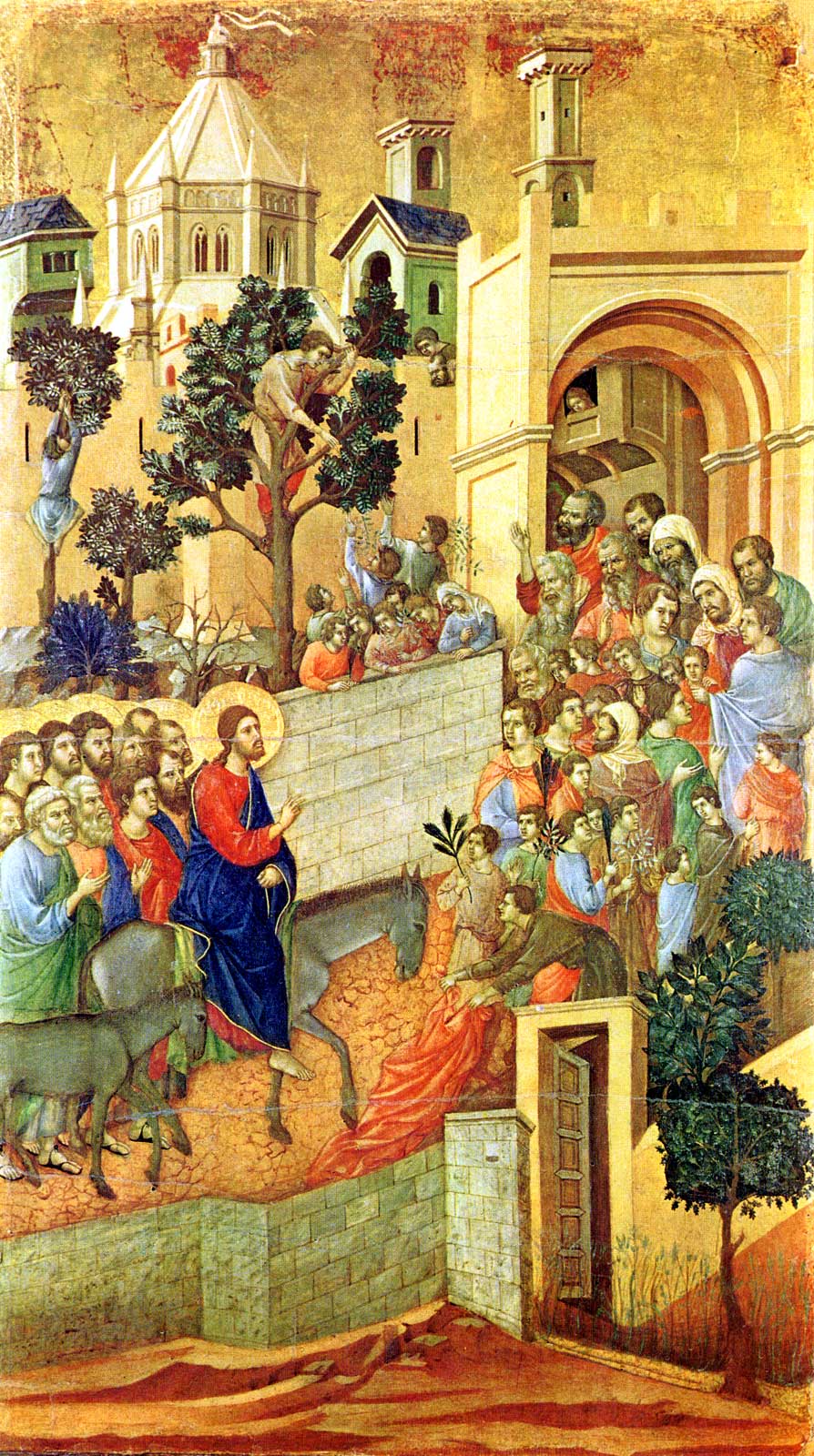
EntryIntoJerusalem-DuccioAs Jesus rides into Jerusalem and he looks at the City, he sees what the people could not see. It is there on the outskirts of the city that the battle will end. He sees the staging of Satan. The Evil One has seized the heart of Judas and he has whispered in the ear of Caiaphas. Jesus knew that when the going got tough, his closest friends would run, and that his was not the glory of popularity, but the glory of isolation. It was glory because it was for us, and because it was instead of us.

Jesus knew that before the war would be over, he must be taken captive. He knew that before victory there would be pain. He knew that before the throne would come the cup. He knew that before the light of Easter Sunday, there must be the darkness of Good Friday, and before his ascent into heaven, there must be a descent into hell. At the very moment when the crowds of people would be cheering, Jesus would be in agony.

He would be in agony because this was his hour, the hour to which every word and every act in scripture pointed. Jesus would be in agony because He knew from all eternity past that this was indeed the time for the cross. It was agony for Jesus to do the will of his Father, but there was no other way. Jesus was not saved from this hour. He was saved for it, and so are we. What was the passion of Jesus? We are the passion of Jesus because in the end Jesus would rather go through hell for us than go to heaven without us.

Jesus made a decision, a decision that would change the course of history forever. His entry into Jerusalem would not be in anticipation of being crowned; it would be in anticipation of being crucified. It would be the ultimate example of supreme courage, knowing He was going, voluntarily and sacrificially to his death on our behalf, as our ransom, as our substitute.

Jesus came to the Jews with a new view of life. They looked on glory as conquest, the acquisition of power, and the right to rule. He looked on it as the cross. He taught that life comes only by death, that only by spending life do we retain it, and that greatness only comes through service.

Jesus was fighting a battle with the human longing to avoid the cross, but nothing is gained without sacrifice. Real courage doesn’t mean not being afraid. It means being terribly afraid, yet sacrificing out of love, doing what must be done for the good of others and for the glory of God.

This is what his passion was all about. Sacrificial love is what we see when we look at the cross. Sacrificial love is the goal of our Lenten journey – the only sure foundation for life, the only sure foundation for a family, a community or a kingdom. Sacrificial love is the only thing that we take with us when we leave this world, and the only thing that will last forever. It’s the key to conversion, the key to becoming just like Jesus.

So for those preparing to come into the church at the Easter Vigil and for all of us preparing for Holy Week, let this be our fervent prayer:

Take from us, Lord, that which continues to separate us from you: pride, greed and selfishness. Increase in us that which brings us closer to you: patience, humility and sacrificial love.

Deacon Greg Ollick teaches Sacred Scripture for Saint Joseph’s College Online.
The Reality of Being Known

Everyone wants to be known. We long to be acknowledged, understood and ultimately, loved. We look for affirmation of who we are and praise for what we do. We want to be desired, sought after and needed. As if we couldn’t find evidence of these desires in our own experience, Exhibit A can certainly be found in Reality TV. What began with talk shows that gave ordinary people their 15 minutes of fame has morphed into a “true confessions-meets men and women behaving badly” phenomenon, churning out people famous for being…famous. Reality TV doesn’t just open a window into its inhabitants lives; it throws open the doors and pulls down the walls so that everyone inside is utterly exposed. On our television sets we see them: the good – but mostly the bad and the ugly. It’s those last two that grab the highest ratings and biggest headlines. Who would open themselves to such exposure, laying bare even the most intimate aspects of life – and why? Why reveal so much of oneself, resorting to the kind of over-the-top behavior that would otherwise be unthinkable – except for when the cameras are rolling? Perhaps an equally important question is: Why do so many of us watch?

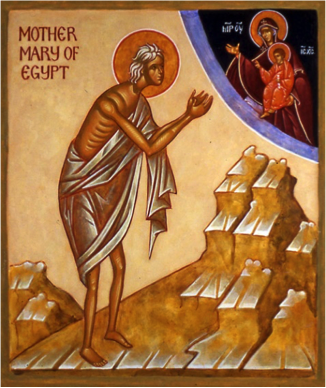
According to St. Sophronius’ account of her life (as told to the priest Zosimus), Mary was a prostitute, and a woman who found great satisfaction in her work. One day Mary saw a group of people boarding a ship to Jerusalem and, intrigued by what might draw so many on this voyage, she decided to follow them. Mary paid her way doing what she knew best, Koshute 1and after the ship docked, she eventually made her way to the passengers’ destination: a church where a relic of the True Cross was housed. A large crowd pushed their way into the church to celebrate the great Feast of the Exaltation and Mary fell in line. Hard as she tried, Mary was unable to get inside. Convinced the crowd was just too heavy Mary hung back and tried again, and again, and again. Each time she attempted to cross the church’s threshold Mary was repelled, as if some hidden force were protecting the sacred place from her presence. Frustrated and confused, Mary was gripped by a longing to be in God’s presence. From her place outside the church she saw an icon of the Mother of God and begged her to petition the Lord to grant her entrance. The Holy Mother heard her cry and suddenly the barrier was removed and Mary entered and gave praise and thanks to God. Promising to dedicate her life to prayer and penance, Mary made for the Jordan River and the Church of St. John the Baptist. There she was baptized and finally experienced the authentic love and true gift of self she could not have known until she received her Lord in Holy Communion. Leaving the church nourished and reborn, Mary went into the desert. There she lived, praying, making penance – still battling her demons – yet resting in the presence and safety of her True Love.

Mary of Egypt’s life might have made for salacious reality TV. Her insatiable carnal desire, fierce independence and disregard for the potential dangers inherent in her lifestyle would have provided hours of voyeuristic delight. Mary lived over a thousand years ago, yet the longing in her heart is ours, too. Mary wanted to be known and loved; she craved attention, even of the “wrong kind,” because any notice of her was at least an acknowledgment of her existence. Like each one of us, Mary grew restless and dissatisfied and looked for satisfaction everywhere except in the one place where it lay: with the One who knows us more intimately than we even know ourselves. We may not resort to the kind of lifestyle, or even the same nature of sin as Mary. But each one of us takes “refuge” in sin due to human weakness, rebellion, the need to “fit in,” and the simple longing for something to fulfill us, even temporarily.

The season of The Great Fast is our opportunity to be “laid bare” in front of God; to be exposed not for titillation or exploitation, but to be truly known by the One who sees us in Koshute 2truth. God knows our weakness and our flaws, and He is well aware of our sins, even before we openly confess them. His desire for us is not that we remain trapped in the cycle of sin, or that we seek attention in ways that violate our personal dignity. Yet when He beholds us He does so with eyes of love and with the knowledge of who we are as He created us. This is why He so desires us to let go of our sins and embrace Him. When Mary approached the church doors and was denied entrance it was not because God wished to refuse her. Rather, He awakened Mary’s true longing, giving her the space to realize her past mistakes. God presented Himself to her respecting her freedom, exposing His desire for her and allowing her to “fall in love.” Mary encountered True Love on that day, and even as she continued to battle temptation and sinfulness, she finally let Him fight for her.

Our True Love waits patiently for us, making Himself known in ways subtle and unexpected. We need not (over) expose ourselves for others in order to be known and appreciated. The God who loves us, who became a man in order to die for us, knows the desires of our hearts and Himself longs for us to know Him.

O Christ the Bridegroom, my soul has slumbered in laziness. I have no lamp aflame with virtues. Like the foolish virgins I wander aimlessly when it is time for work. But do not close your compassionate heart to me, O Master. Rouse me, shake off my heavy sleep. Lead me with the wise virgins into the Bridal Chamber, that I may hear the pure voice of those that feast and cry unceasingly: O Lord, Glory to You!

Bridegroom Matins, Great and Holy Week

Ann Koshute teaches theology for Saint Joseph’s College Online.