We’ve all had experiences of “barrenness” in our lives; those times when we feel lifeless, and the world around us is drained of its color. Unfulfilling work, static relationships and the general boredom with the “ordinary” in life affects us all at one time or another. More serious entrances into spiritual, emotional and physical “deserts” (for example, the death of a loved one, the breakdown of a relationship, loss of one’s job; and of course, the burden of sin) leave us feeling abandoned, drained and thirsting for some kind of relief. We look for God in these deserts, but many times we can’t find Him. We may get further lost in anger, doubt, and even stumble into the desiccated land of unbelief. Where is God?
Scripture is filled with deserts, and people – just like us – wandering through them. The pages of the Old and New Testaments are also filled with people experiencing emotional and spiritual deserts, places where they feel loss of hope, loss of intimacy with another, and the loss of God in their lives. But even in the desert there is a tension between heartache and hope; a place in one’s soul where the thirst for God lives, and where possibility wrestles with suffering. Such was the case for Zechariah and Elizabeth: the Priest and his wife. Despite being “righteous in the eyes of God,” (Lk 1:6), the couple were advanced in age and childless. In addition to the difficulties this presented in terms of the fulfillment of the Covenant, the sorrow associated with their infertility was great. Zechariah and Elizabeth thirsted for God’s blessing on their marriage with the gift of a child, but each passing year drew them further into a physical and emotional desert. And yet – their faith did not waver, and they continued to “observ[e]all the commandments and ordinances of the Lord blamelessly.” (Lk 1:6) Zechariah and Elizabeth lived in the tension between heartache and hope, and certainly some days were more dry and desolate than others. Yet they never ceased to thirst for God, and eventually He revealed His thirst for them.
Today the Church celebrates the Birth of St. John the Baptist, son of the once barren 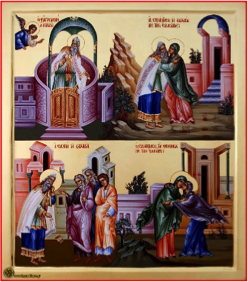 Zechariah and Elizabeth. John was conceived from the dryness of faith. Our daily lives are ordinary, often boring, and sometimes quite dry, and our faith is like that, too. We move through each day, subtly aware of God on some days, intimately aware of Him on others – and many times altogether forgetful of Him. God never forgets us, though, or our thirst for happiness and fulfillment. Though Zechariah and Elizabeth experienced sorrow, and perhaps anger in their unfulfilled desire to be parents, they didn’t allow their thirst to consume them. The Lord thirsted for their faithfulness to Him and each other, and from their desert grew the last Prophet, the one to announce the coming of the long-awaited Messiah. In that tension between hope and despair was born the Friend of the Bridegroom, who would bear witness to the consummation of the Covenant between God and His people.
From the very beginning, John’s was a desert life, and he placed himself in the literal desert as he prepared for his mission to call the people to repentance, renewed relationship with God, and welcoming the Messiah. Having been born from the sorrow of the desert, John knew well the possibility and promise held there:
As it is written in the book of the words of the prophet Isaiah: “A voice of one crying out in the desert: ‘Prepare the way of the Lord, make straight his paths. Every valley shall be filled and every mountain and hill shall be made low. The winding roads shall be made straight, and the rough ways made smooth, and all flesh shall see the salvation of God.’” (Lk 3:4-6)
In every desert of our lives there is an oasis, a promise of the possibility for new life. Most of the time we focus on the aridity, the heat of isolation and what seems an endless landscape of…nothingness. Yet it is in the lonely places, those that are forsaken, where God waits. He does not cast us into the wilderness; nor does He demand we use our own wits to find our way out. God meets us in the loneliness, the heartache, in the depths of our thirst for relief and reminds us that it is He who quenches our thirst. Jesus, too, entered the desert and met temptation and desolation. But Jesus also enters our deserts to meet us. At Jacob’s Well, in the peak the day’s heat (and in the stifling intensity of her own heartache), He met the Samaritan Woman and invited her to experience the “living water” of His love and mercy. Before sin our first parents met God in the lush beauty of the Garden; and their disobedience removed them from that perfect experience of life in full bloom, as it was created. Now, it is in the desert where God always meets us, is always waiting for us with the invitation to drink from Him. There are no easy answers to suffering and no proverbs or platitudes that can instantly instill us with confidence and peace. Instead, there is the promise of lasting and resilient peace, and joy and hope that resist the scorching rays of despair and desolation of anger, bitterness and fear. That place is in the heart of God, and faithful love of Jesus Christ. Zechariah, Elizabeth, John and Jesus Himself testify to this promise.
I will lead the blind on a way they do not know; by paths they do not know I will guide them. I will turn darkness into light before them, and make crooked ways straight.
These are my promises: I made them, I will not forsake them. (Is 42:16)
Ann Koshute teaches theology for Saint Joseph’s College Online.
 perate in those graces and to return often to the font of those graces. We repeatedly bring our sinful lives before Christ on the cross to redeem us, so that we can live lives that are true to our identity as the Body of Christ, the People of God. (Notice that the first thing we do at Mass is the Penitential Rite. We acknowledge our sins in preparation for our offering of ourselves. We offer a contrite heart.)