
“’I am the Alpha and the Omega’, says the Lord God, who is and who was
and who is to come, the Almighty [pantocrator]” (Rev. 1:8).
“You judge your people with righteousness and new life abounds.”
Prayer of Dedication by Rev. James G. Kirk
This past February my husband and I spent two weeks in Sicily. Our “home base” for that time was stunning Cefalú on the northern coast, with its famous Norman cathedral built in 1131, commissioned by King Roger II. In the cathedral’s apse is one of the most famous mosaic icons of Christ Pantocrator. “Pantocrator” can be translated as “Ruler” or “Sustainer” of all, an idea that, if you peruse the internet quickly, you will see described as an apt image, borrowed from imperial Rome, for an imperial church. It is sometimes even translated as “king.”
But this Easter I’d like to propose that following Jesus, even as a king, is somewhat more complex than most Wikipedia articles and travel guidebooks suggest, and one way we can be certain of that is the widespread popularity through the ages of the Christ Pantocrator image. To put it more personally, I might be the Christian least likely to be attracted by empire in any place or in any form, so I don’t think that’s the reason I felt drawn to stop in to visit that Christ Pantocrator twice a day. I would guess it has been the same for other Christians who have been drawn to that image, either in Cefalú or many other places, throughout the Christian world.
Even a brief gaze at the icon begins to reveal its complexity. The Christ in Pantocrator images carry a book of scripture in his left hand. I am not an expert in icons, but I understand that if the book is closed, the image is technically a Pantocrator, and if the book is open to reveal a passage of scripture, as in Cefalú, the image is a slight variant usually called “Christ the Teacher.” Therein lies the beginning of the depth of the image in Cefalú: is this Christ merely the image of conquering Norman power in religious dress, or is he more? And if he is more, then what does he have to teach?
So Pantocrator sometimes translates as “king”. But what if the point of using it, like the imperial titles and slogans that are applied to Christ throughout the New Testament (“savior,” “prince of peace,” and so on), is to subvert imperial pretensions? When we hear phrases like “all things,” we tend to think “all things human.” But the phrase is repeated enough in the scriptural witness that I do think it means all things. “He is the image of the invisible God, the firstborn of all creation; for in him all things in heaven and on earth were created, things visible and invisible, whether thrones or dominions or rulers or powers—all things have been created through him and for him. He himself is before all things, and in him all things hold together” (Col 1:15-17). Aside from a line or two in Virgil, even the masterful propagandists of Augustus dared not make such claims.
How do we, limited as our horizons are, even begin to consider this idea that “in him all things hold together”? In Cefalú, the book Jesus carries is open to the Gospel of John 8:12, which reads in both Greek and Latin: “I am the light of the world, who follows me will not wander in darkness but will have the light of life.” A lock of Jesus’ hair is being gently blown across his forehead. The better guidebooks will point out this realistic detail as one of the great artistic triumphs of this particular image, and indeed it is dazzlingly that.
But the lock of hair and the passage from John reminded me that light often represents the gentle presence of God but it rarely gets the credit that Elijah’s moving “gentle breeze” does. Both images suggest an all-encompassing and ever-present reality of God’s sustaining love to which we often choose not to attend and yet most of us wish to experience as fully as possible. Some have recently found the appreciation of the cosmic Christ in the everyday expressed poignantly in what is now referred to collectively as the Celtic tradition. In a meditation on an Easter pilgrimage she took in Wales, Rev. Mary Earle tells us that
[i]n Welsh, the ordinary word for universe is “bydysawd,” which means “that which is baptized.” All that has come into being—every particle of matter, every creature, every person, every star and planet—is encompassed in the pattern of Christ’s dying and rising…The Celtic Church, following the teachings of the early councils of the church, understood that this all-encompassing, uncreated Light of Christ, the Light that breaks into the tombs of our hearts and the graves of our bodies, is eternally present in all times and in all places.
I expect this is what the image of our Pantocrator meant all along to those not looking through eyes and hearts desiring dominance, a deeply benevolent sustainer of all who loves so much as to join us in darkness and help us find the gentle light in all. That is a far cry from the “peace through victory” that is a maxim of any form of empire. I once heard Daniel Berrigan say, in response to a question that was desperate with the desire for the United States always to win in all ways and at any violent cost, “Maybe we just need to change our idea of what winning means.” That sentence changed the course of my life, because I suddenly understood that domination is never true power, not at all related to God’s power.
So now I see t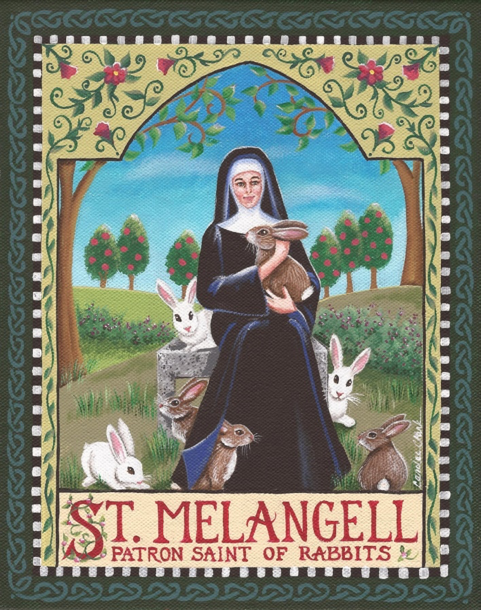 his Christ Pantocrator with the blowing lock of hair and the words of light ruling more like the Celtic St. Melangell. The sixth century Irish princess fled her father and his plans for her marriage, becoming a hermit in Wales. She was given land for a monastery, as the story goes, by a prince who found her sheltering under her robe the rabbit he and his hounds were hunting.
So maybe it’s time to stop rolling our collective Catholic eyes at rabbits as a “pagan” Easter symbol (mea culpa). Maybe care for the most vulnerable creatures and recognition of our oneness with them—created by God for himself and from his love and redeemed together with all creation—is in fact at the heart of Christ’s resurrection and rule. And perhaps the righteous judgment that comes from our great Pantocrator is the ever-flowing gift of new life, even when we can’t quite discern either the light or the life in a particular situation. The Pantocrator images represent the constancy of God’s gentle sustenance, symbolized especially in this annual feast of Easter.
At the end of their pilgrimage, Rev. Earle writes that the pilgrims were given a poem by the Welsh poet, Saunders Lewis, one of my own favorites. They are lines which can serve as a daily reminder to stay attentive to the Uncreated Light who sustains all:
Cherish the dark’s obscurity
Look for the diamonds in debris,
Thank God for all His mystery
And LIVE.
Pamela Hedrick teaches Sacred Scripture and spirituality for Saint Joseph’s College Online.