The Ordinariness of Sainthood

Don’t call me a saint – I don’t want to be dismissed that easily.

Dorothy Day
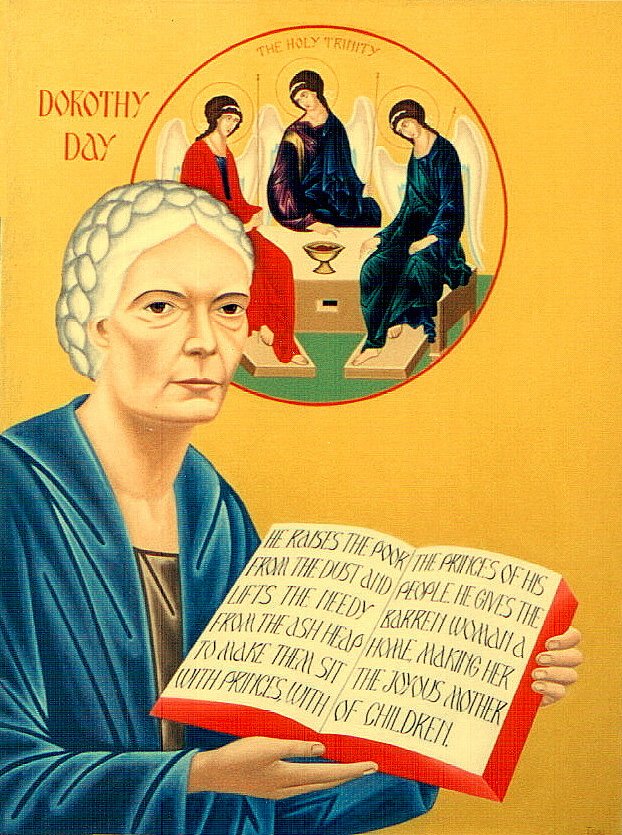
A painting by Nicholas Brian Tsai.

A painting by Nicholas Brian Tsai.

One of Dorothy Day’s better known quotes, some interpret it to mean that she didn’t think much of the saints and of sainthood in general. Indeed, there are those in the Catholic Worker Movement that she co-founded with Peter Maurin who do not support her cause for canonization, claiming she would not want it, and that the money spent on the process should be given to the poor.

Yet, her attitude toward sainthood is exactly what makes her so relevant for us today in the post-Vatican II church. Her remark is directed at those who see sainthood as something extraordinary that can then be dismissed by the average person as something out of reach. They are happy to call her a saint for serving the poor, because then they don’t have to, since they would never presume themselves to be that holy.

But Dorothy didn’t want her work with the poor to be dismissed as something extraordinary. She understood it as simply her duty as a Christian to care for the needs of her brothers and sisters. And she wondered why all Christians didn’t feel the same way, why they all didn’t love their neighbor as themselves, and why they did not act on those feelings. Wasn’t that the message of the Gospel?

“You have heard that it was said, `You shall love your neighbor and hate your enemy.’  But I say to you, Love your enemies and pray for those who persecute you, so that you may be sons of your Father who is in heaven; for he makes his sun rise on the evil and on the good, and sends rain on the just and on the unjust. For if you love those who love you, what reward have you? Do not even the tax collectors do the same?  And if you salute only your brethren, what more are you doing than others? Do not even the Gentiles do the same?  You, therefore, must be perfect, as your heavenly Father is perfect.

Matthew 5:43-48

To be perfect, then, is to be like God. It is to love perfectly, as God loves. Only God is holy. All holiness comes from God, and it is given to humanity as a gift. A saint is one who is made holy, or sanctified. Saints are not holy by their own efforts. They are made holy by God as a gift, and their efforts are their acceptance of, appreciation of, and cooperation in this gift.

Holiness depends on one’s relationship with God. People are holy to the degree that they are united to God. By perfectly holy, then, we mean intimately united to the Trinitarian God (the Father, through the Son, in the Holy Spirit) so much so that there is a oneness of heart, mind and will. In this intimate union, we are able to love perfectly as God loves. Pope Francis tells us of the need for a relationship with God on this road to holiness.

Being holy is not a privilege for the few, as if someone had a large inheritance; in Baptism we all have an inheritance to be able to become saints. Holiness is a vocation for everyone. Thus we are all called to walk on the path of holiness, and this path has a name and a face: the face of Jesus Christ. He teaches us to become saints.

Pope Francis, Angelus,  November 1, 2013

One who is sanctified possesses a yearning for God, an intimacy with God, perseverance in prayer, humility of heart, and a love for others. All of us are called to this holiness. Each of us is called to this intimate relationship with God. This is the beauty of relationship – each one is unique. God communicates with us uniquely. His message is the same – God will not contradict himself. He only speaks the truth. But his communication with us is so personal, so “meant just for us”.

We must strive to unite our heart, mind, and will to that of Christ – to love as Christ loves, to think as Christ thinks, and to desire as Christ desires. This seems rather extraordinary (as those who dismissed Dorothy Day as such), but it is, in fact, what is expected of every baptized person. The grace of our baptism empowers us to be like Christ. We need only to cooperate in it.

We are all called to be great saints, don’t miss the opportunity.

Mother Angelica

Carmina Chapp is Associate Director of Online Theology Programs at Saint Joseph’s College.
St. Anthony and Theology

One of my goals when teaching the lives and writings of the saints to an undergraduate audience is to take these figures “out of stained glass.” That is to say, I endeavor to teach this material in such a way that brings these authors to life. An image of a saint piously kneeling before the Virgin and Child can leave a somewhat one-dimensional impression upon the viewer. This impression is then reinforced as one becomes accustomed to it and does not probe its theological meaning.

Today the Church celebrates the memorial of St. Anthony of Padua, O.F.M. (1195-1231). St. Anthony’s feast day is particularly special to me as it is my onomastico or “name day,” and the imagery of St. Anthony with which we are most familiar has him holding the Child Jesus. This artistic motif is derived from an apparition that St. Anthony received of the Child Jesus, and it became part of his standard artistic depiction during the 17th century. Prior to that time, he was often portrayed with a lily (a symbol of purity) and a book (a symbol of the preaching for which he was renowned even in his own lifetime).

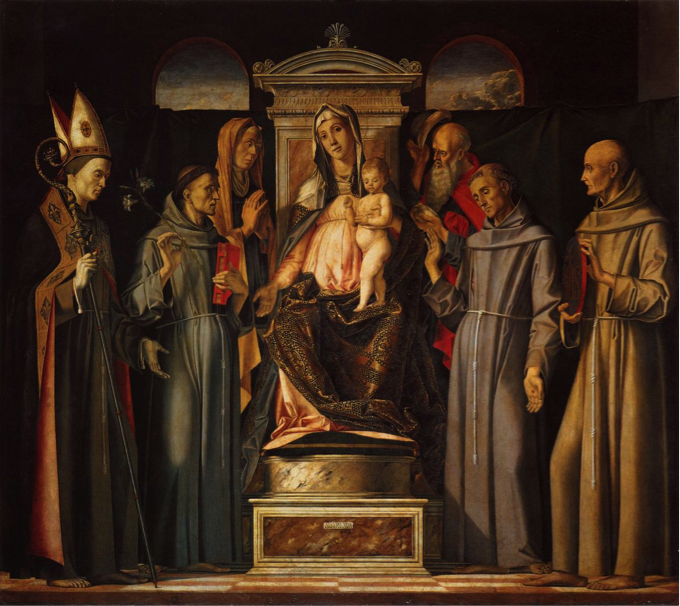
Alvise Vivarini, Sacra Conversazione (1480) (l-r, Ss. Louis, Anthony, Anna, the Virgin and Child, Joachim, Francis and Bernardino)

Alvise Vivarini, Sacra Conversazione (1480)
(l-r, Ss. Louis, Anthony, Anna, the Virgin and Child, Joachim, Francis and Bernardino)Further, though we may think of St. Anthony as the “finder of lost things” or identify his popularity with Italian and Portuguese Catholics, St. Anthony reminds me most of the goal of theology.


Further, though we may think of St. Anthony as the “finder of lost things” or identify his popularity with Italian and Portuguese Catholics, St. Anthony reminds me most of the goal of theology.

While theology is the diligent study of sacred realities, we can often stress the activity (diligent study) over the object (sacred realities). As a mentor of mine is fond of saying: theology is about transformation, not information. Few religious orders have incorporated this belief into their spiritual legacy as profoundly as the Franciscans and, in particular, St. Anthony was acutely aware that the goal of theology is eternal beatitude – not the accumulation of facts and certainly not an academic degree.

St. Anthony joined the Franciscans, after first becoming an Augustinian, while they were still in their infancy. He was the Order’s first reader of theology, or “official theology teacher,” and yet no manuals or scholastic disputations have survived from his work. What we possess from St. Anthony’s writings are a collection of sermons. Like many Patristic Fathers before him, St. Anthony was most concerned with living the Gospel of Jesus Christ, and his homilies are rich examples of a probative explication of Scripture at the service of the conversion of souls.

Rather than provide a quotation from one of his homilies which demonstrates this point, I would instead like to share a letter which was written to St. Anthony by St. Francis. The occasion for this correspondence was the instillation of St. Anthony as the Order’s first reader of theology. The entire letter is the following:

“Brother Francis [sends his] wishes of health to Brother Anthony, my overseer. It pleases me that you teach sacred theology to the brothers, as long as – in the words of the [Franciscan] Rule – you ‘do not extinguish the Spirit of prayer and devotion’ with study of this kind.”

Coleman 6 14 2

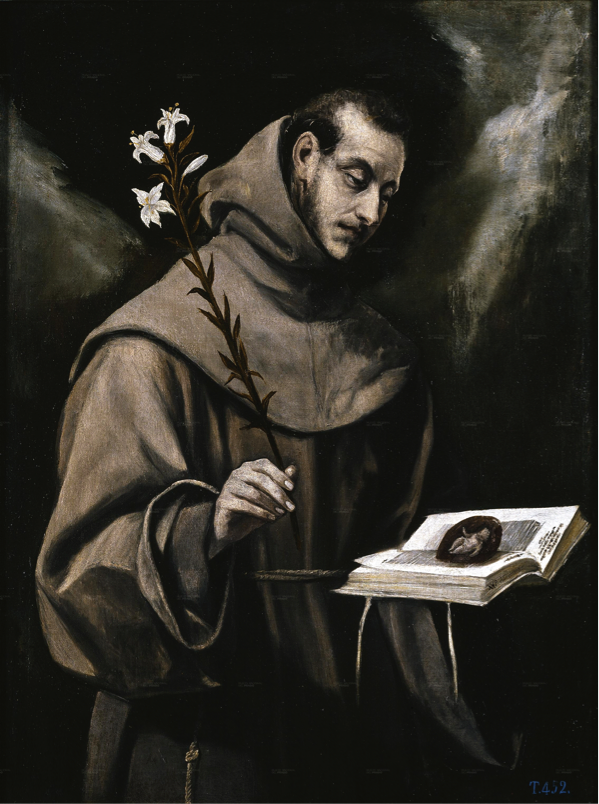
El Greco, St. Anthony of Padua (1577)

St. Anthony reminds us that theology is an activity which serves the Church, seeks the conversion of souls, and aims at our eternal communion with God. Without these goals, theology is just another collection of facts and figures like any other academic discipline. And if theology remains the latter, it can more easily “‘extinguish the Spirit of prayer and devotion’” than inspire it.

A painting of St. Anthony which communicates this well is by the artist known as El Greco (a.k.a., Domenikos Theotokopoulos). El Greco combines the more traditional imagery of St. Anthony with that which will soon become standard. In doing so the artist reminds us that, for St. Anthony, theology is a lived activity; an activity of mind (book), heart (Child Jesus), and body (lily). The integration of these elements can be seen in St. Anthony’s posture, as he looks serenely upon a book which upholds the Child Jesus and holds a lily as if it were a pen. The senses gaze upon the sacred mysteries, which are then communicated through intellectual and physical acts. St. Anthony reminds us that the goal of theology is a living relationship with Christ which embraces every dimension of the human person, not simply an intellectual activity.

Anthony Coleman teaches theology for the Saint Joseph’s College Online Theology Program. This post originally appeared on June 14, 2015.