Nobody Does It Better

On Divine Mercy Sunday, two extraordinary men were canonized: Pope St. John XXIII and Pope St. John Paul II. When these two heavenly friends sat on their papal thrones, they looked towards another extraordinary man to provide them—and the world—words of wisdom and hope: the Venerable Fulton J. Sheen, whose birthday we commemorate tomorrow.

From John XXIII

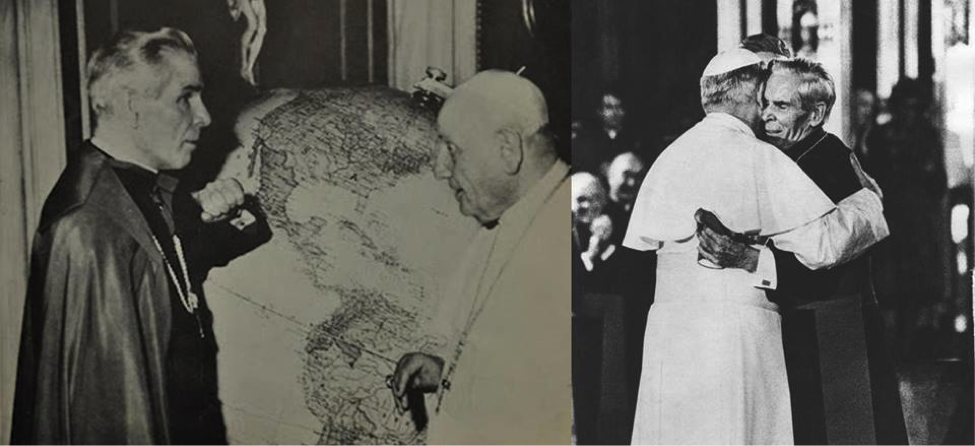
During Archbishop Sheen’s first visit with Pope John XXIII, the Pope presented Sheen with a small silver gondola. During his second visit, the Holy Father asked Sheen to visit his brother and relatives in his home in northern Italy. When Sheen went there, the entire town turned out to bid him welcome. At that same audience, John XXIII told Sheen “You have suffered much…Is there anything I can do for you?” Sheen replied that there was nothing he wanted except to do the will of God. To that the Pope replied, “That makes it very easy for me.” On another visit with John XXIII, Sheen went to the Pope’s private residence, and John XXIII gifted him some autographed books he had authored. Sheen was surprised at the simplicity of the papal private chapel. After they prayed together in the chapel, they returned to his office downstairs, John XXIII called in a photographer and told Sheen.“Come, let us have our picture taken. It may make some in the Church jealous, but that will be fun.” (https://www.facebook.com/FultonJSheen)


sheen with pope saints

From John Paul II

Shortly before Sheen’s death in 1979, Pope John Paul II reached out to him in a personal letter.

God called you to proclaim in an extraordinary way his dynamic word. With great zeal you accepted this call, and directed your many talents to spreading the Gospel of Jesus Christ. Thus, in these six decades of your priestly service, God has touched the lives of millions of the men and women of our time. They have listened to you on radio, watched you on television, profited from your many literary achievements and participated in spiritual conferences conducted by you. And so with Saint Paul, “I thank my God whenever I think of you; and every time I pray for…you, I pray with joy, remembering how you have helped to spread the Good News.”  (October 11, 1979.)

In his inimitable wit, Sheen summed up the essence of the Church’s teaching on the papacy and not only that, but the means and meaning of our salvation:

No chain is stronger than its weakest link, and the weakest link of the chain of Popes was the first. But that weak link was held in the hands of Christ. That is why the papacy will never fail.                    (Through the Year with Fulton Sheen)

This excerpt from Archbishop Sheen’s television show in which he offers a teaching on the life of Pope John XXIII provides a window into Sheen’s gift of oratory, his love for the papal office, and of the man, John XXIII. Prepared to be amazed and humbled.

Speaking personally about my own spiritual growth, “nobody does it better” than Sheen. His audio talks were my constant companion during my long and solitary commute to and from work; the cadence of his voice mesmerized my young children on family trips, and they never once asked to “switch the radio station.” During down times, I find myself searching YouTube for clips of his television show. Interestingly, when I have used his writings in undergraduate classes, the students respond favorably, and they tell me they can understand him.

Saint Joseph’s College has acquired the complete Sheen audio files. SJC students can access them all here. If you are not a student, you can purchase them for under $30. I even have the app on my iphone – the portable Sheen! If you haven’t already done so, I would encourage everyone to become a friend of Archbishop Fulton J. Sheen. Listen to his talks; watch his videos; get fed a daily quote by “friending” him on Facebook; watch a movie on his life; pray for his canonization.

Heavenly Father, source of all holiness, you raise up within the Church in every age, men and women who serve with heroic love and dedication. You have blessed Your Church through the life and ministry of your faithful servant, Archbishop Fulton J. Sheen. He has written and spoken well of Your Divine Son, Jesus Christ, and was a true instrument of the Holy Spirit in touching the hearts of countless people.

If it be according to Your Will, for the honor and glory of the Most Holy Trinity and for the salvation of souls, we ask you to move the Church to proclaim him a saint. We ask this prayer through Jesus Christ, our Lord. Amen.

From CatholicWeb.com

 Patricia Ireland is Director of Theology Programs for Saint Joseph’s College Online.
 

Going for Two

Thirty years ago, a great college football team faced an awful choice.  Expected to win a championship game handily, they instead found themselves playing catch-up throughout.  With less than a minute to go, though, they scored and trailed by only one point.  Thus their choice:  play it safe and kick an extra point to tie the game and probably still win the championship, or go for two points, risking everything to win clearly.  The team and its coach never hesitated; they lined up for the two point conversion but fell tragically short.  The other team won, and ever since experts have mused ‘what if’ the expected winner hadn’t overreached.

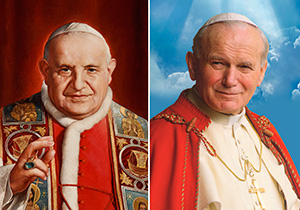
Saints John XXIII and John Paul II. (CNS photo)

On Divine Mercy Sunday, the Universal Church celebrated the canonizations of two recent popes:  John XXIII (Angelo Roncalli, 1881-1963) and John Paul II (Karol Wojtyla, 1920-2005). The Church prepared for this remarkable day with great anticipation.  All sorts of Catholics offer their devotions to John and John Paul.  Their legacies appear where the Church now grows fastest.

Still, similar ‘overreach’ questions have emerged.  What does it mean that two popes enter the Communion of Saints on the same day?  In the conventional wisdom, John XXIII and John Paul II represent two loci of the post-Vatican II Church.  John XXIII, who convened the Council but then died before the Second session started, stands as the great hope of liberals or at least those who seek greater reforms in the Church.  “Good Pope John” wrote passionately about socio-economic justice and peace.  On the other hand, the same stereotype casts John Paul II as the great restorative hope for conservatives.  Elected as a young, vibrant fifty-six year old, the Polish pope quickly restored the Church’s teaching and spiritual authority following the decade-long fallout from Paul VI’s Humanae Vitae.

Of course, the nay-sayers offer counter-narratives.  John’s Council welcomed the very Modernist innovations condemned so vigorously by Popes Pius IX and St. Pius X.  John Paul’s concern for restoring authority suppressed the Council’s reforming zeal, especially regarding women’s ordination, and ignored clear signs indicating clergy sexual abuse.  How can these two popes stand, let alone enter sainthood, together? Thus in “going for 2” the dual canonization appears as overreach or, perhaps worse, a confused message about papal legacies.  Well-read Catholic critic Paul Elie sees (mistakenly, I think) Francis slyly undermining Benedict’s legacy.  How then would this dual canonization aid that quiet revolution?  (If anything, Benedict will perhaps enjoy the canonizations more than most.  After all, he worked for and with both saints!)

Investigation reveals the myopia of such concerns.  For all his zeal about the Council’s aggiornomento, John XXIII conserved as much as he inaugurated.  Reading John’s body of work (short, compared to John Paul II’s exhaustive writings) challenges the customary view that John’s Council turned its back on Catholic history.  Roncalli clearly saw himself standing on the shoulders of giants.  His early encyclicals in 1959 and 1960 teem with references to Pius X and Pius XI, especially. This makes sense; St. Pius X had ordained Roncalli to the priesthood and both men came to the papacy through Venice.  Furthermore, John saw aggiornomento following Pius X’s motto:  Instaurare Omnia in Christo (To Restore All Things in Christ).   Likewise, John Paul II cannot be dismissed as a ham-handed reactionary.  His five-year lecture series on the Theology of the Body thoroughly reconstructed the Church’s teaching on human sexuality and continues to inspire new research, especially among women theologians.  His extensive writings on work and freedom contributed directly to the downfall of the Iron Curtain, starting in his own beloved Poland.  John Paul II also boldly added the Luminous Mysteries to the Rosary, that most Catholic of prayers.  Tellingly, the most frequent citations in John Paul II’s own writings?  Scripture and the documents of Vatican II.

So instead of overreach, perhaps Francis chose, following John XXIII’s own example, to celebrate two of the popes who most formed his own ministry.  If that’s the case, we should expect more citations from both as long as Francis remains pope.  Given their heroic challenges to unreflective conventions, this cannot be bad.

From what Pope Francis has shown us thirteen months into his own ground-breaking papacy, celebrating the saintliness of these two predecessors reaffirms the Church’s catholicity—its universality and inclusiveness.  Both John XXIII and John Paul II celebrated the joy and hope the Gospels give the entire human race, not solely Christians or Roman Catholics.  The canonizations also remind us of God’s surprising providence.  That God might call a humble Italian or an orphaned Pole, both of whom worked clandestinely against the Nazis, should alert us to God’s unexpected presence in our own lives.  A glance at Pope Francis’ Twitter feed reveals the same utter reliance on God’s grace.  Why play it safe?

Guest blogger Jeffrey Marlett blogs at Spiritual Diabetes.