One month ago, I had the privilege of celebrating Mass on the altar above the tomb of St. John Paul II. Our small pilgrimage group had requested a Mass at one of the altars, either in the crypt or in St. Peter’s Basilica itself. We never expected that we would be given this particular altar, and all in the group were rather excited. One of my friends, who is an American serving on the general council of his religious community, asked me ho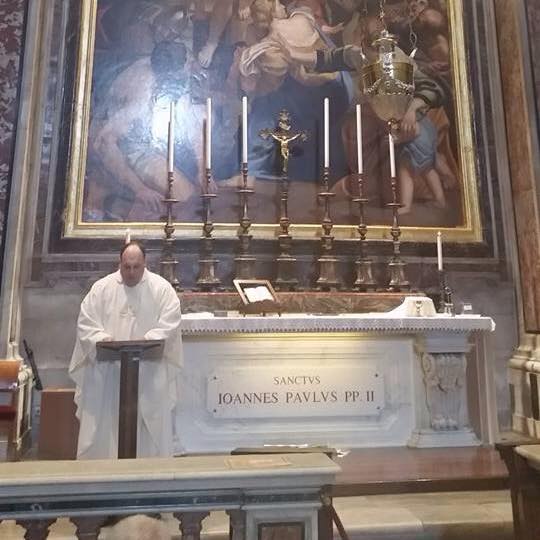 w we had arranged it. He had been trying for months through various contacts in the Vatican. I told him how we asked simply for a Mass in the basilica. Of course, he was very surprised that no special arrangements had been made. I was simply thankful to the Holy Spirit for arranging it and giving both the pilgrims and me such an important spiritual opportunity. As we made our way to the altar of St. John Paul, we went by the tomb of St. John XXIII. I hope someday to celebrate a Mass on the altar above his tomb as well. Both are personal heroes of mine because of their efforts to expand the role of all in the Church, especially the laity, which was so central to the charism of the founder of my religious community, St. Vincent Pallotti. In his homily for their canonizations, Pope Francis spoke about the efforts of these two popes in this regard:
John XXIII and John Paul II cooperated with the Holy Spirit in renewing and updating the Church in keeping with her pristine features, those features which the saints have given her throughout the centuries.
The renewal and updating of the Church called for by the Second Vatican Council, initiated by St. John XXIII, is central to the work of the New Evangelization as articulated by St. John Paul II. This work continued through the efforts of Pope Emeritus Benedict XVI, especially in the Synod on the New Evangelization, and is finding even greater momentum through the witness of Pope Francis. All of them, along with Blessed Paul VI, the teaching of the Council, and Church leadership in general, have called all of the baptized to engage in greater co-responsibility for the life of the Church and for the work of evangelization.
When Pope Francis canonized St. John XXIII and St. John Paul II together, various pundits, both in Church and secular media, were quick to give their sometimes very simplistic analysis of the message that he was trying to convey. If there was any “message”, I believe that it is a continued or re-commitment to the on-going renewal of the Church in trustful cooperation with the Holy Spirit and in prayerful communion with the saints.
St. John XXIII and St. John Paul II were both visionary leaders who put forward programmatic plans for not simply renewal of the Church as an institution, but renewal of all the baptized in faith and holiness who are called to go forth into the world and renew it as well. In 1959, St. John XXIII said, “Profession of the Christian faith is not intelligible without strong, lively apostolic fervor” (Princeps Pastorum, 32). The Second Vatican Council confirmed this understanding in Lumen Gentium through its teachings about the Universal Call to Holiness and the role of all the baptized in the mission of Christ. St. John Paul II was one of the drafters of the Decree on the Apostolate of the Laity (Apostolicam Actuositatem) along with the then Rector General of the Society of the Catholic Apostolate, Fr. Wilhelm Möhler, S.A.C. St. John Paul taught in his apostolic exhortation Christifideles Laici, which followed the Synod on the Laity in 1987, that
The Second Vatican Council has reminded us of the mystery of this power and of the fact that the mission of Christ – Priest, Prophet-Teacher, King – continues in the Church. Everyone, the whole People of God, shares in this threefold mission’” (14).
Sharing in the mission of Christ is not simply staying within the confines of the church building. Instead, especially in this time of the New Evangelization, all of the baptized are called to recognize that they are followers of the Christ who are sent on mission by him. In fact, Pope Francis even calls the baptized, in Evangelii Gaudium, “missionary disciples” (120).
Fr. Frank Donio, S.A.C., is Director of the Catholic Apostolate Center and teaches for Saint Joseph’s College Online.