“For no one hates his own flesh but rather nourishes and cherishes it…” (Ephesians 5:29)
I was recently in a conversation with someone who is a new father. He was commenting to me about the challenges of being a parent. Then in bold honesty he said: “I’m not able to be selfish anymore…” as if he was lamenting the lost opportunity to focus almost exclusively on himself (he is married, hence the “almost”). I have to admit the honesty was refreshing in a way. It also contributed a point to an ongoing reflection I have been having on the Sacrament of Matrimony and its relationship with the Eucharist (cf. Sacramentum Caritatis 27).
The following might seem out of left field, but bear with me. Blessed Pope Paul VI’s 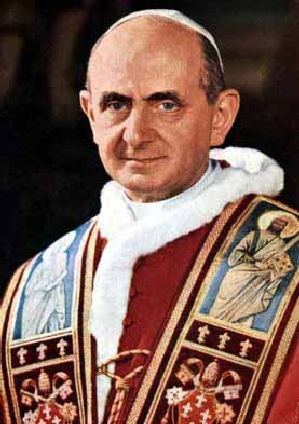 reasserted in his encyclical Humanae Vitae that there is an “inseparable connection, established by God” between the unitive significance and procreative significance “which are both inherent to the marriage act” (Humanae Vitae 12, emphasis added; cf. Gaudium et Spes 51). In other words each act of sexual intercourse is unitive for the spouses and must be open to life. However, couples who exhibit a “contraceptive mentality” (cf. Evangelium Vitae 13) seek to avoid new life in some cases because it is truthfully difficult to raise children. Especially for the mother who has to give of her body so that another human being can grow inside her. It is evident that sacrifice is required. In theory parents are not able to be selfish anymore.
I find it amazing to reflect on the Scripture passage which says that women will be saved through childbearing, “provided [they] persevere in faith and love and holiness, with self-control” (1 Timothy 2:15). I don’t think St. Paul was attempting to say that all women are saved only through childbearing, especially since he encourages virginity at another point (1 Corinthians 7:34). However, there is a Eucharistic dimension in the great mystery of the generation of human life that may easily get overlooked.
St. Paul urges the disciples in Rome to offer their bodies as a “spiritual sacrifice” that is pleasing to the Lord (cf. Romans 12:1). Women, and men, can give glory to God with their bodies (cf. 1 Corinthians 6:20). One of the beautiful realities of the Eucharistic sacrifice is that Jesus’ disciples can be united with His one-time sacrifice which is made present at Mass. The Catechism explains this profound mystery in the following:
“In the Eucharist the sacrifice of Christ becomes also the sacrifice of the members of his Body. The lives of the faithful, their praise, sufferings, prayer, and work, are united with those of Christ and with his total offering, and so acquire a new value. Christ’s sacrifice present on the altar makes it possible for all generations of Christians to be united with his offering” (CCC 1368).
The lives of the faithful can be “brought to the altar,” as gifts to the Lord, to be united with the sacrifice of Christ. Spouses can offer the gift of themselves, offering all that they are, including their fertility, in response to God’s plan of salvation and the generation of new life. Each spouse can reflect on the words of our Lord in the institution narrative: “This is my body which will be given up for you, do this in remembrance of me.” These words can simply inspire a spouse to give of himself or herself completely for the life of another in the conjugal act of love. This is particularly the case when a mother conceives in her womb and a new life grows inside her.
There is the inseparable connection between the unitive and procreative significance when spouses unite as one flesh. The unitive significance is aimed at communion and the procreative involves sacrifice which is open to new life. And this brings us to my reflection on the Eucharist. The Eucharist is of course a communion meal in which the members of the Body of Christ are united with Jesus. Concurrently the Eucharist is a sacrifice in which Jesus offers Himself as a gift of self and we have the opportunity to respond with the gift of our self. And the gift of our self can lead to “new life” as we’re transformed to be more like Christ. Also there can be new life in the Spirit for those who encounter Christ through us. In other words when we receive the Eucharist we must respect the unitive (communion) and procreative (sacrifice) significances of this great mystery when our flesh unites with the flesh of our Lord.
Yet, when we go to receive the Eucharist we may approach simply because we want the “communal” or unitive significance. We want to be united with God and with each other and this is praiseworthy. However, there is also the inseparable significance of sacrifice through the gift of ourselves in response to Christ which is open to the Father’s will and new life in the Spirit. We have to be ready to give our lives as a spiritual sacrifice which gives glory to God. Let’s avoid an analogical “contraceptive mentality” when we receive the Eucharist in which we don’t give ourselves completely to Christ. So as we approach Jesus in the Eucharist we should say to ourselves: “I’m not able to be selfish anymore…”
Edward Trendowski teaches marriage and family ministry for Saint Joseph’s College Online.