
On Sunday September 14, 2014 Pope Francis celebrated a Holy Mass with the Rite of Marriage inside St. Peter Basilica. It also was on the occasion of the Feast of the Exaltation of the Holy Cross. In his homily during the Mass, Pope Francis made some important connections between the feast day and the Sacrament of Matrimony, between the new life that is found through the Holy Cross and new life that is found in Holy Matrimony.
As to be expected, “the press” captured the opportunity to discuss this significant Holy Mass, especially since popes don’t regularly preside over a Mass with the Rite of Marriage. I wrestled with two different options for a topic for this article: (1) point out the errors of the media; or (2) focus on the truth of what Pope Francis stated in his homily. Certainly we must be ready to stand up for the truth and correct errors. One specific passage from Scripture comes to mind: “Always be prepared to make a defense [Greek apologian] to anyone who calls you to account for the hope that is in you, yet do it with gentleness and reverence” (1 Peter 3:15 RSVCE). But in apologetics, there is a danger of focusing too heavily on the errors of our critics and not enough on the reason for our hope: the truth that is found in Christ Jesus (cf. John 14:6).
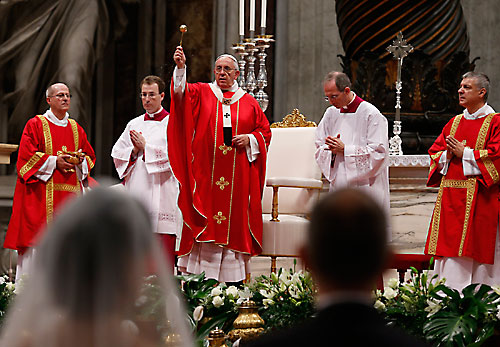 In his homily, Pope Francis reflected on the first reading of the day, and he recalled that when the Israelites were on their journey through the desert, they became impatient (cf. Numbers 21:4). But married couples, too, as they walk together through the journey of life, can become impatient, even with each other. Pope Francis makes this exact point:
Here our thoughts turn to married couples who “become impatient on the way,” the way of conjugal and family life. The hardship of the journey causes them to experience interior weariness; they lose the flavour of matrimony and they cease to draw water from the well of the Sacrament. Daily life becomes burdensome, and often, even “nauseating.”
This is not a great frame of mind for any married person to be in. Whether you’re Catholic or not, you can recognize that married life can be difficult at times.
Because of the impatience of the Israelites, they failed to see the threat which was about to take them by surprise. “During such moments of disorientation … poisonous serpents come and bite the people, and many die” the pope commented. In married life there are serpents that attempt to attack the husband and wife. The serpents which threaten married life are seeking the death of their relationship. But the Israelites had a remedy to the serpents’ poisonous bites: they could look at Moses’ staff and recover (cf. Numbers 21:8). Likewise, married couples and indeed all people have a remedy, as we learn from our Savior:
And just as Moses lifted up the serpent in the desert, so must the Son of Man be lifted up, so that everyone who believes in him may have eternal life. For God so loved the world that he gave his only Son, so that everyone who believes in him might not perish but might have eternal life. For God did not send his Son into the world to condemn the world, but that the world might be saved through him (John 3:14-17).
Married couples, when facing “nauseating” days and weeks, can gaze upon the Cross of Jesus Christ and recognize a preeminent sign of God’s love for His people (cf. Romans 5:8). Pope Francis expresses his confidence in the One who can bring aid:
The cure which God offers the people applies also, in a particular way, to spouses who ‘have become impatient on the way’ and who succumb to the dangerous temptation of discouragement, infidelity, weakness, abandonment… To them too, God the Father gives his Son Jesus, not to condemn them, but to save them: if they entrust themselves to him, he will bring them healing by the merciful love which pours forth from the Cross, with the strength of his grace that renews and sets married couples and families once again on the right path.
One might be tempted to think: “Of course… the Pope is going to say ‘Jesus is the answer’ and the Catholic blogger is going to agree. For those of us who are really in a troubled marriage, what can we do?” But the pope’s advice is the most real, the most concrete, advice that anyone will ever give us. If spouses try to heal their relationship on their own, they will quickly lose hope and they will fail. But if spouses entrust themselves to the living God who loves them beyond measure, they will be able to love each other with God’s love through the Holy Spirit: “if we love one another, God abides in us and his love is perfected in us” (1 John 4:12). We always have hope when we trust the One who makes all things new (cf. Revelation 21:5).
Edward Trendowski is Coordinator for Catechetical Resources for the Diocese of Providence and teaches pastoral theology for Saint Joseph’s College Online.