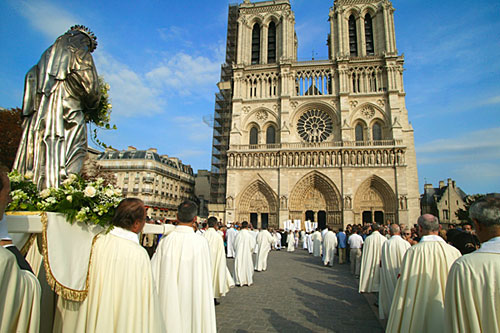
 The purpose of Pope Benedict’s initiative, which he calls “The Courtyard of the Gentiles,” is to promote communication with human cultures, sciences and institutions. It is a practical implementation of what Pope Francis is calling “a culture of encounter.” Although its first meeting was in Paris in 2011, it is the kind of thing that Christians have been doing since the beginning when Paul praised the Athenians for their worship of the Unknown God (Acts 17: 22). “The Courtyard of the Gentiles” came to mind as I read about Barbara Ehrenreich’s latest book, Living with a Wild God (New York: Grand Central Publishing, 2014).
In his speech founding the Courtyard project Pope Benedict noted, “I consider most important the fact that we, as believers, must have at heart even those people who consider themselves agnostics or atheists. When we speak of a new evangelization these people are perhaps taken aback. They do not want to see themselves as an object of mission or to give up their freedom of thought and will. Yet the question of God remains present even for them, even if they cannot believe in the concrete nature of his concern for us. … We must be concerned that human beings do not set aside the question of God, but rather see it as an essential question for their lives. We must make sure that they are open to this question and to the yearning concealed within it. Here I think naturally of the words which Jesus quoted from the Prophet Isaiah, namely that the Temple must be a house of prayer for all the nations (cf. Is 56: 7; Mk 11: 17).”
The Pope concluded: “Today, in addition to interreligious dialogue, there should be a dialogue with those to whom religion is something foreign, to whom God is unknown and who nevertheless do not want to be left merely Godless, but rather to draw near to him, albeit as the Unknown.” (Address to the Roman Curia, 21 December 2009)
When she was 13 years old, Barbara Ehrenreich had the following experience:
The world flamed into life. How else to describe it? There were no visions, no prophetic voices or visits by totemic animals, just this blazing everywhere. Something poured into me and I poured out into it. This was not the passive beatific merger with the ‘All,’ as promised by the Eastern mystics. It was a furious encounter with a living substance that was coming at me through all things at once, and one reason for the terrible wordlessness of the experience is that you cannot observe fire really closely without becoming part of it. Whether you start as a twig or a gorgeous tapestry, you will be recruited into the flame and made indistinguishable from the rest of the blaze.
Was this a religious experience? I don’t know. In an April 14, 2014 Time magazine interview with this scientist, defender of the poor, and atheist, she spoke of this fascinating event. And judging from her interest in publishing a book about it, the experience is still important to her.
And here’s one of two things I want to point out: the experience is important to her not in spite of her scientific training (she has a PhD in biology) but because of it. Her account of the experience and why she has refused to dismiss it should be of interest to those in the Courtyard project or anyone concerned with the relationship between religion and science.
Question: “Are you worried that people are going to think you’ve gone off the reservation?”
Answer: “I’m more worried that people will say I’m crazy. But I was educated as a scientist, and one of the things I learned was that you do not discard anomalous results. If you have a result that doesn’t fit your theory, that falls way off the curve in your graph—I’m sorry, you don’t get to erase that. You have to figure out what’s going on. I’m just opening up the conversation. If in the process I completely ruin my reputation as a rational person and end up in a locked ward, that’s the chance I’m taking.”
Notice that the questioner makes the predictable secularist assumption: religion and science are incompatible because religion is irrational. If you think such an experience is important, you must be leaving the rational world of science. But also notice how Ehrenreich refuses that presumptive cliché: the authentic scientist does not discount what is exceptional. Unlikely things do happen, and they fall within post-Newtonian scientific theories, which search for probability and not necessity. The dismissal of such experiences as Ehrenreich’s is not science but ideology. The task is, as she knows, to interpret it, not to prejudge it as impossible or meaningless.
Here’s the second thing I want to say: in the Christian theology of the Trinity there are two missions. The more familiar mission is the Outer Word, the Logos incarnate, sent by the Father into human history as Jesus of Nazareth. But there is also the pre-verbal, pre-conceptual Inner Word that we call the Holy Spirit, sent into the hearts of all human beings. Tad Dunne has sums up the role of the Spirit this way:
The “Spirit” very seldom is reported in Scripture to deliver a message; rather, it disposes men and women to receive a message. At times this “Spirit” is portrayed as seeking, groaning or wondering. …It seems, then that the mission of God’s “Spirit” is experienced in our inner and immediately-felt wonder, be it the suffering kind that still searches or the enjoyable kind that appreciates the meanings embraced. God is present to us in the unmediated fashion that our own dynamic wonder is.[*]
Thank you, Barbara Ehrenreich, not only for your relentless work in defense of the poor but now, for “opening up the conversation” about your experience. Perhaps your book will give others who feared that they would be branded as unscientific or even crazy the confidence to heed Hamlet’s words:
There are more things in heaven and earth, Horatio,
Than are dreamt of in our philosophy.
David Hammond teaches theology and church history for Saint Joseph’s College Online.
[*] Tad Dunne, “Trinity and History” Theological Studies 45 (1984), 147.

 sophisticated alternatives. Like the iPhone 6. Or the right job. Or the great relationship. But we are still just overgrown kids, vainly throwing Lego bricks into an infinite hole and wondering why we still feel lousy.
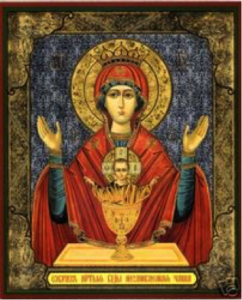 al, self-giving love of her Son Jesus. Like Christ arising from the chalice, so are we, as little Christs, resurrected into the newness of Christian life by his Eucharist grace. The Christification that God has achieved in Mary, he wants to do for each of us. What Mary has allowed God to do for her, she wishes us to experience through her maternal care. And we will, if we say fiat as she did.