The Beginning of Knowledge

It’s the end of August, and that means just one thing for a teacher: course prep.

I’m doubly blessed—that’s the word, right?—to be preparing both for homeschooling and for my graduate theology classes. A friend asked me if I was ready for the new homeschool year. No, of course I’m not. But it always starts anyway.

Homeschooling is actually the most fun right now. That’s right, before the year has started. All is promise. All is potential. All is sweetness and light. The curricula I have picked line up in shining rows; the books practically glisten. Visions of docile and happy children working industriously intrude into my mind, despite my intimate knowledge of what it all really looks like. (“Mom, Joseph looked at me funny while I was trying to read!” “Mom, can I just tell you my essay rather than write it out?” “Mom, why do I have to do math? I’ll never use it!” Ignore him, no, and … oh, just do it.)

In fact, I do enjoy homeschooling, or we wouldn’t do it. I love having the kids around and giving them the chance to interact with each other in longer snatches than a few stressful hours before school and before bed. And nothing beats the thrill of seeing a young mind open up with the space and quiet to explore the really exciting things.

But there is no denying that the beginning of the year is always the most exciting. What really stinks is February. By then, the snow seems to be up to the deck railing, the books have grown stale, and I can see all the flaws in the curricula I so lovingly handled six months before. February is a great time for field trips and snow days. (Yeah, I know homeschoolers can’t actually have snow days. We make them up. The homeschool police haven’t arrested us for it yet.) February is not a beginning. February is a stuck-in-the-middle month. It lacks the freshness and potential of a beginning.

Despite all that, however, Proverbs 1:7 tells us, “The fear of the LORD is the beginning of knowledge; fools despise wisdom and instruction.” The wisdom we seek in study always has a beginning, and I don’t mean August. The beginning is the step taken into the depths: “Put out into the deep!” as Pope Saint John Paul II always exhorted us. When we “fear the Lord,” we trust that He is God and we are not. We put out into the depths of His loving wisdom. We trust that He really is running the show. We are, in other words, humble. Only the fool thinks he doesn’t need to be instructed. The wise person knows how little he knows.

The beauty of this is that we can reclaim the freshness of the beginning of knowledge any time. Every day is a new start, pulsing with the potential that is as infinite as the triune God. Every hour can be the beginning of wisdom. We can start again … and again … and again. Even in February.

In any case, this year February will be just fine. You see, there’s this new curriculum we’re going to use…

Angela Franks teaches theology for Saint Joseph’s College Online.
Marriage: Total Self-Gift

“Wow, you got your hands full.”Trendowski

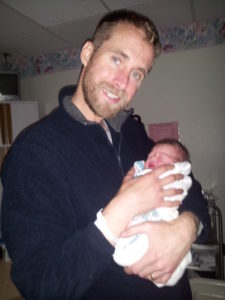
If you’re a parent, it’s possible that you have heard this statement thrown in your direction before. My wife and I, as we approach our seventh wedding anniversary, have three children. I find it amazing when people say “you got your hands full” when I am only holding one of my children. Imagine if they saw me when all three were climbing on me at the same time, or when they’re hungry and in a seemingly rehearsed chorus they ask for different foods in harmony.

With the Third Extraordinary Synod of Bishops set to meet this Fall, Pope Francis and bishops from around the world will be discussing issues related to marriage and family life. I believe that the Catholic Church’s vision for married life offers a fresh and engaging perspective for our contemporary world. St. John Paul II declares, “The communion of love between God and people, a fundamental part of the Revelation and faith experience of Israel, finds a meaningful expression in the marriage covenant which is established between a man and a woman” (Familiaris Consortio 12). The approaching synod has caused me to reflect on how I live my vocation to married life.

In his book Divine Likeness, Cardinal Marc Ouellet suggests that since Vatican II and St. John Paul II, “the theology of marriage has been developed in terms of ‘gift’…” (Ouellet 150-151). Men and women are created in the image of God (cf. Genesis 1:26-27). One of the great theological insights of Vatican II was the idea that “man, who is the only creature on earth which God willed for itself, cannot fully find himself except through a sincere gift of himself” (Gaudium et Spes 24). Only through a gift of self can people find their true purpose and meaning in life. This is because a total self gift both participates in and manifests the divine life to which we’re invited.

Many of us are familiar with St. John Paul II’s Wednesday audiences which have become what we call the “Theology of the Body.” The giving of oneself in marriage, including in the conjugal act, is discussed in terms of a total gift of oneself. In a marriage covenant, husband and wife can manifest Trinitarian love, and the communion to which all people are drawn. For a husband or wife to hold back anything would be a betrayal of the communion which they’re guided by the Holy Spirit to manifest.

Cardinal Angelo Scola in The Nuptial Mystery draws from St. John Paul II’s “Theology of the Body” and describes how the perichoresis of the Triune God is based on total self-giving. This is described beautifully in the following:

Communio personarum exists in its perfection in the Three in One, because the Father gives himself completely to the Son without keeping anything of his divine essence for himself… The Son himself gives back the same, perennial divine essence. This exchange of love between the two is so perfect as to be fruitful in a pure state: it gives rise to another person, the Holy Spirit (donum doni) (Scola, 131).

The Father completely gives everything He is to the Son; the Son completely gives Himself back in totality to the Father. Their self-giving love is so total and so perfect that it is fruitful and a third Person arises, the Holy Spirit.

Cardinal Scola makes the connection between this Trinitarian relationship and the relationship between husband and wife. A husband and wife can give a total gift of self, offering all that they are, and in the context of the conjugal act, it is possible that a new person can be created. But Cardinal Ouellet also mentions that whether or not a new child is conceived, the love of the spouses is fruitful in that they are manifesting the Trinitarian gift of self (cf. Ouellet 172).

There is an element of sacrifice involved here. The spouses freely commit to each other, accepting the new life if God should bless them with a child. However, if a couple experiences difficulty in conceiving, they also accept the sacrifice associated with not being able to bear children. In both cases, the spouses who completely give of themselves in love have the opportunity to offer themselves as a spiritual sacrifice to the Lord (cf. Romans 12:1) and to participate in the economy of salvation by manifesting Trinitarian love through a gift of self.

So my response to my interlocutors should be “Yes, I have my hands full: they’re full with my gift of self to the Lord. I give Him all that I am in loving surrender in an act of self-emptying gift-giving aimed at being drawn deeper into the mystery of the Trinitarian communio personarum, and this participation in the divine life penetrates who I am, giving me the grace and love to offer myself as a self gift to my wife.” Do you think that would get their attention?

Either way, what is essential to remember is that God invites us to participate in His very own divine life and we can experience true love through sincere acts of self gift.

Edward Trendowski is Coordinator for Catechetical Resources for the Diocese of Providence and teaches pastoral theology for Saint Joseph’s College Online.