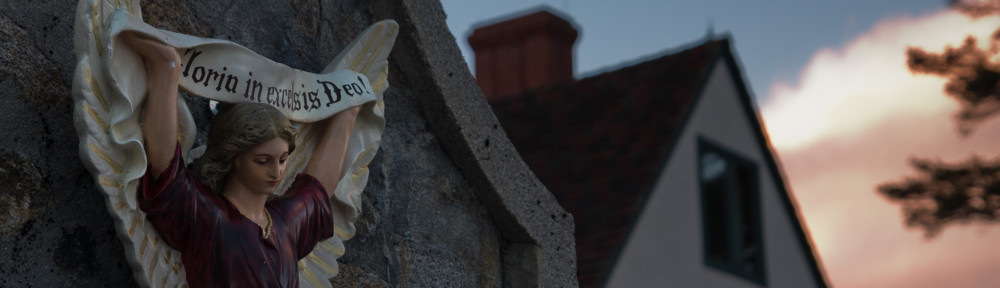
…and the darkness has not overcome it (John 1:5). Amen! Today is the feast of the Holy Family as well as St. John the Apostle. Not surprisingly, today’s readings focus on family images, starting with Sirach’s exhortation to honor fathers and Hannah’s dedication of Samuel to Yahweh, through the Psalmist’s invocation of blessing upon those doing God’s will. St. Paul calls husbands and wives to serve Christ by serving each other. Luke’s Gospel (2:41-52) retells an intimate, but nonetheless revealing, story of Jesus’ childhood. Accompanying Mary and Joseph to Jerusalem for Passover, Jesus then stays behind to join the rabbinical discussions in the Temple. When his parents, understandably distraught, locate him three days later, they find the rabbis astonished by the twelve-year-old’s answers. Joseph and Mary sweep this aside and implore: why have you done this to us? Jesus’ response and the story’s conclusion remain a wellspring of theological and spiritual reflection:
““Why were you looking for me?
Did you not know that I must be in my Father’s house?”
But they did not understand what he said to them.
He went down with them and came to Nazareth,
and was obedient to them;
and his mother kept all these things in her heart.
And Jesus advanced in wisdom and age and favor
before God and man.”
This Gospel passage provides the basis for the fifth, concluding decade of the Rosary’s Joyous Mysteries. Jesus’ answer sets the stage for the subsequent Sorrowful, Luminous, and Glorious Mysteries, wherein the Incarnation achieves our salvation, precisely by going through our very human life, even death. So, even here in the depths of December’s darkness, an oblique reference to Golgotha appears, itself the culmination of the Temple’s own work.
Indeed, as the New Year approaches in what are some of the darkest days of the year (in terms of daylight itself), St. John’s gospel, especially its Prologue (1:1-18), speaks to us ever anew. In the beginning the Word exists with, and is, God. Through the Word comes light and life, and that Word itself came into the world. The world does not recognize the occasion’s momentousness, but those who do, receive grace upon grace. The passage concludes with the astonishing claim that nobody has seen God, but the Son, the Incarnate Word, has revealed Him. So, again, echoing St. Luke’s passage, amid the darkness of this world, St. John reassures us that great events are underway.
Family life, we know, is much more mundane. Tellingly, Luke informs us Mary kept in her heart all those stories of Jesus’ childhood. St. John Paul II overlooked neither this detail nor the story’s broader point that this, after all, concerns a family. In the Holy Family, St. John Paul saw a “house”—a place where we all live—and where we should always be found. The family, precisely in its inescapable reality and rootedness, provides the everyday location for encountering God’s plan for each of us.
When considered, that is a frightful proposition: the earthly and the heavenly united…in your family. Perhaps it is thus no surprise that scholars usually prefer to distinguish clearly between the earthly Synoptic Gospels of Mark, Matthew, and Luke and the lofty, heavenly Gospel by John. It is true that real differences exist between the Gospels. Further, Christians of all sorts choose favorites. William C. Placher, whose deceptively clear writing masked profound theological reflection, insisted Mark alone came closest to revealing Jesus’ message. Liberation-minded theologians often prefer Luke for his inclusive vision of the Gospel. Some of Jesus’ best known parables appear only in Luke: the Prodigal Son, the Good Samaritan. John’s Gospel, as the Prologue indicates, starts not with lowly Nazareth and Bethlehem, but with the very origins of existence itself. That is quite a difference, but the Church, cognizant of it, nonetheless left it unresolved in the Scriptural canon.
Theologically we would do well to read the Bible with the Church. When challenged by a Scripturally-informed student, one liberation theologian at a prominent Midwestern Catholic institution once blurted out that “John is so much <<expletive>>!” Scripture’s diversity can lead to high or low Christologies, over-emphasizing either Christ’s divinity or humanity. John’s Gospel, with its lofty language, casts Jesus as heaven-sent and th us not much concerned with earthly concerns like the poor. That is a real concern, but Scripture reiterates thoroughly the preferential option for the poor. On the other hand, St. John—his Gospel and his own story—likewise has enjoyed widespread Christian devotion. The disciple Jesus loved, John with Mary does not abandon Jesus at the Cross. He then accompanies Peter to the empty tomb, and in old age he received the visions recounted in the Book of Revelation. His gospel’s Prologue is still read at the conclusion of the Extraordinary Form of the Mass. And in Rome, Constantine dedicated to St. John, not
 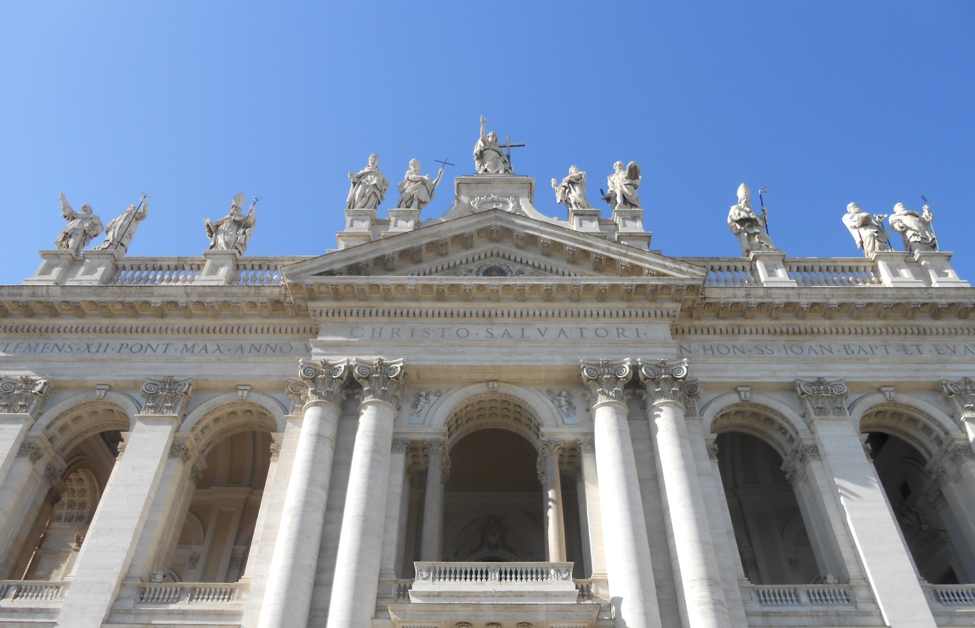 St. Peter, the first Church he built. The Lateran Basilica stands on what used to be Rome’s outskirts, just inside the Aurelian walls. In other words, where the Roman people themselves lived. And there, among those ancient homes and families, arose the church dedicated to the saint whose writings illuminate Christ’s presence in our own families.
Guest blogger Jeffrey Marlett blogs at Spiritual Diabetes.