
Is Marriage a Name or a Reality?

obergefell vs hodgesThe Supreme Court decision Obergefell v. Hodges cries out for commentary, and there are many more able persons than I providing just that. I won’t try to speak to the decision itself, or even to its consequences. What I would like to talk about is its antecedents: how did we get here? To those of you who study theology (perhaps at St. Joseph’s College!), I want to affirm what you are doing and show how the supposedly abstract ideas we think about actually have enormous power to shape the world for good or ill.

The key to the marriage debate, it seems to me, is the choice between two options: either marriage is a reality to which we conform ourselves, or it is a name for something that we change to fit our desires. Marriage either changes us, or we change it. Guess which one is more comfortable?

The first option is usually called “realism.” The philosophy lying beneath the second option is called “nominalism.” To oversimplify, nominalism holds that reality is disconnected from what happens in our minds. We have concepts or ideas, but those concepts don’t necessarily line up with the real world. So when we name something—say, a minivan—what we are really doing is sorting out our own thoughts about transportation, not naming something that really is beyond our mind. For the nominalist, there is a disconnect between the reality between his ears and the reality of the rest of the world. “Nominalism” comes from the Latin word for names. For the nominalist, names don’t signify something real in the world. We can play with names, make them into what we want. There is no reality tying us down.

That might all seem very abstract, until we apply it to our culture. Then we see that we are all nominalists, unless we work really hard not to be.

Let’s apply these categories to the marriage debate. If marriage is not a “mere” name but is a reality, then our task is to understand that reality and act accordingly. (This is a receptive approach to the world, if you like.) Even prescinding from what Scripture says, the history of human society demonstrates that marriage is the pair-bonding relationship between a man and a woman that facilitates the best environment for raising children. Its features are fidelity, exclusivity, and totality. It is, as the Code of Canon Law says, a partnership of the whole of life oriented to the good of the spouses and the procreation and education of children.

This orientation toward children is, by the way, why governments have ever cared about marriage. The government does not and should not care about your intimate friendships. You don’t have to get a friendship license. You don’t need to appear before a justice of the peace to swear your commitment to your best friend. And this is a good thing. The government is not in the love-and-friendship business. It is very much in the looking-out-for-the-future business, which is why it has cared about marriage, because kids flourish when their biological parents are committed to each other and to them.

If, conversely, “marriage” is just a name that we tack onto intimate relationships, then it is elastic and can be stretched to accommodate all kinds of relationships. Why stop at two people? Marriage is just a name for indicating “the relationships which we value.” It’s a governmental seal of approval. Without it, our relationships aren’t just not-marriage; they are actually, positively demeaned. If marriage is desirable, and people desire it, they should have it. A double-tall latte is desirable; if people desire it, they should be able to have it, and if they can’t, it’s discrimination.

What may or may not apply to consumerist choices cannot apply to relationships, though. Plenty of people can’t marry: my six kids, for example. They don’t have the prerequisites to marry (such as psychological and sexual maturity). It’s not discrimination to tell my kids they can’t marry; it’s simply a realization that “marriage” is not an empty name signifying nothing but rather a reality that you either can or cannot fit into. It’s certainly not a condemnation or judgment of my kids. I can’t be a basketball center (I’m 4’11” and most certainly cannot jump). While this has caused fleeting moments of discomfort—stupid gym class!—it is not a matter of discrimination, but of reality.

Now, let me be clear: I don’t believe Justice Anthony Kennedy posted a status update along the lines of: “Just confirmed my nominalism in the Obergefell majority decision! ‘Like’ it if you reject metaphysical realism too!” Nominalism is generally not a consciously chosen lifestyle option. It’s just the default mode. But it’s not healthy. As I have argued elsewhere, it’s better to live in reality, even when it requires me to change, than to try to construct reality to fit me.

Angela Franks teach theology for Saint Joseph’s College Online.
Lectio divina: a renewed commitment

I have been taught lectio divina in the past, which I practiced fervently at one time and set aside as I pursued other spiritual interests. Lectio divina, though, has never been put together for me quite the way Fr. Chris Hayden (a New Testament scholar, author, and a priest in the Diocese of Ferns, Ireland) was able to do when I recently attended his seminar “Praying the Scriptures.” As a result, I have refreshed my own spiritual life and have reincorporated lectio divina into my spiritual repertoire. My point here is not to relay new facts but (as Fr. Chris would say) to rehearse what we already know – to cement who we are as a people who want to pray, who want to grow in the spiritual life.

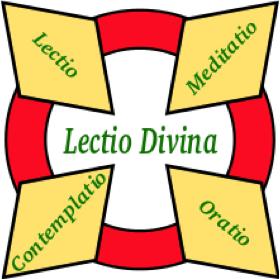
Lectio DivinaLectio divina (Latin for “divine reading”) was not something new to Christians but flowed out of the Hebrew method of studying the Scriptures, haggadah, or learning by the heart: “The word is very near to you; it is in your mouth and in your heart for you to observe” (Deut 30:14). While many Church Fathers stressed the prayerful reading of the scriptures, Origen is credited with the first use of the term “lectio divina” in the 3rd century: “While you attend to this lectio divina, seek aright and with unwavering faith in God the hidden sense which is present in most passages of the divine Scriptures” (Epistle to Gregory 4). Traditionally, lectio divina is a Benedictine practice of praying the scriptures that consists of reading, meditating, praying, and contemplating God’s Word in order to grow in our relationship with God. Saint Benedict first established it as a Monastic practice in the 6th century in which the four parts were not so much steps but rather moments prompted by the Holy Spirit. During the 12th century, the Carthusians formalized a scholastic approach (“the Monk’s Ladder”) of lectio (reading), meditatio (meditation/reflecting), oratio (prayer/responding), and contemplatio (contemplation/resting).

We distinguish lectio divina from reading the Bible for enlightenment or encouragement, which we may do individually or together as in a Bible study group, and from praying the scriptures in common. Lectio divina is a practice that uses thoughts, images, insights, and inner silence to enter into a conversation with God. There are varying approaches to lectio divina, but in reality, simplicity is at the heart of the practice. After Vatican II and the document Dei Verbum that encouraged lay people and priests to use lectio divina, there has been a resurgence in its exercise. When we read Scripture, we should be doing so not just as an intellectual activity but also as a means of gathering its intention and meaning for our lives. Lectio divina will transform you for transformation is at its core – whether you realize that transformation consciously or not, and whether you reflect that transformation visibly or not.

To appreciate fully lectio divina, we must understand prayer as a relationship between God and ourselves. Through prayer, we enter into the abiding relationship of unconditional love of the Holy Trinity. Three key underpinnings of our prayer life should be humility, heart, and listening. In prayer, we enter into humility, deflating our egos, realizing we are not God. Our humility helps us discern the true self from the false self. We continue to pray in order to break open our hearts to God, to realize what is going on inside ourselves for the heart of prayer is not what we get but rather what we become. We all know we should be receptive to God heeding the advice of Eli to Samuel, “Speak Lord, your servant is listening” (1 Sam 3:1-10), but many of us might prefer to tell God in prayer, “Listen Lord, your servant is speaking!” As anyone who has been successful with Christian meditation or contemplative prayer will attest, we need to make time and spaces for silence so we can listen.

What should we do, though, if our prayers seem to be unanswered? Fr. Chris offers five guides or reasons to continue in prayer (he admits, certainly, there is not just five, but I find the five he presented crucial) even when our prayer life seems to be in a drought:

  1. When we pray, we are not reminding God of what is needed (He already knows), but we are growing in our recognition of our neediness.
  1. When we pray for others, we recognize our solidarity with others. We are not alone; we are all connected.
  1. When we pray for others, we acknowledge our ability to help others is very limited. Our helplessness is our reflection of reality. When we cannot do it all, we pray.
  1. When we pray for others, we implicate ourselves in their situation. Though our ability is limited, we are responsible for helping others as far as we can. Prayer puts us on the hook to do something, to take action.
  1. When we pray, we share in the cruciform prayer, an intercession for all of humanity just as Jesus did with outstretched arms on the crucifix.

To pray is to trust that God has a plan and to beak open the details of our lives to God. Since Scripture is God’s living word, it is through Scripture that we open ourselves to God, pursue His will, and enter into His plan. If we are not praying with Scripture, we are at least praying from it for Scripture is the basis for all that we have learned about prayer in our lives. Through prayerful reading of Scripture, we enter into that Great Mystery, the basis for which is a trusting relationship, a relationship that will transform us. In fact, the best effect of our prayer is not in getting something but rather in becoming something.

Because we have the Bible, the living Word of God, our spirituality is not a set of speculations. The Bible is our story – our metanarrative. Our metanarrative unites all of our individual stories into a collective under the overarching theme of God’s eternal love. We find today that the separate designations of yours and mine drive our society; today’s society is certainly no metanarrative, no uniting of us all. Within the Biblical texts, however, we find our collective and individual stories in which we participate along with Christ in the Trinitarian love. We can break our metanarrative into four acts: Act I: The beginning; Act II: The Fall; Act III: Redemption; and Act IV: Fulfillment. Our story begins with life (the “Tree of Life” in Genesis) and ends with life (the “New Order” in Revelations as found in Christ.) We find ourselves living in the drama between Acts II and III, that constant struggle of our lives that tugs between our disobedience and our obedience as we reach for that time of fulfillment.

With this acceptance of the Bible as our metanarrative and our understanding of prayer, especially the reasons for continuing in prayer when our prayer life is dry, we can appreciate the power of praying the scriptures to transform our lives. Lectio divina becomes, in reality, so simple.

  1. Read (lectio) – what does the text say in itself? What do I know of the historical context that helps provide the background? One need not be a biblical scholar, though, to answer the question “What does the text say?”
  1. Meditate (meditatio) or reflect – what does the text say to me? How do I find myself reflected in the passage? My reading is not just to understand but rather find myself there in the passage, or as Fr. Chris states, “to stand under it.” Saint Augustine supposedly used to stop in the middle of his proclamation of the Gospel to say, “Listen now, this applies to you!”
  1. Pray (oratio) or responding – what does the text lead me to say or do? What is my response based on my reading and meditation? I need to rejoice (be thankful), repent (be sorry; atone), and/or resolve (to act; to serve)
  1. Contemplate (contemplatio) or rest – silence; be in the presence of the Lord. “Be still and know that I am” (Ps 46:10). I may not get an answer, but I will gain perspective.

It is important to note that the steps themselves are not necessarily sequential, for instance, we usually end up meditating while we are reading as well as praying. The sequence is not what is important; the action of “praying the scriptures” is what is critical. Choose a passage and pray it, enter into that conversation with God!

Fr Chris HaydenFr. Chris told me not to give him credit, but I must at least thank him for traveling to Great Falls, Montana, for sharing his joy of the faith, and for his stimulating way of presenting prayer, scripture, and the ancient art of lectio divina that inspired me to take a fresh look at how I pray the scriptures. I hope I have given him due credit by relaying the simplicity of lectio divina and its importance in helping us live out our shared metanarrative of God’s love.

With Fr. Chris’ inspiration, I renew myself to the simplicity of lectio divina, enhancing my spiritual life, and I pray: God help us live our story, our metanarrative, as we pray for our transformation in You, our destination.

Fawn Waranauskas teaches in the Catholic Catechesis Certificate Program for Saint Joseph’s College Online.