
 “Why do you seek the living one among the dead? He is not here, but he has been raised.”
Is this not the core of our faith which God graciously gives? The tomb is empty and He is risen. This day is just another day—it is the same length as any other day—and yet it is not another day. It is the day, that by which all other days—and all the days of our lives—are measured. Christ is risen and thus death, the end which awaits us all, has been vanquished. Christ suffered and died, just as we all will. Our baptism into that death, though, also promises which this day proclaims, that Christ’s death was not final and thus will not be final for us. Easter proclaims the Resurrection. It is Christ’s now, and someday it will be ours, too.
The Church knows this day comes at a great price. On Holy Thursday our hearts rejoiced at the institution of the Eucharist, the Last Supper. The next day, though, demolished that joy as we hear again the account of Christ’s Passion. Good Friday ends abruptly with Christ entombed. Holy Saturday dawned with everything apparently lost. Carmina Chapp’s reflections unite our anxieties with those of Mary and the apostles:
Holy Saturday is a very long day for me. I imagine what it must have been like for the disciples and Mary during that time between the crucifixion and the resurrection. What they hoped for had never been done before – a man would rise from the dead. Plus, the Romans would be after them soon, too. What if this really was the end? What if they had been duped? What was it all for? What if they stopped trusting themselves and their own experience of Jesus? Did he really heal and feed all those people? Could they trust their own memories? What if it was all in their imaginations?
The Rosary
Over a month ago the movie Risen appeared. Tracing the experience of a Roman legionnaire Lucius (played superbly by Joseph Fiennes), the movie covers the Crucifixion and the aftermath of the Resurrection. Seeking to dispel annoying rumors that Jesus, whose execution he oversaw, Lucius crashes a gathering of Christ’s disciples. In the tumult Lucius glimpses the resurrected Christ Himself. Lucius sees, but neither understands nor believes. From this scene Bishop Robert Barron discusses the tendency of mainstream theologians to downplay and discredit the Resurrection as a merely emotional experience within the disciples’ own subjectivity. In other words, non-believers did not see, and would not have seen, the Resurrection because they did not experience Christ as resurrected. This is a fancy way of denying the Resurrection’s historicity. It did not really happen, but in the disciples’ minds it did happen. Barron details all this quite well, and then brushes it all aside. Working with N. T. Wright, Barron notes that the Resurrection’s reality undergirds the entire realty of the Gospels and St. Paul’s epistles.
The great English Biblical scholar N.T. Wright is particularly good at exposing and de-bunking such nonsense. His principal objection to this sort of speculation is that it is profoundly non-Jewish. When a first century Jew spoke of resurrection, he could not have meant some non-bodily state of affairs. Jews simply didn’t think in the dualist categories dear to Greeks and later to Gnostics. The second problem is that this post-conciliar theologizing is dramatically unhistorical. Wright argues that, simply on historical grounds, it is practically impossible to explain the rise of the early Christian movement apart from a very objective construal of Jesus’ resurrection from the dead. For a first-century Jew, the clearest possible indication that someone was not the promised Messiah would be his death at the hands of Israel’s enemies, for the unambiguously clear expectation was that the Messiah would conquer and finally deal with the enemies of the nation. Peter, Paul, James, Andrew, and the rest could have coherently proclaimed—and gone to their deaths defending—a crucified Messiah if and only if he had risen from the dead. Can we really imagine Paul tearing into Athens or Corinth or Ephesus with the breathless message that he found a dead man deeply inspiring or that he and the other Apostles had felt forgiven by a crucified criminal? In the context of that time and place, no one would have taken him seriously.
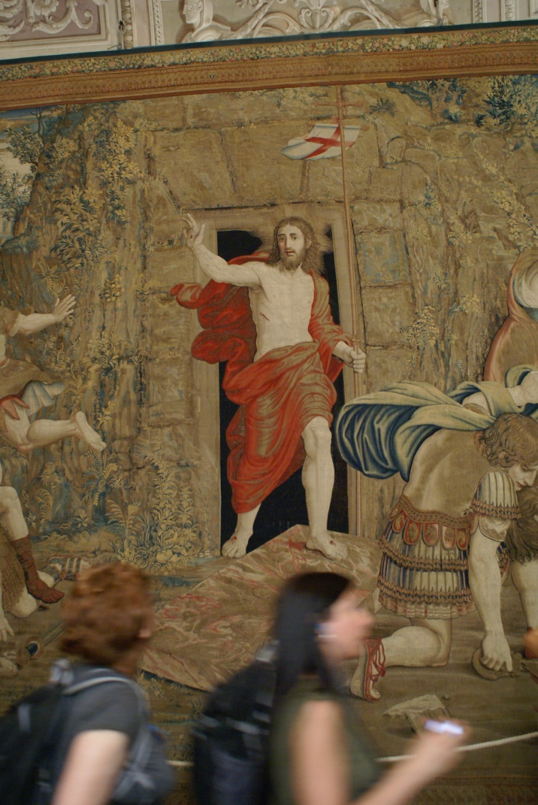
It is hard to imagine such fervor and evangelical joy—with which the Holy Spirit enlivened the Church–stemming from mere good feelings and hopeful postmortem wishes. Granted, we were not there, we do not see the empty tomb ourselves, but we can surely know that something happened, and that something was Christ’s resurrection. Bishop Barron notes: “What you sense on every page of the New Testament is that something happened to the first Christians, something so strange and unexpected and compelling that they wanted to tell the whole world about it.” Its inescapability pursues us just like the risen Christ’s gaze follows us from Pieter Coecke van Aelst’s tapestry in the Vatican Museums.
And yet, as the photo shows, the blur of modern life bustles past our crucified and resurrected Lord. Jesus emerges from the tomb victorious, and the tapestry’s soldiers turn away. After all, Christ stands triumphantly atop the door He knocked down. We, though, shuffle past, blurry and otherwise preoccupied. Reflecting on this image gave me pause for another reason: Christ’s obvious stigmata. Once a focus for intense popular devotion, Christ’s wounds on hands, feet, and side appear only rarely on the most pious and simple souls, great saints like St. Francis of Assisi and St. Padre Pio of Pietrelcina. These wounds serve as anti-triumphal rewards God bestows on whom He pleases. They are not ‘rewards’ so much as graces given freely, through which the saint and those following might receive even more graces. They certainly are not bragging rights, or if they are, bizarrely reversed ones. Both St. Francis of Assisi and St. Padre Pio suffered the doubts and outright hostility to their new evangelical endeavors, whether it was hearing confessions (Padre Pio heard an estimated five million confessions during his life, roughly seventy per day) or preaching the Gospel, joyfully and in poverty, to all who would hear, including birds and Saracens (as St. Francis did). Who would want painful, bleeding signs as a reward and thus a call to such work?
Well, we do. We are those people. Hans Urs von Balthasar reminds us: “In all reality, Easter occurs on earth, but it does not lead away from the Cross but always to it. The whole Pasch—the whole passing-over from death to life—is a perennnially present reality” (The Threefold Garland, p. 114). Precious few, if any, of us will receive the stigmata, but that does not exclude us from emulating the work of those who did and asking for their saintly intercession in our lives now. The Paschal Vigil’s fifth reading (Isaiah 55: 1-11) proclaims the mystery—and the confidence to Israel:
For my thoughts are not your thoughts,
nor are your ways my ways, says the LORD.
As high as the heavens are above the earth,
so high are my ways above your ways
and my thoughts above your thoughts.
For just as from the heavens
the rain and snow come down
and do not return there
till they have watered the earth,
making it fertile and fruitful,
giving seed to the one who sows
and bread to the one who eats,
so shall my word be
that goes forth from my mouth;
my word shall not return to me void,
but shall do my will,
achieving the end for which I sent it.
The stigmata now makes sense only with today’s Easter good news, the original eu angelion. Christ has died, Christ is Risen, and Christ will come again. Those are three distinct realities, and the stigmata merely indicate that, being linked intimately with Christ’s death, the other two realities follow soon. The Resurrection we celebrate today. Thus the Parousia, Christ’s return in power, has started already but has yet to come fully. St. Paul wrote his great letters in this “already but not yet” zwischen den Zeiten “between the times.” God sustains us as this age passes and the new one dawns. That dawn starts with Christ’s resurrection. Thus we do not save or sustain ourselves. What we do in and through the Church comes through God’s gracious action first, and the empty tomb indicates what God accomplishes among us.
Guest blogger Jeffrey Marlett blogs at Spiritual Diabetes.
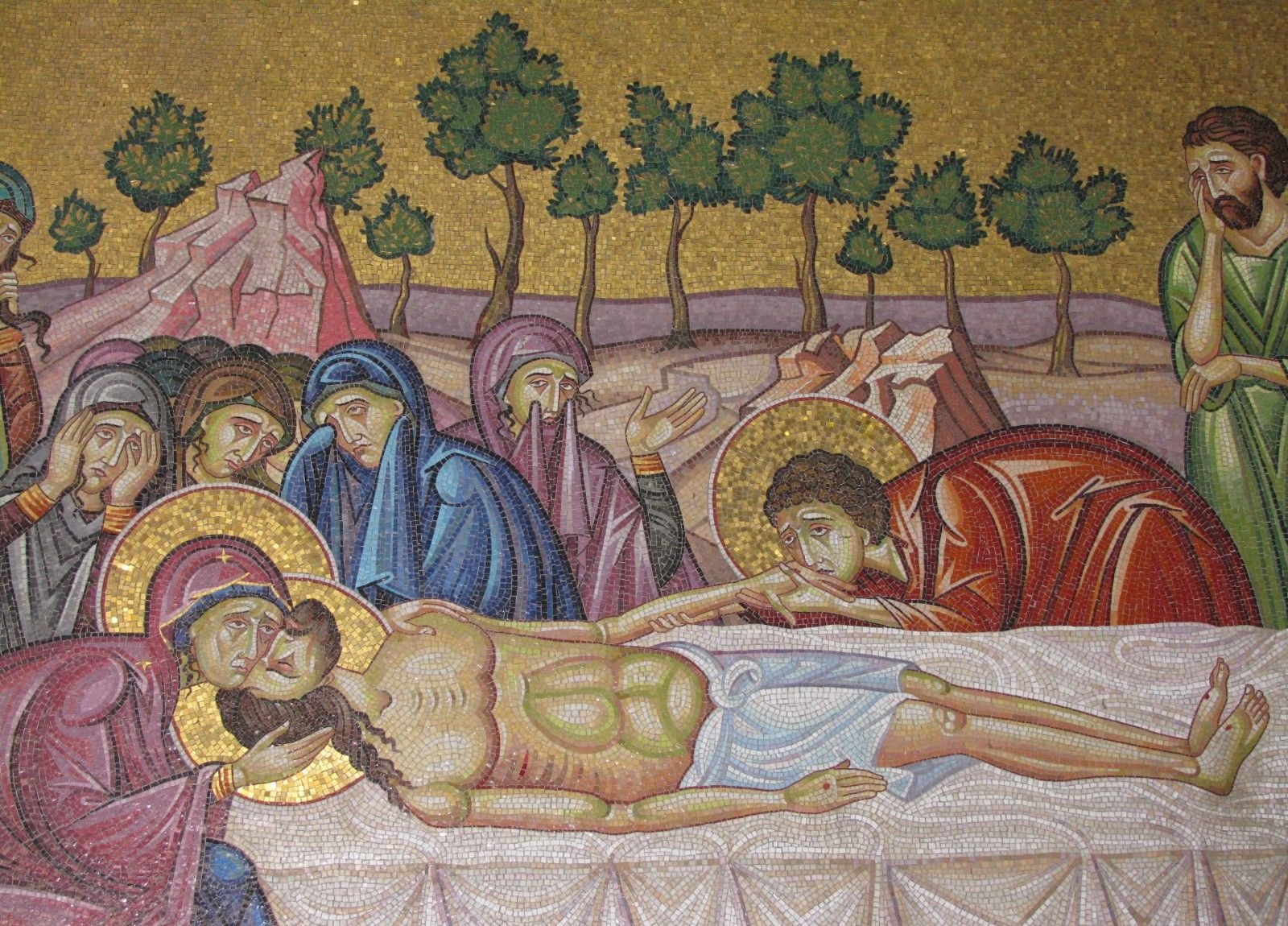 Of course, on Good Friday, we are present at the trial, condemnation, and crucifixion of Jesus, playing our role in His suffering, “Crucify Him! Crucify Him!” Leaving Good Friday service, I am always left with a keen awareness that the tabernacle is empty, that all tabernacles are empty. I must admit, it scares me a bit – to think that Jesus is not here! Yes, I know he is in my thoughts and in my heart, but that makes his presence dependent on me. In the Eucharist, he is here in a much fuller capacity (indeed, the fullest) than I could ever imagine spiritually – and I can feel that presence in front of the Blessed Sacrament. It is a grace far beyond me. With that presence gone, I feel the inadequacy of my own memories of Jesus.